Go outside tonight, look up, and you are looking at one of 88 named regions of sky. Every star you can see, every planet, every galaxy and nebula, belongs to one of them. There is no leftover space and no overlap: the 88 constellations tile the entire celestial sphere.
This guide is the starting point for all of them. It explains what a constellation actually is, how to read the sky well enough to find things, and then links to a full write-up of every one of the 88 — how to find it, what it looks like, the stars inside it, the story behind the name, and what you can see with your eyes, binoculars or a telescope.
You do not need equipment to start. You do not need to be somewhere dark. You need to be able to find one pattern you recognise, and work outwards from there.
What a constellation actually is
Most people think a constellation is a pattern of stars. That is how they began, but it is not what they are now.
Since 1922 a constellation has been an area of the sky — a region with precise borders, like a country on a map. The International Astronomical Union fixed the list at 88, and in 1930 the Belgian astronomer Eugène Delporte drew the boundaries, following lines of right ascension and declination so that every point in the sky falls inside exactly one constellation.
That change matters more than it sounds. When astronomers say a comet is "in Taurus", they do not mean it is sitting among the bull's stars — they mean its position falls within Taurus's borders. The stars of a constellation are usually nothing to do with each other either: they sit at wildly different distances and simply happen to line up from where we stand. Orion's Belt looks like three evenly spaced stars in a row, but they are hundreds of light years apart.
Constellation or asterism?
A pattern that is not one of the official 88 is an asterism. The distinction trips people up constantly, because several of the most famous shapes in the sky are asterisms rather than constellations:
- The Big Dipper (or Plough) is an asterism inside the constellation Ursa Major.
- The Summer Triangle is an asterism spanning three constellations — Lyra, Cygnus and Aquila.
- The Teapot is an asterism inside Sagittarius.
- The Winter Hexagon stretches across six constellations at once.
Asterisms are often easier to learn than the constellations that contain them, and they make excellent signposts. Use them.
Where the names came from
The 88 arrived in three waves, and you can date almost any constellation by looking at what it depicts:
- The ancient 48. Mesopotamian and Greek figures, catalogued by Ptolemy around 150 AD — gods, heroes, animals and the zodiac. These have the brightest stars, because they were named by people choosing what stood out.
- The southern additions, 1590s–1600s. Dutch navigators Pieter Dirkszoon Keyser and Frederick de Houtman charted the far southern sky on trading voyages, naming constellations after exotic animals: a toucan, a peacock, a bird of paradise, a chameleon, a flying fish.
- The Enlightenment instruments, 1750s. Nicolas-Louis de Lacaille catalogued nearly 10,000 southern stars from the Cape of Good Hope and filled the remaining gaps with the tools of science — a telescope, a microscope, a pendulum clock, an air pump, a set of compasses.
Between those waves, astronomers like Johannes Hevelius added faint filler constellations between the famous ones — the lynx, the little fox, the lizard. Many other proposals were made and later abolished, including several dedicated to kings and patrons. The 1922 settlement kept 88 and discarded the rest.
How to read the night sky
Five ideas will get you most of the way. None of them require equipment.
Magnitude: how bright is bright?
Star brightness is measured in magnitude, on a scale that runs backwards: lower numbers mean brighter stars. It is confusing at first and then becomes second nature.
- Magnitude −1.5: Sirius, the brightest star in the night sky
- Magnitude 0 to 1: the brightest couple of dozen stars — Vega, Arcturus, Rigel
- Magnitude 2 to 3: the stars that make up most constellation patterns
- Magnitude 4 to 5: visible from a dark suburb, gone from a city
- Magnitude 6: roughly the naked-eye limit under genuinely dark skies
Each step of 1 magnitude is about 2.5 times the brightness. When a constellation write-up says "nothing brighter than magnitude 4", that is a warning that you will need to get away from streetlights.
Right ascension and declination: the sky's grid
Declination is the sky's version of latitude, measured in degrees north (+) or south (−) of the celestial equator. Right ascension is the sky's longitude, measured in hours from 0 to 24. Together they pin any object to a fixed point.
The practical value is declination. A constellation at declination −60° is a southern object and northern observers will struggle or fail. One near 0° sits on the celestial equator and is visible from essentially everywhere on Earth.
Which constellations can you see?
This depends entirely on your latitude, and it is the single biggest factor in what is available to you.
- From the northern hemisphere you can see the northern sky plus a decreasing slice of the southern one. Crux, Carina and the Magellanic Clouds are simply unavailable.
- From the southern hemisphere the reverse applies — no Polaris, no Ursa Minor, and the Big Dipper skims the horizon at best.
- From near the equator you get almost everything across a full year, which is the best deal available.
Constellations near your celestial pole are circumpolar: they never set, and you can see them any clear night of the year.
When to look
Every constellation has a month when it sits highest in the evening sky. Look six months either side and it will be up during the day, invisible. The tables in each write-up give a "best seen at 9 pm" month — treat it as the centre of a window that runs roughly two months either side.
Start with what you can already find
The most useful skill in astronomy is star hopping: finding something you know, then using it as a pointer to something you do not.
- Find the Big Dipper, and its two end stars point to Polaris.
- Follow the Dipper's handle in an arc to Arcturus, then spike on to Spica.
- Find Orion's Belt, follow it down-left to Sirius and up-right to Aldebaran.
- From the Southern Cross, extend the long axis four and a half times to find south.
Learn three or four of these and the whole sky opens up.
The eight constellation families
The 88 are traditionally sorted into eight families — groups that share a region of sky, a mythological story, or a moment of history. This is the most useful way to learn them, because constellations in a family are neighbours: find one and the others are close by.
The Ursa Major family (10 constellations)
The circumpolar northern group anchored by the Big Dipper.
Boötes, Camelopardalis, Canes Venatici, Coma Berenices, Corona Borealis, Draco, Leo Minor, Lynx, Ursa Major, Ursa Minor.
The Zodiac family (12 constellations)
The twelve constellations the Sun, Moon and planets travel through.
Aquarius, Aries, Cancer, Capricornus, Gemini, Leo, Libra, Pisces, Sagittarius, Scorpius, Taurus, Virgo.
The Perseus family (9 constellations)
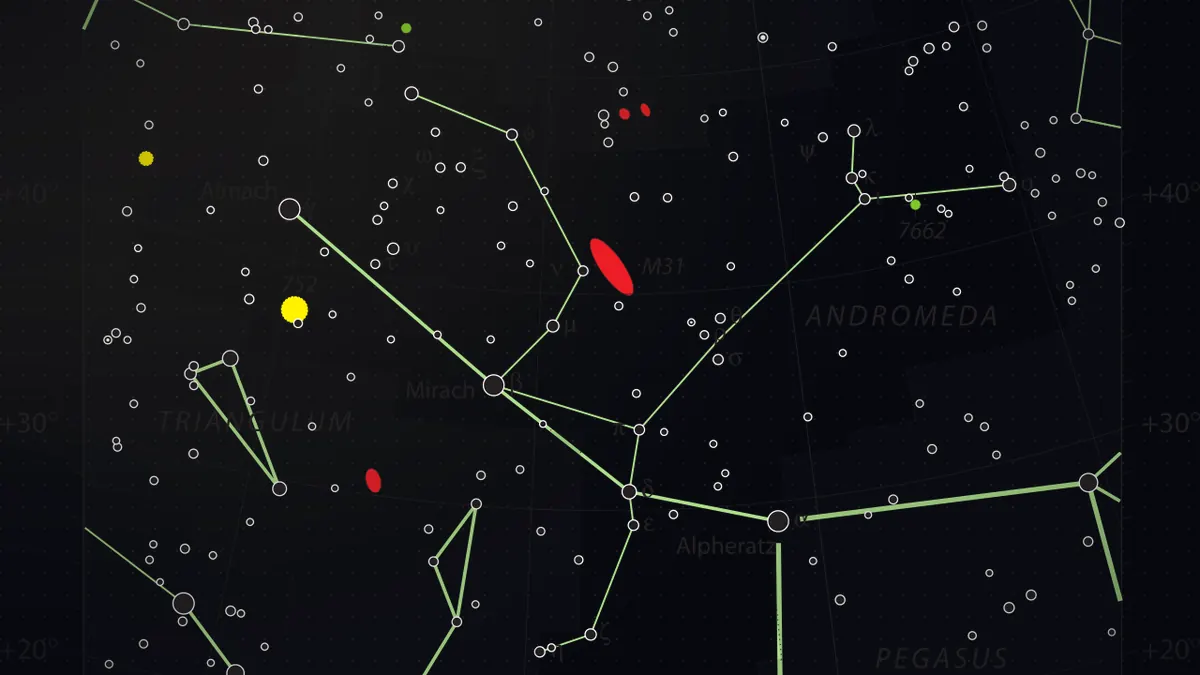
The northern sky's Andromeda myth, told across nine constellations.
Andromeda, Auriga, Cassiopeia, Cepheus, Cetus, Lacerta, Pegasus, Perseus, Triangulum.
The Hercules family (19 constellations)
The largest family — heroes, serpents and the far southern sky.
Aquila, Ara, Centaurus, Corona Australis, Corvus, Crater, Crux, Cygnus, Hercules, Hydra, Lupus, Lyra, Ophiuchus, Sagitta, Scutum, Serpens, Sextans, Triangulum Australe, Vulpecula.
The Orion family (5 constellations)
The Hunter and the animals around him, the brightest patch of sky.
Canis Major, Canis Minor, Lepus, Monoceros, Orion.
The Heavenly Waters family (9 constellations)
Constellations tied to water, ships and the sea.
Carina, Columba, Delphinus, Equuleus, Eridanus, Piscis Austrinus, Puppis, Pyxis, Vela.
The Bayer family (11 constellations)
Southern constellations charted by Dutch navigators in the 1590s.
Apus, Chamaeleon, Dorado, Grus, Hydrus, Indus, Musca, Pavo, Phoenix, Tucana, Volans.
The La Caille family (13 constellations)
Eighteenth-century southern constellations named after instruments.
Antlia, Caelum, Circinus, Fornax, Horologium, Mensa, Microscopium, Norma, Octans, Pictor, Reticulum, Sculptor, Telescopium.
All 88 constellations, A to Z
The largest is Hydra at 1303 square degrees; the smallest is Crux at 68. Every name links to a full guide.
| Constellation | Abbr. | Meaning | Brightest star | Best seen | Family |
|---|---|---|---|---|---|
| Andromeda | And | Andromeda, the Chained Woman | Alpheratz (α And) | November | Perseus |
| Antlia | Ant | the Air Pump | α Ant | April | La Caille |
| Apus | Aps | The Bird-of-Paradise | α Aps (Paradys) | July | Bayer |
| Aquarius | Aqr | the Water-Bearer | β Aqr (Sadalsuud) | October | Zodiac |
| Aquila | Aql | the Eagle | Altair (α Aql) | August | Hercules |
| Ara | Ara | the Altar | β Ara | July | Hercules |
| Aries | Ari | the Ram | Hamal (α Ari) | December | Zodiac |
| Auriga | Aur | the Charioteer | Capella (α Aur) | February | Perseus |
| Boötes | Boo | The Herdsman | Arcturus (α Boo) | June | Ursa Major |
| Caelum | Cae | the chisel | α Cae | January | La Caille |
| Camelopardalis | Cam | Giraffe | β Cam | February | Ursa Major |
| Cancer | Cnc | the Crab | β Cnc (Tarf) | March | Zodiac |
| Canes Venatici | CVn | the Hunting Dogs | Cor Caroli (α CVn) | May | Ursa Major |
| Canis Major | CMa | the greater dog | Sirius (α CMa) | February | Orion |
| Canis Minor | CMi | The Lesser Dog | Procyon (α CMi) | February | Orion |
| Capricornus | Cap | the Sea-Goat | δ Cap (Deneb Algedi) | September | Zodiac |
| Carina | Car | the keel | Canopus (α Car) | March | Heavenly Waters |
| Cassiopeia | Cas | the Seated Queen | α Cas (Schedar) | November | Perseus |
| Centaurus | Cen | the Centaur | α Cen | May | Hercules |
| Cepheus | Cep | the King/King Cepheus | α Cep (Alderamin) | November | Perseus |
| Cetus | Cet | the Whale, Shark, or Sea Monster | Diphda | November | Perseus |
| Chamaeleon | Cha | the Chameleon | α Cha | April | Bayer |
| Circinus | Cir | Compass | α Cir (Xami) | June | La Caille |
| Columba | Col | the dove | α Col (Phact) | January | Heavenly Waters |
| Coma Berenices | Com | Berenice's hair | β Com | May | Ursa Major |
| Corona Australis | CrA | The Southern Crown | α CrA (Meridiana) | August | Hercules |
| Corona Borealis | CrB | The Northern Crown | α CrB (Alphecca or Gemma) | June | Ursa Major |
| Corvus | Crv | the Crow/Raven | γ Crv (Gienah) | May | Hercules |
| Crater | Crt | the cup | δ Crt | April | Hercules |
| Crux | Cru | Southern Cross | Acrux (α Cru) | May | Hercules |
| Cygnus | Cyg | the Swan or Northern Cross | Deneb (α Cyg) | September | Hercules |
| Delphinus | Del | dolphin | Rotanev (β Del) | September | Heavenly Waters |
| Dorado | Dor | the dolphinfish | α Dor | January | Bayer |
| Draco | Dra | the Dragon | γ Dra (Eltanin) | July | Ursa Major |
| Equuleus | Equ | the pony | α Equ (Kitalpha) | September | Heavenly Waters |
| Eridanus | Eri | the river Eridanus | Achernar (α Eri) | December | Heavenly Waters |
| Fornax | For | the brazier | α For | December | La Caille |
| Gemini | Gem | the Twins, Castor and Pollux | Pollux (β Gem) | February | Zodiac |
| Grus | Gru | the crane | α Gru (Alnair) | October | Bayer |
| Hercules | Her | Heracles | β Her (Kornephoros) | July | Hercules |
| Horologium | Hor | The Pendulum Clock | α Hor | December | La Caille |
| Hydra | Hya | the sea serpent | Alphard (α Hya) | April | Hercules |
| Hydrus | Hyi | the water snake | β Hyi | December | Bayer |
| Indus | Ind | the Indian | α Ind | September | Bayer |
| Lacerta | Lac | the Lizard | α Lac (Stellio) | October | Perseus |
| Leo | Leo | the Lion | Regulus (α Leo) | April | Zodiac |
| Leo Minor | LMi | the lesser Lion | Praecipua | April | Ursa Major |
| Lepus | Lep | the Hare | α Lep (Arneb) | January | Orion |
| Libra | Lib | the balance | β Lib | June | Zodiac |
| Lupus | Lup | The Wolf | α Lup (Uridim) | June | Hercules |
| Lynx | Lyn | the Lynx | α Lyn | February | Ursa Major |
| Lyra | Lyr | Lyre, harp | Vega (α Lyr) | August | Hercules |
| Mensa | Men | the Table Mountain | α Men (Hoerikwaggo) | January | La Caille |
| Microscopium | Mic | the Microscope | γ Mic | September | La Caille |
| Monoceros | Mon | the Unicorn | β Mon | February | Orion |
| Musca | Mus | the Fly | α Mus | May | Bayer |
| Norma | Nor | the carpenter's square | γ 2 Nor | June | La Caille |
| Octans | Oct | the Octant | ν Oct | October | La Caille |
| Ophiuchus | Oph | the serpent-bearer | α Oph (Rasalhague) | July | Hercules |
| Orion | Ori | Orion, the Hunter | Rigel (β Ori) | January | Orion |
| Pavo | Pav | the Peacock | α Pav (Peacock) | August | Bayer |
| Pegasus | Peg | the Winged Horse | ε Peg (Enif) | October | Perseus |
| Perseus | Per | Perseus | α Per (Mirfak) | December | Perseus |
| Phoenix | Phe | the Phoenix | α Phe (Ankaa) | November | Bayer |
| Pictor | Pic | Easel | α Pic | January | La Caille |
| Pisces | Psc | the Fishes | η Psc (Alpherg) | November | Zodiac |
| Piscis Austrinus | PsA | the Southern Fish | Fomalhaut (α PsA) | October | Heavenly Waters |
| Puppis | Pup | the Poop Deck | ζ Pup (Naos) | February | Heavenly Waters |
| Pyxis | Pyx | The compass box | α Pyx | March | Heavenly Waters |
| Reticulum | Ret | the Reticle | α Ret (Rhombus) | December | La Caille |
| Sagitta | Sge | the Arrow | γ Sge (Telum) | August | Hercules |
| Sagittarius | Sgr | the Archer | ε Sgr (Kaus Australis) | August | Zodiac |
| Scorpius | Sco | the Scorpion | Antares (α Sco) | July | Zodiac |
| Sculptor | Scl | the Sculptor | α Scl | November | La Caille |
| Scutum | Sct | the Shield of John III Sobieski | α Sct | August | Hercules |
| Serpens | Ser | the Snake | α Ser (Unukalhai) | July | Hercules |
| Sextans | Sex | the Sextant | α Sex | April | Hercules |
| Taurus | Tau | the Bull | Aldebaran (α Tau) | January | Zodiac |
| Telescopium | Tel | the Telescope | α Tel | August | La Caille |
| Triangulum | Tri | The Triangle | β Tri (Alaybasan) | December | Perseus |
| Triangulum Australe | TrA | the Southern Triangle | α TrA (Atria) | July | Hercules |
| Tucana | Tuc | the toucan | α Tuc (Lang-Exster) | October | Bayer |
| Ursa Major | UMa | the Great Bear | Alioth (ε UMa) | April | Ursa Major |
| Ursa Minor | UMi | the Little Bear | Polaris | June | Ursa Major |
| Vela | Vel | the Sails | γ Vel | March | Heavenly Waters |
| Virgo | Vir | the Maiden | Spica (α Vir) | May | Zodiac |
| Volans | Vol | the Flying Fish | γ 2 Vol | February | Bayer |
| Vulpecula | Vul | the Fox | α Vul (Anser) | September | Hercules |
Actually going outside
You can do a great deal with nothing at all, and the jump from nothing to binoculars is bigger than the jump from binoculars to a telescope.
With your eyes. Constellation patterns, the Milky Way, meteor showers, the Andromeda Galaxy, the Magellanic Clouds, the Pleiades, bright double stars like Mizar and Alcor. Give yourself twenty minutes away from any light for your eyes to dark-adapt properly, and use red light if you need to see anything — white light resets the process instantly.
With binoculars. This is the best value in astronomy. A cheap pair of 10x50s transforms open clusters, shows the Orion Nebula as a glowing cloud, resolves the Beehive and the Coathanger, and reveals hundreds of stars in the Milky Way. Some objects — the Pleiades, the Hyades, the Coathanger — are actually worse through a telescope, because they are larger than the field of view.
With a telescope. Planets, the Moon in detail, planetary nebulae, globular clusters resolved into individual stars, galaxies. Aperture matters more than magnification: a bigger mirror collects more light, and light is what you are short of.
What actually limits you is not equipment but sky darkness and the Moon. A full Moon washes out everything faint. Plan galaxy and nebula hunting around the new Moon, and if you can drive thirty minutes away from a town, do — it will do more for your view than any amount of money spent on gear.
Where to start
Eighty-eight regions, one sky, and a few thousand years of people looking at the same stars and telling different stories about them. Pick a constellation you can already find, read its write-up, and use its neighbours to reach the next one.
Every page below covers where to find it, what shape you are looking for, its brightest stars, the story behind the name, what deep-sky objects are inside it, and when and where you can actually see it — plus a summary table of every observing fact worth knowing.