Canis Major is the Greater Dog, and it follows Orion across the sky like a hound at heel. It would be a notable constellation on its own, but it has one feature that makes it unforgettable: Sirius, the brightest star in the entire night sky.
Nothing else comes close. Sirius is so bright that when it is low on the horizon it flashes red, white and blue as the atmosphere splits its light, and it gets reported as a UFO more often than any other object in the sky.
Where to find Canis Major
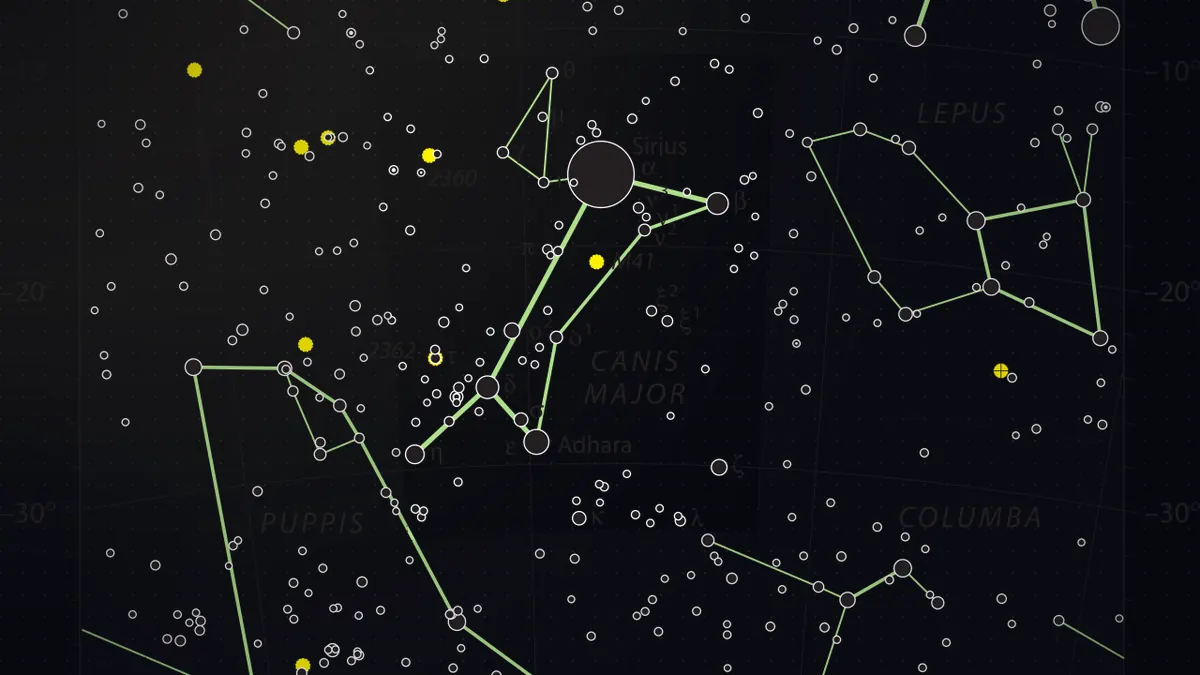
Find Orion's Belt, then follow its line down and to the left (northern hemisphere) or up and to the right (southern hemisphere). The first brilliant star you hit is Sirius. It is unmistakable — noticeably brighter than anything else around it.
From Sirius, the rest of the dog stretches south: a rough triangle of stars below it forms the body and hind legs. Sirius, Betelgeuse in Orion and Procyon in Canis Minor form a large, near-perfect equilateral triangle called the Winter Triangle, which is one of the easiest patterns to spot once you know it is there.
In sky coordinates Canis Major sits at right ascension 6h 12m and declination −11.0°. Right ascension is the sky's version of longitude and declination its version of latitude, so those two numbers pin the constellation to one spot on the celestial sphere the way a map reference pins a town. It sits in the southern half of the sky, high for southern observers and low on the horizon for northern ones. In practice that means you can find it from anywhere south of latitude 60°N, including the whole southern hemisphere; it rides highest in the evening sky in February.
What Canis Major actually looks like
The figure is a dog in profile, standing or leaping. Sirius sits at the neck or collar, often drawn as the dog's head. Below and to the south, Wezen, Adhara and Aludra form the hindquarters and tail, while Mirzam sits ahead of Sirius as the front paw.
Those southern stars are worth pausing on. They look fainter than Sirius, but that is purely a matter of distance: Sirius is a near neighbour, while Adhara and Wezen are hundreds to well over a thousand light years away. Put them side by side at equal distance and Sirius would be the faint one.
The stars of Canis Major
- Sirius (Alpha Canis Majoris, magnitude −1.46) — the brightest star in the night sky, and one of the closest at just 8.6 light years. It is bright for both reasons at once: genuinely luminous, and very near. It has a faint white dwarf companion, Sirius B, nicknamed the Pup: the burnt-out core of a star that was once the larger of the pair.
- Adhara (Epsilon Canis Majoris, magnitude 1.5) — the second brightest star here and one of the strongest sources of extreme ultraviolet light in the sky. About five million years ago it passed much closer to us and would have been the brightest star in the sky, easily outshining Sirius.
- Wezen (Delta) — a yellow-white supergiant so large that it is nearing the end of its life; it will likely explode as a supernova.
- Mirzam (Beta) — a variable blue giant whose name means 'the announcer', because it rises just before Sirius.
- VY Canis Majoris — one of the largest stars known, a red hypergiant hundreds of times wider than the Sun. Far too faint for the naked eye, but a good thing to know is up there.
The story behind the name
Canis Major is one of Orion's two hunting dogs, chasing the hare Lepus across the sky. In other tellings it is Laelaps, a magical dog that was destined always to catch what it hunted: set loose after a fox that was destined never to be caught. Faced with an unresolvable paradox, Zeus turned both to stone and put the dog in the sky.
The star itself carried more weight than the constellation for most of history. In ancient Egypt the reappearance of Sirius in the dawn sky signalled the annual flooding of the Nile, and the calendar was built around it. To the Greeks and Romans, its return in midsummer coincided with the hottest, most oppressive weeks of the year, which is where the phrase 'the dog days of summer' comes from. It is one of the few everyday English expressions that is a direct fossil of naked-eye astronomy.
What else is hiding in Canis Major
The Milky Way runs through Canis Major, so the background is rich even though the constellation is not large.
- M41 — an open star cluster about four degrees south of Sirius, roughly the size of the full Moon in the sky. It is visible as a faint smudge to sharp eyes under dark skies and resolves into dozens of stars in binoculars. Aristotle may have recorded it around 325 BC, which would make it one of the oldest documented deep-sky objects.
- NGC 2362 — a tight, young cluster gathered around the star Tau Canis Majoris. Compact and genuinely pretty in a small telescope.
- The Thor's Helmet Nebula (NGC 2359) — an emission nebula blown into a winged bubble by the wind of a hot Wolf-Rayet star. A photographic favourite.
When and where to see it
Canis Major is best placed in the evening sky in February, and follows Orion through the same November-to-April window.
It sits in the southern half of the sky, which makes it a southern hemisphere favourite, from there it rides high overhead. Northern observers still see Sirius easily, but the dog's southern stars stay low, and from far northern latitudes the tail never clears the horizon at all.
Sirius needs no equipment. For M41, binoculars are the sweet spot: a telescope magnifies too much to fit the cluster comfortably in view.
Canis Major at a glance
| Name | Canis Major |
| Abbreviation | CMa |
| Genitive form | Canis Majoris |
| Meaning | the greater dog |
| Family | Orion family |
| First recorded | ancient (Ptolemy) |
| Right ascension | 6h 12m |
| Declination | −11.0° |
| Area | 380 square degrees (43rd largest of 88) |
| Main stars in the figure | 8 |
| Stars brighter than magnitude 3 | 5 |
| Named Bayer / Flamsteed stars | 32 |
| Brightest star | Sirius (α CMa) (magnitude −1.46) |
| Messier objects | 1 |
| Meteor showers | None |
| Visible from | Anywhere south of latitude 60°N, including the whole southern hemisphere |
| Best seen at 9 pm in | February |
| Bordering constellations | Columba, Lepus, Monoceros, Puppis |
Where to go next
Its neighbours in the sky
Canis Major borders all of these, which makes them the natural next targets once you can pick it out: Columba, Lepus, Monoceros, Puppis.
The rest of the Orion family
Canis Major belongs to the Orion family: the Hunter and the animals around him, the brightest patch of sky. The others are: Canis Minor, Lepus, Monoceros, Orion.
Start from the beginning
If you are starting from scratch, the complete beginner's guide to the 88 constellations covers what a constellation actually is, how the sky is carved up, and links to every one of them.
Star chart: Canis Major IAU chart by IAU and Sky & Telescope magazine (Roger Sinnott & Rick Fienberg), used under CC BY 3.0. Observing data cross-checked against Wikipedia's Canis Major entry.