Puppis is the stern of the great ship Argo Navis, and it is one of the richest hunting grounds for open star clusters anywhere in the sky. The Milky Way runs straight through it, so a pair of binoculars pointed here almost cannot miss.
It also contains Zeta Puppis, one of the hottest and most luminous stars visible to the naked eye: a blue supergiant burning at around 40,000 degrees, pouring out ultraviolet light and racing across the galaxy as a runaway star.
Where to find Puppis
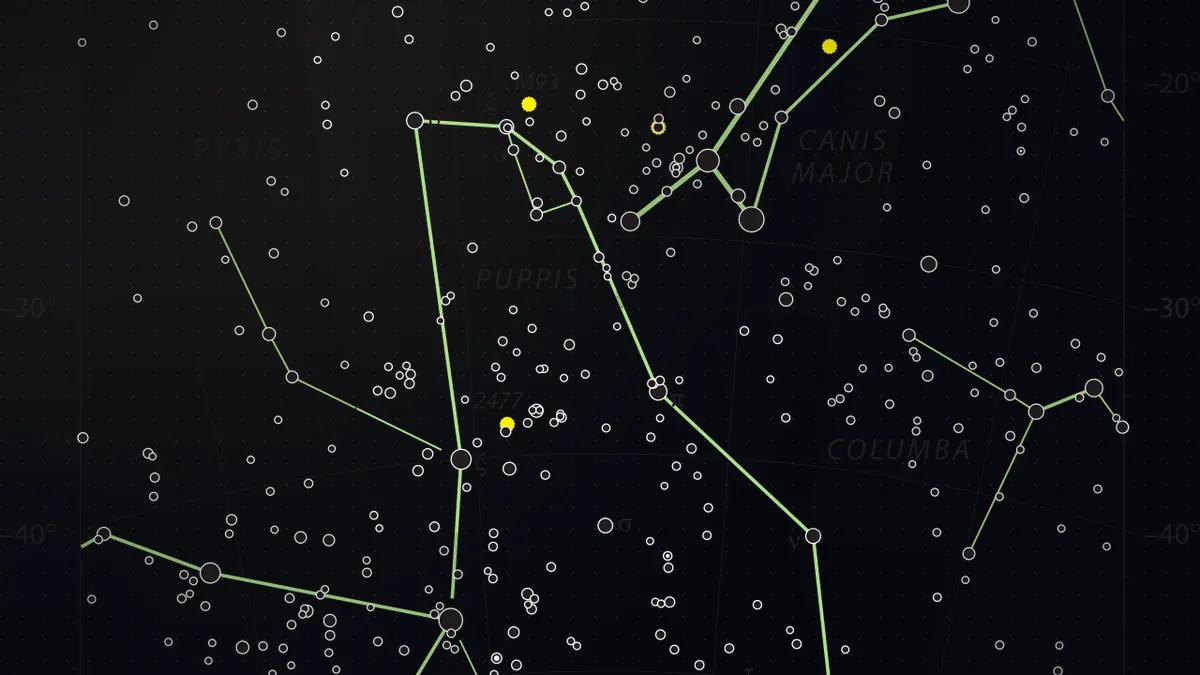
Puppis lies immediately east of Canis Major, so start from Sirius, the brightest star in the night sky. Move east and slightly south and you are in Puppis.
There is no obvious figure to look for, so use the Milky Way itself as your guide: Puppis occupies a bright, dense stretch of it. Under a dark sky the region is visibly grainy with unresolved stars.
The clusters M46, M47 and M93 sit in a loose line here, and once you find one the others are a short hop away. M47 is bright enough to glimpse without optics.
In sky coordinates Puppis sits at right ascension 7h 30m and declination −30.0°. Those two numbers work like a grid reference. Right ascension runs around the sky the way longitude runs around the Earth, and declination measures north and south the way latitude does. It sits in the southern half of the sky, high for southern observers and low on the horizon for northern ones. In practice that means you can find it from anywhere south of latitude 40°N, including the whole southern hemisphere; it rides highest in the evening sky in February.
What Puppis actually looks like
There is no coherent figure, and that is a direct consequence of history. Puppis is a fragment — one third of a constellation that was cut up in the 1750s — so it was never designed to stand alone.
The most obvious symptom is the star naming. Because Lacaille kept the original Argo Navis Bayer sequence when he split it, Puppis has no Alpha, Beta, Gamma, Delta or Epsilon. Its brightest star is Zeta Puppis. Those earlier letters went to Carina and Vela.
Treat Puppis as a rich region of the Milky Way to sweep rather than a pattern to trace, and it becomes one of the more rewarding constellations in the sky.
The stars of Puppis
- Naos (Zeta Puppis, magnitude 2.2) — a blue supergiant and one of the hottest, most luminous stars you can see without optics. Its surface is around 40,000 K, and it emits most of its enormous output in the ultraviolet, so what reaches your eye is a small fraction of the truth. It is also a runaway, moving fast enough to suggest it was ejected from a binary when its companion exploded.
- Pi Puppis — an orange supergiant, the second brightest, sitting at the centre of a small cluster.
- Rho Puppis — a pulsating variable of the Delta Scuti type.
- L Puppis — a red giant with a companion, currently studied as a possible glimpse of what our Sun's system will look like in five billion years.
The story behind the name
Puppis has no mythology of its own, because it did not exist as a separate constellation until the eighteenth century. Its story is that of Argo Navis, the ship that carried Jason and the Argonauts to Colchis in search of the Golden Fleece.
The Argo was said to have been built with a prow of oak from the sacred grove at Dodona that could speak and give prophecies. After the voyage the ship was dedicated to Poseidon and placed among the stars.
Nicolas-Louis de Lacaille broke it up during his 1750s survey from the Cape of Good Hope, judging it too large to be useful. Argo covered a colossal area, and dividing it into Carina, Puppis and Vela made practical sense, but it means the only Ptolemaic constellation ever abolished was also the most romantic one.
What else is hiding in Puppis
The Milky Way makes Puppis cluster country.
- M47 — a bright, loose open cluster visible to the naked eye under dark skies and lovely in binoculars.
- M46 — right beside M47 and a beautiful contrast: much richer, fainter and more distant. Its party trick is the small planetary nebula NGC 2438 that appears superimposed on it. The nebula is not actually a member of the cluster, just a line-of-sight coincidence, but seeing a planetary nebula sitting inside a star cluster is a memorable view.
- M93 — a compact, wedge-shaped open cluster, bright and easy.
- NGC 2477 — an extremely rich open cluster, so dense it looks almost like a globular in small instruments. Many observers rate it among the finest open clusters in the sky.
- NGC 2440 — a bright, complex planetary nebula whose central star is one of the hottest white dwarfs known.
When and where to see it
Best placed in the evening sky in February, alongside Orion and Canis Major in the southern summer and northern winter.
Puppis is a southern constellation but reaches far enough north to be partly visible from mid-northern latitudes: the northern parts, including M46, M47 and M93, are reachable from Europe and North America, while the southern reaches stay below the horizon. Southern observers get the whole thing high overhead.
This is prime binocular territory. Rather than hunting specific objects, sweep slowly along the Milky Way through Puppis and let the clusters come to you. It is one of the most rewarding low-effort observing sessions available.
Puppis at a glance
| Name | Puppis |
| Abbreviation | Pup |
| Genitive form | Puppis |
| Meaning | the Poop Deck |
| Family | Heavenly Waters family |
| First recorded | ancient (Ptolemy); 1756, Lacaille, split from Argo Navis |
| Right ascension | 7h 30m |
| Declination | −30.0° |
| Area | 673 square degrees (20th largest of 88) |
| Main stars in the figure | 9 |
| Stars brighter than magnitude 3 | 1 |
| Named Bayer / Flamsteed stars | 76 |
| Brightest star | ζ Pup (Naos) (magnitude 2.25) |
| Messier objects | 3 |
| Meteor showers | Pi Puppids, Zeta Puppids, Puppid-Velids |
| Visible from | Anywhere south of latitude 40°N, including the whole southern hemisphere |
| Best seen at 9 pm in | February |
| Bordering constellations | Canis Major, Carina, Columba, Hydra, Monoceros, Pictor, Pyxis, Vela |
Where to go next
Its neighbours in the sky
Puppis borders all of these, which makes them the natural next targets once you can pick it out: Canis Major, Carina, Columba, Hydra, Monoceros, Pictor, Pyxis, Vela.
The rest of the Heavenly Waters family
Puppis belongs to the Heavenly Waters family: constellations tied to water, ships and the sea. The others are: Carina, Columba, Delphinus, Equuleus, Eridanus, Piscis Austrinus, Pyxis, Vela.
Start from the beginning
New to all this? The 88 constellations: a complete beginner's guide explains what a constellation actually is, how the sky is divided up, and lists all 88 with a link to each one.
Star chart: Puppis IAU chart by IAU and Sky & Telescope magazine (Roger Sinnott & Rick Fienberg), used under CC BY 3.0. Observing data cross-checked against Wikipedia's Puppis entry.