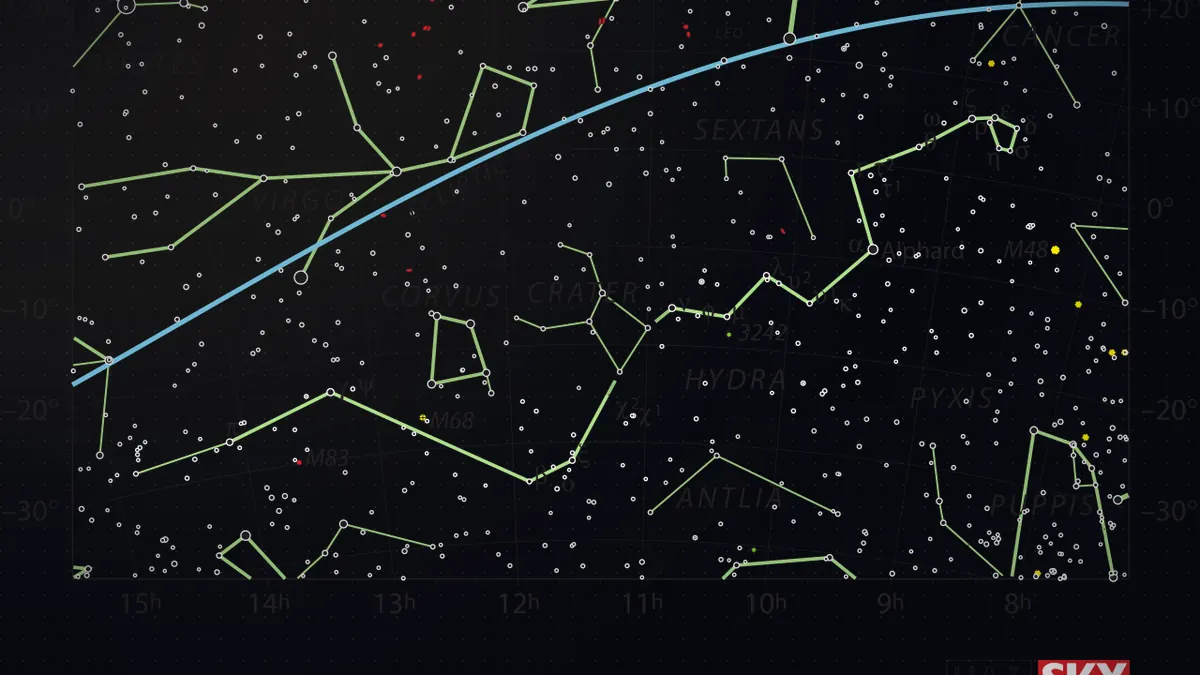
Hydra is the largest constellation in the sky, covering 1,303 square degrees. It is a long water snake stretching across more than a quarter of the celestial sphere, from Cancer in the north-west all the way to Libra in the south-east.
It is so long that it takes about six hours to fully rise. When the head is well up, the tail has not yet cleared the horizon. Despite that enormous span it has only one reasonably bright star, which makes it simultaneously the biggest and one of the least conspicuous constellations.
Where to find Hydra
Start with the head, which is the most distinctive part. It sits south of Cancer and west of Regulus in Leo: a compact group of five or six stars forming a small, clear pattern. That is the easiest piece of Hydra to identify.
From the head, the body runs east and south in a long, meandering line beneath Leo and Virgo. The brightest star, Alphard, sits below Leo and is conspicuous because it has nothing bright near it.
Tracing the whole snake from head to tail is a genuine project. Do it in sections rather than trying to take it in at once.
In sky coordinates Hydra sits at right ascension 8h 10m and declination +6.6°. Right ascension is the sky's version of longitude and declination its version of latitude, so those two numbers pin the constellation to one spot on the celestial sphere the way a map reference pins a town. It straddles the celestial equator, which is the happy case: essentially everyone on Earth can see it. Practically speaking it is visible from between latitudes 54°N and 83°S, with the best evening views around April.
What Hydra actually looks like
An extremely long, winding line of stars: a snake, and a convincing one, because a meandering chain is exactly what a snake looks like.
The head is a tidy little cluster of stars; the body then snakes east across a vast stretch of sky, with Alphard as its heart. The tail finally ends near Libra.
Three small constellations ride on Hydra's back: Crater the cup, Corvus the crow, and Sextans the sextant. They are much easier to spot than the section of Hydra beneath them, and they are useful landmarks for tracing the snake's middle.
The stars of Hydra
- Alphard (Alpha Hydrae, magnitude 2.0) — the only bright star, an orange giant about 180 light years away. Its name means 'the solitary one', given because it sits in an empty region with no bright companions: an accurate and rather poetic piece of naming.
- Gamma Hydrae — a yellow giant in the snake's body, second brightest.
- R Hydrae — a Mira-type variable, one of the first such stars discovered. It swings between naked-eye visibility and telescope-only faintness over about 380 days.
- V Hydrae — a carbon star and one of the reddest objects in the sky, currently shedding material in a series of ejections.
For the largest constellation in the sky to contain exactly one second-magnitude star is a striking piece of statistical bad luck.
The story behind the name
Hydra is the Lernaean Hydra, the many-headed serpent Hercules faced as his second labour. Every time a head was cut off, two grew back, so Hercules had his nephew cauterise each stump with fire as he cut. The final immortal head he buried under a rock.
There is a second story attached to the region. A crow was sent by Apollo to fetch water in a cup, dallied waiting for figs to ripen, and returned late: blaming a water snake for blocking the spring. Apollo saw through the lie and placed all three in the sky: the crow (Corvus), the cup (Crater) and the snake (Hydra), with the snake positioned to keep the thirsty crow forever from the water.
That arrangement is still visible: Corvus and Crater sit on Hydra's back, and the crow never reaches the cup.
What else is hiding in Hydra
Spread over such a huge area, Hydra's objects are scattered rather than concentrated.
- M48 — a large, bright open cluster near the snake's head, good in binoculars.
- M68 — a globular cluster in the southern part of the constellation, reachable in a small telescope.
- M83, the Southern Pinwheel Galaxy — the highlight. A magnificent face-on barred spiral, one of the brightest and closest galaxies of its type, and a prolific producer of supernovae. In a modest telescope under dark skies you can begin to see the spiral structure, which is rare and very satisfying.
- NGC 3242, the Ghost of Jupiter — a bright planetary nebula with a blue-green disc about the apparent size of Jupiter, hence the name. One of the better planetary nebulae for small telescopes.
When and where to see it
Best placed in the evening sky in April, though because it spans such a range of right ascension, different sections are best at different times through spring.
Hydra straddles the celestial equator and extends well south, so it is visible from most of the world. Southern observers get the tail and M83 considerably higher and clearer.
Alphard is easy from anywhere. Tracing the full snake needs a dark sky and patience. It is one of the more satisfying naked-eye projects precisely because it takes effort and covers so much ground. M83 is the deep-sky priority and rewards the darkest sky you can find.
Hydra at a glance
| Name | Hydra |
| Abbreviation | Hya |
| Genitive form | Hydrae |
| Meaning | the sea serpent |
| Family | Hercules family |
| First recorded | ancient (Ptolemy) |
| Right ascension | 8h 10m |
| Declination | +6.6° |
| Area | 1303 square degrees (1st largest of 88) |
| Main stars in the figure | 17 |
| Stars brighter than magnitude 3 | 2 |
| Named Bayer / Flamsteed stars | 75 |
| Brightest star | Alphard (α Hya) (magnitude 1.98) |
| Messier objects | 3 |
| Meteor showers | Alpha Hydrids, Sigma Hydrids |
| Visible from | Between latitudes 54°N and 83°S |
| Best seen at 9 pm in | April |
| Bordering constellations | Antlia, Cancer, Canis Minor, Centaurus, Corvus, Crater, Leo, Libra, Lupus, Monoceros, Puppis, Pyxis, Sextans, Virgo |
Where to go next
Its neighbours in the sky
Everything here shares a border with Hydra. Find one and the rest are a short hop away: Antlia, Cancer, Canis Minor, Centaurus, Corvus, Crater, Leo, Libra, Lupus, Monoceros, Puppis, Pyxis, Sextans, Virgo.
The rest of the Hercules family
Hydra belongs to the Hercules family: the largest family — heroes, serpents and the far southern sky. The others are: Aquila, Ara, Centaurus, Corona Australis, Corvus, Crater, Crux, Cygnus, Hercules, Lupus, Lyra, Ophiuchus, Sagitta, Scutum, Serpens, Sextans, Triangulum Australe, Vulpecula.
Start from the beginning
Not sure where to begin? The guide to all 88 constellations explains how the sky is divided, what a constellation really is, and links to each of the 88.
Star chart: Hydra IAU chart by IAU and Sky & Telescope magazine (Roger Sinnott & Rick Fienberg), used under CC BY 3.0. Observing data cross-checked against Wikipedia's Hydra entry.