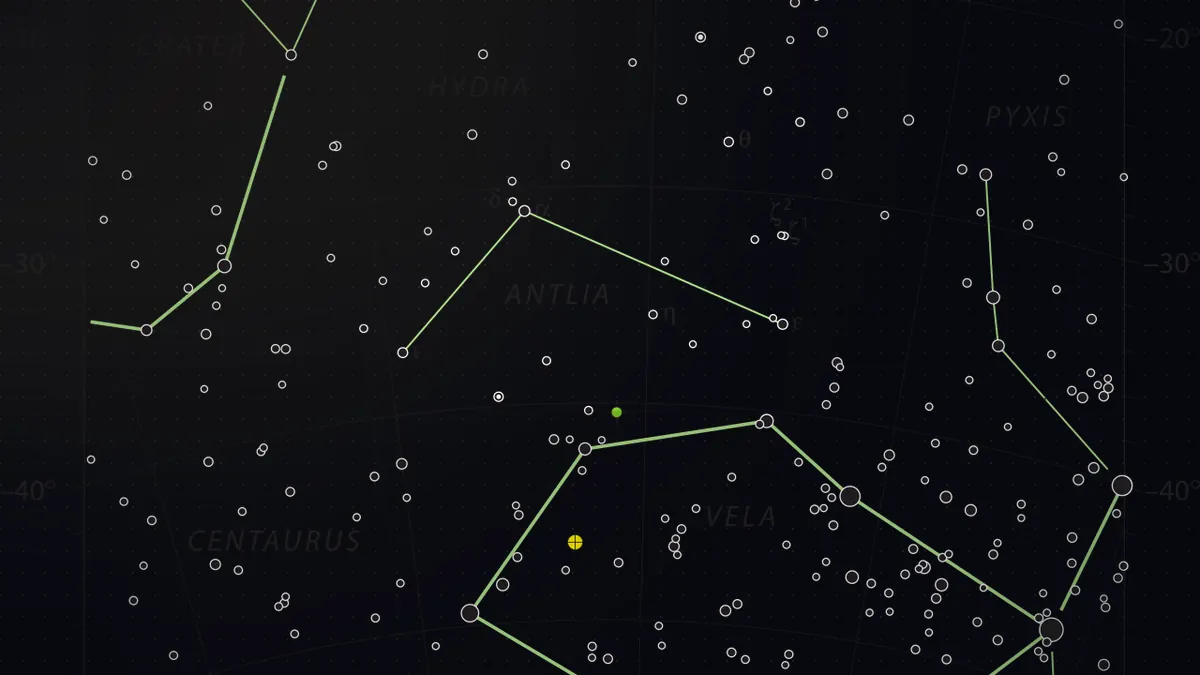
Antlia is a faint, unremarkable-looking constellation south of Hydra, with nothing brighter than magnitude 4.3.
Its name commemorates the air pump: specifically the vacuum pump built by Robert Boyle and Robert Hooke in the 1650s, used in experiments that established the behaviour of gases and demonstrated that sound cannot travel through a vacuum. It is one of the more genuinely historic instruments to have a constellation named after it.
Where to find Antlia
Antlia sits south of Hydra's body and north of Vela, in a dim region of the southern spring sky.
Because it is faint, navigate from the neighbours. Find Alphard, the solitary bright star in Hydra, and look south. Or work up from the False Cross in Vela and Carina.
You are looking for a few fourth-magnitude stars in a loose arrangement. A reasonably dark sky is needed; from a suburb, Antlia does not appear.
In sky coordinates Antlia sits at right ascension 9h 27m and declination −24.5°. Those two numbers work like a grid reference. Right ascension runs around the sky the way longitude runs around the Earth, and declination measures north and south the way latitude does. It sits in the southern half of the sky, high for southern observers and low on the horizon for northern ones. You can see it from anywhere south of latitude 45°N, including the whole southern hemisphere, and it sits highest after dark in April.
What Antlia actually looks like
A sparse scatter of faint stars with no coherent figure. Charts draw a single-cylinder vacuum pump, which is not something any arrangement of stars would suggest.
Lacaille created it in the 1750s as Antlia Pneumatica, the pneumatic machine, later shortened to Antlia.
It fills part of the gap left by the enormous old constellation Argo Navis, which Lacaille was in the process of dismantling. Several of his creations occupy space around the fragments of the ship, tidying up a part of the sky that had been awkwardly organised for centuries.
The stars of Antlia
- Alpha Antliae (magnitude 4.3) — the brightest star, an orange giant roughly 320 light years away.
- Epsilon Antliae — an orange giant, second brightest.
- Zeta Antliae — a wide double star, splittable in binoculars.
- S Antliae — an eclipsing binary of the W Ursae Majoris type: two stars so close together that they are actually touching, sharing a common envelope of gas. They orbit each other in under eight hours, and the system will eventually merge into a single star. It varies enough to follow with binoculars.
Contact binaries like S Antliae are among the more extreme configurations stars can end up in, and having one in an otherwise dull constellation is a fair consolation.
The story behind the name
There is no mythology. Antlia is a Lacaille creation from the 1750s, named after the air pump.
The instrument mattered. Robert Boyle, assisted by Robert Hooke, built an improved vacuum pump in 1659 and used it for a series of experiments that became foundational: showing that air is necessary for sound to travel, that a candle will not burn without it, and establishing the relationship between the pressure and volume of a gas now known as Boyle's Law.
Those experiments were among the most celebrated demonstrations of the early Royal Society, and they helped establish the idea that knowledge comes from controlled experiment rather than from authority. Lacaille putting the pump in the sky a century later was a tribute to that shift.
What else is hiding in Antlia
Antlia looks out of the galactic plane and has no Messier objects, but it holds a few worthwhile galaxies.
- NGC 2997 — a beautiful face-on spiral galaxy with well-defined arms, and comfortably the best target here. It is reachable in a medium telescope as a soft round glow, with structure appearing under dark skies and more aperture.
- The Antlia Dwarf Galaxy — a small, faint member of our Local Group, discovered as recently as 1997. It is extremely diffuse and effectively a photographic target.
- The Antlia Cluster (Abell 3627 region) — a nearby galaxy cluster, the third closest to us after Virgo and Fornax, containing several hundred galaxies.
For a constellation this faint, having a genuinely attractive spiral galaxy is a better outcome than it deserves.
When and where to see it
Best placed in the evening sky in April, through the southern autumn and northern spring.
Antlia lies south of the celestial equator, reaching to about 45°N, so it is visible low from much of the northern hemisphere. Southern observers get it comfortably higher.
A dark sky is needed for the constellation and essential for NGC 2997. The realistic plan is to star-hop from Alphard, find NGC 2997, and take the opportunity to explain to whoever is with you that this patch of sky is named after the machine that proved you cannot hear a bell ring in a vacuum.
Antlia at a glance
| Name | Antlia |
| Abbreviation | Ant |
| Genitive form | Antliae |
| Meaning | the Air Pump |
| Family | La Caille family |
| First recorded | 1756, Lacaille, as Antlia Pneumatica |
| Right ascension | 9h 27m |
| Declination | −24.5° |
| Area | 239 square degrees (62nd largest of 88) |
| Main stars in the figure | 3 |
| Stars brighter than magnitude 3 | 0 |
| Named Bayer / Flamsteed stars | 9 |
| Brightest star | α Ant (magnitude 4.25) |
| Messier objects | None |
| Meteor showers | None |
| Visible from | Anywhere south of latitude 45°N, including the whole southern hemisphere |
| Best seen at 9 pm in | April |
| Bordering constellations | Centaurus, Hydra, Pyxis, Vela |
Where to go next
Its neighbours in the sky
These constellations share a border with Antlia, so once you have found it you already know where to look next: Centaurus, Hydra, Pyxis, Vela.
The rest of the La Caille family
Antlia belongs to the La Caille family: eighteenth-century southern constellations named after instruments. The others are: Caelum, Circinus, Fornax, Horologium, Mensa, Microscopium, Norma, Octans, Pictor, Reticulum, Sculptor, Telescopium.
Start from the beginning
New to all this? The 88 constellations: a complete beginner's guide explains what a constellation actually is, how the sky is divided up, and lists all 88 with a link to each one.
Star chart: Antlia IAU chart by IAU and Sky & Telescope magazine (Roger Sinnott & Rick Fienberg), used under CC BY 3.0. Observing data cross-checked against Wikipedia's Antlia entry.