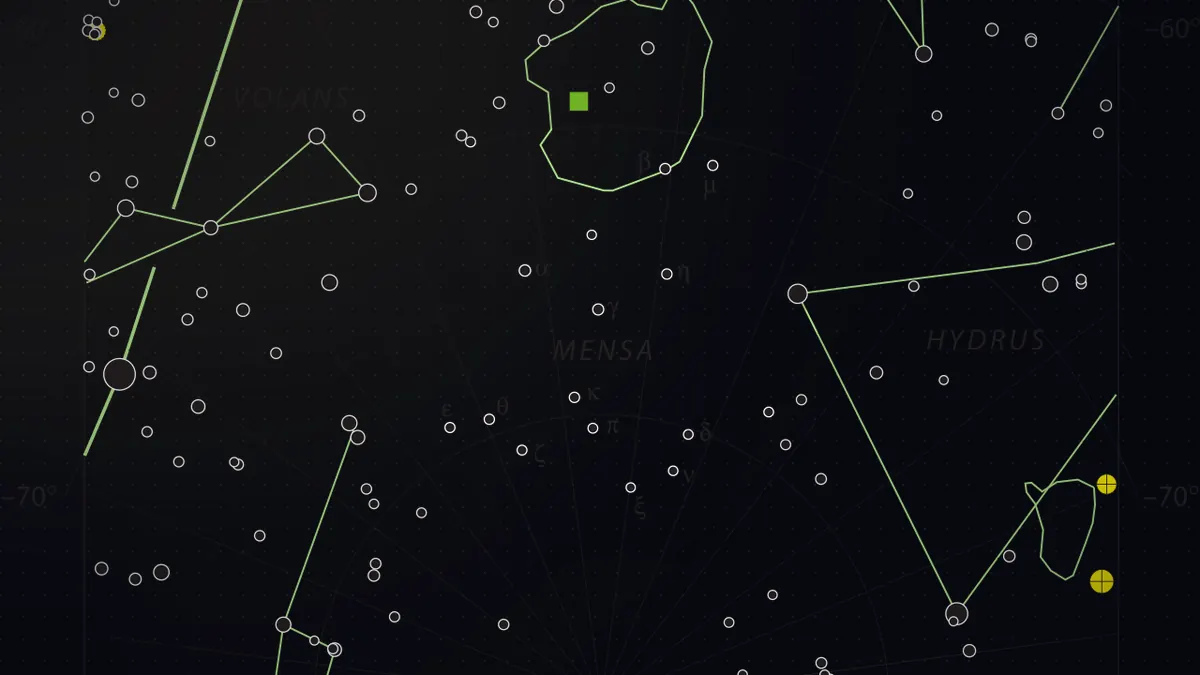
Mensa holds two distinctions. It is the only constellation named after a real geographical feature on Earth: Table Mountain in Cape Town, where Lacaille did his southern survey.
And it is the faintest constellation in the entire sky. No star in Mensa reaches magnitude 5. There is genuinely nothing here to see. What saves it is that part of the Large Magellanic Cloud spills across its border, so a constellation with no visible stars of its own contains a piece of another galaxy.
Where to find Mensa
Mensa sits between the Large Magellanic Cloud and the south celestial pole, south of Dorado.
Trying to find it by its stars is not realistic. Instead, locate the Large Magellanic Cloud — an obvious hazy patch from any dark southern sky — and look at the region on its southern side, towards the pole. That is Mensa.
Lacaille chose the name because the Large Magellanic Cloud sitting above the constellation reminded him of the cloud that famously forms over Table Mountain's flat summit. Once you know that, the arrangement is genuinely charming.
In sky coordinates Mensa sits at right ascension 3h 12m and declination −71.0°. Right ascension is the sky's version of longitude and declination its version of latitude, so those two numbers pin the constellation to one spot on the celestial sphere the way a map reference pins a town. It is a far-southern constellation, so southern observers own it and much of the northern hemisphere never sees it at all. In practice you can see it from anywhere south of latitude 4°N, including the whole southern hemisphere, and it stands highest in the evening sky around January.
What Mensa actually looks like
There is no shape. Mensa's brightest star is magnitude 5.1, which is at the very limit of naked-eye visibility under perfect conditions, and the rest are fainter.
No other constellation is this dim. Even the faint fillers like Sextans and Lacerta have stars around magnitude 3.5 to 4.5. Mensa has nothing.
Lacaille created it in the 1750s as Mons Mensae, Table Mountain, and it was later shortened to Mensa. It is the one exception in his otherwise consistent scheme of naming constellations after instruments and apparatus: a personal tribute to the mountain he worked beneath.
The stars of Mensa
- Alpha Mensae (magnitude 5.1) — the brightest star in the constellation, and a genuinely interesting object despite its faintness. It is a yellow dwarf very similar to the Sun, about 33 light years away, with a debris disc. It is one of the closest solar analogues.
- Beta Mensae — a yellow giant, considerably more distant.
- Gamma Mensae — an orange giant with a possible planetary companion.
- TZ Mensae — an eclipsing binary, dipping in brightness as its components pass in front of one another.
That the brightest star in a constellation is magnitude 5.1 means that from anywhere with the slightest light pollution, Mensa is completely invisible.
The story behind the name
There is no mythology, but there is a good story about the name.
Nicolas-Louis de Lacaille spent 1751 to 1753 at the Cape of Good Hope, observing from beneath Table Mountain and cataloguing nearly 10,000 southern stars. It was one of the most productive observing expeditions of the century.
When he named his fourteen new constellations, thirteen honoured instruments and crafts. The fourteenth honoured the mountain he had lived and worked under. He noted that the Large Magellanic Cloud sits directly above the constellation, just as a distinctive tablecloth of cloud regularly forms over Table Mountain's flat top.
It is the only constellation commemorating a specific place on Earth, and the fact that the faintest constellation in the sky is also the most personal one is a pleasing accident.
What else is hiding in Mensa
Nothing of its own, and no Messier objects, but the border helps.
- Part of the Large Magellanic Cloud crosses into Mensa, so the constellation technically contains a chunk of a satellite galaxy along with several of its star clusters and nebulae. This is comfortably the best thing about Mensa, and it is entirely borrowed.
- NGC 1987 and NGC 1848 — star clusters within the Large Magellanic Cloud that fall inside Mensa's boundary. Observing a star cluster that belongs to a different galaxy is an unusual thing to be able to do with a modest telescope.
- Alpha Mensae — worth finding purely to say you have seen the brightest star of the faintest constellation.
Mensa is a constellation for completists, and it wears that honestly.
When and where to see it
Best placed in the evening sky in January, through the southern summer.
Mensa lies close to the south celestial pole and is circumpolar from most of the southern hemisphere, so it is technically available every night of the year from Australia, southern Africa and southern South America. It never rises from the northern hemisphere.
You need an exceptionally dark, transparent sky to register any of its stars at all. This is the one constellation where 'reasonably dark' is not good enough. Realistically, enjoy the Large Magellanic Cloud objects that fall within its borders, note that you are looking at Table Mountain in the sky, and move on satisfied.
Mensa at a glance
| Name | Mensa |
| Abbreviation | Men |
| Genitive form | Mensae |
| Meaning | the Table Mountain |
| Family | La Caille family |
| First recorded | 1756, Lacaille, as Mons Mensæ |
| Right ascension | 3h 12m |
| Declination | −71.0° |
| Area | 153 square degrees (75th largest of 88) |
| Main stars in the figure | 4 |
| Stars brighter than magnitude 3 | 0 |
| Named Bayer / Flamsteed stars | 16 |
| Brightest star | α Men (Hoerikwaggo) (magnitude 5.09) |
| Messier objects | None |
| Meteor showers | None |
| Visible from | Anywhere south of latitude 4°N, including the whole southern hemisphere |
| Best seen at 9 pm in | January |
| Bordering constellations | Chamaeleon, Dorado, Hydrus, Octans, Volans |
Where to go next
Its neighbours in the sky
Mensa borders all of these, which makes them the natural next targets once you can pick it out: Chamaeleon, Dorado, Hydrus, Octans, Volans.
The rest of the La Caille family
Mensa belongs to the La Caille family: eighteenth-century southern constellations named after instruments. The others are: Antlia, Caelum, Circinus, Fornax, Horologium, Microscopium, Norma, Octans, Pictor, Reticulum, Sculptor, Telescopium.
Start from the beginning
New to all this? The 88 constellations: a complete beginner's guide explains what a constellation actually is, how the sky is divided up, and lists all 88 with a link to each one.
Star chart: Mensa IAU chart by IAU and Sky & Telescope magazine (Roger Sinnott & Rick Fienberg), used under CC BY 4.0. Observing data cross-checked against Wikipedia's Mensa entry.