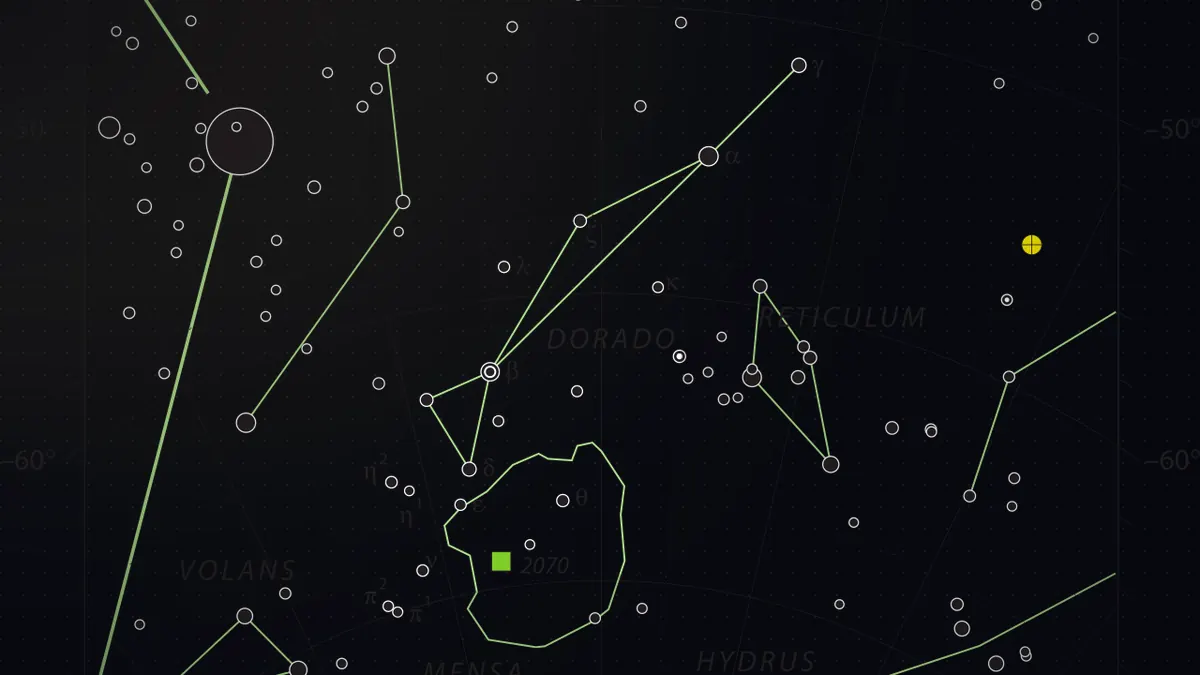
Dorado is a faint southern constellation that happens to contain most of the Large Magellanic Cloud: a satellite galaxy of the Milky Way, about 160,000 light years away and visible to the naked eye as a large, detached cloud of light.
Inside it sits the Tarantula Nebula, the most active star-forming region known in the Local Group, and the site of SN 1987A, the closest supernova observed since the invention of the telescope.
Where to find Dorado
Look for the Large Magellanic Cloud rather than the constellation. From a dark southern sky it is unmistakable: a large, hazy patch several times the width of the full Moon, looking like a piece of the Milky Way that has broken away.
It sits between Canopus in Carina and the south celestial pole. Once you have it, you have Dorado: the constellation's boundary encloses most of the cloud.
Newcomers to the southern sky often mistake it for a cloud in Earth's atmosphere. The test is simple: real clouds move, and this one does not.
In sky coordinates Dorado sits at right ascension 5h 00m and declination −65.0°. Those two numbers work like a grid reference. Right ascension runs around the sky the way longitude runs around the Earth, and declination measures north and south the way latitude does. It is a far-southern constellation, so southern observers own it and much of the northern hemisphere never sees it at all. In practice that means you can find it from anywhere south of latitude 20°N, including the whole southern hemisphere; it rides highest in the evening sky in January.
What Dorado actually looks like
A long, faint chain of stars, with nothing brighter than magnitude 3.3. There is no meaningful figure to trace.
The name is usually translated as the dolphinfish or mahi-mahi, a fast-swimming tropical fish that Dutch sailors would have encountered constantly, not the dolphin, which is Delphinus in the northern sky. It was sometimes called Xiphias, the swordfish.
Like Tucana, Dorado's stars are almost beside the point. The constellation is a container for a galaxy.
The stars of Dorado
- Alpha Doradus (magnitude 3.3) — the brightest star, a close binary about 170 light years away.
- Beta Doradus — a bright Cepheid variable, cycling between magnitude 3.4 and 4.1 over about 9.8 days. It is one of the brightest Cepheids in the sky and easy to follow by eye against nearby comparison stars.
- R Doradus — a red giant that has one of the largest apparent sizes of any star other than the Sun, meaning telescopes can actually resolve its disc. It has been imaged showing convection cells moving across its surface.
- S Doradus — a luminous blue variable in the Large Magellanic Cloud, one of the most luminous stars known and the prototype of its class.
The story behind the name
Dorado has no mythology, having been created in the 1590s by Keyser and de Houtman during Dutch voyages east.
Its real significance is modern and scientific. On 23 February 1987, light from a supernova in the Large Magellanic Cloud reached Earth: SN 1987A, the nearest observed supernova since Kepler's star of 1604 and the first visible to the naked eye in nearly four centuries.
It was a landmark event. For the first time, detectors on Earth caught neutrinos from a supernova, about two dozen of them, arriving hours before the light, exactly as theory predicted. That handful of particles confirmed the basic physics of how massive stars collapse, and it essentially founded neutrino astronomy. Astronomers have been watching the expanding debris ever since.
What else is hiding in Dorado
- The Large Magellanic Cloud (LMC) — a satellite galaxy about 160,000 light years away containing tens of billions of stars, along with its own clusters and nebulae. It is large enough and close enough that a telescope can pick out individual objects within another galaxy, which is a genuinely unusual thing to be able to do.
- The Tarantula Nebula (NGC 2070) — the most active star-forming region in the Local Group by a wide margin. If it were as close as the Orion Nebula it would cast shadows on Earth. Its sprawling filaments give it the spidery appearance behind the name, and it is superb in a telescope.
- SN 1987A — the remnant is still expanding and still monitored. Amateur telescopes cannot show it, but you can point at the spot.
- NGC 1850, NGC 2100 — rich star clusters within the LMC, resolvable in a good telescope.
When and where to see it
Best placed in the evening sky in January, through the southern summer.
Dorado is far southern and circumpolar from much of the southern hemisphere, so it is available all year from Australia, southern Africa and southern South America. From the northern hemisphere it never rises.
The Large Magellanic Cloud is a naked-eye object under dark skies, and moonlight or light pollution washes it out badly, so plan around a new Moon and get away from towns. Binoculars show structure within it; a telescope on the Tarantula Nebula is one of the finest views available from Earth.
Dorado at a glance
| Name | Dorado |
| Abbreviation | Dor |
| Genitive form | Doradus |
| Meaning | the dolphinfish |
| Family | Bayer family |
| First recorded | 1598, Plancius, Keyser, de Houtman |
| Right ascension | 5h 00m |
| Declination | −65.0° |
| Area | 179 square degrees (72nd largest of 88) |
| Main stars in the figure | 3 |
| Stars brighter than magnitude 3 | 0 |
| Named Bayer / Flamsteed stars | 14 |
| Brightest star | α Dor (magnitude 3.27) |
| Messier objects | None |
| Meteor showers | None |
| Visible from | Anywhere south of latitude 20°N, including the whole southern hemisphere |
| Best seen at 9 pm in | January |
| Bordering constellations | Caelum, Horologium, Hydrus, Mensa, Pictor, Reticulum, Volans |
Where to go next
Its neighbours in the sky
These constellations share a border with Dorado, so once you have found it you already know where to look next: Caelum, Horologium, Hydrus, Mensa, Pictor, Reticulum, Volans.
The rest of the Bayer family
Dorado belongs to the Bayer family: southern constellations charted by Dutch navigators in the 1590s. The others are: Apus, Chamaeleon, Grus, Hydrus, Indus, Musca, Pavo, Phoenix, Tucana, Volans.
Start from the beginning
Not sure where to begin? The guide to all 88 constellations explains how the sky is divided, what a constellation really is, and links to each of the 88.
Star chart: Dorado IAU chart by IAU and Sky & Telescope magazine (Roger Sinnott & Rick Fienberg), used under CC BY 3.0. Observing data cross-checked against Wikipedia's Dorado entry.