Volans is the flying fish, one of the more charming names in the sky and drawn from something Dutch sailors saw constantly: fish that break the surface and glide above the waves to escape predators.
It is a small, faint constellation wedged against Carina, and its position is appropriate: the flying fish appears to be leaping away from the great ship, which is exactly what the real animals do when a vessel disturbs them.
Where to find Volans
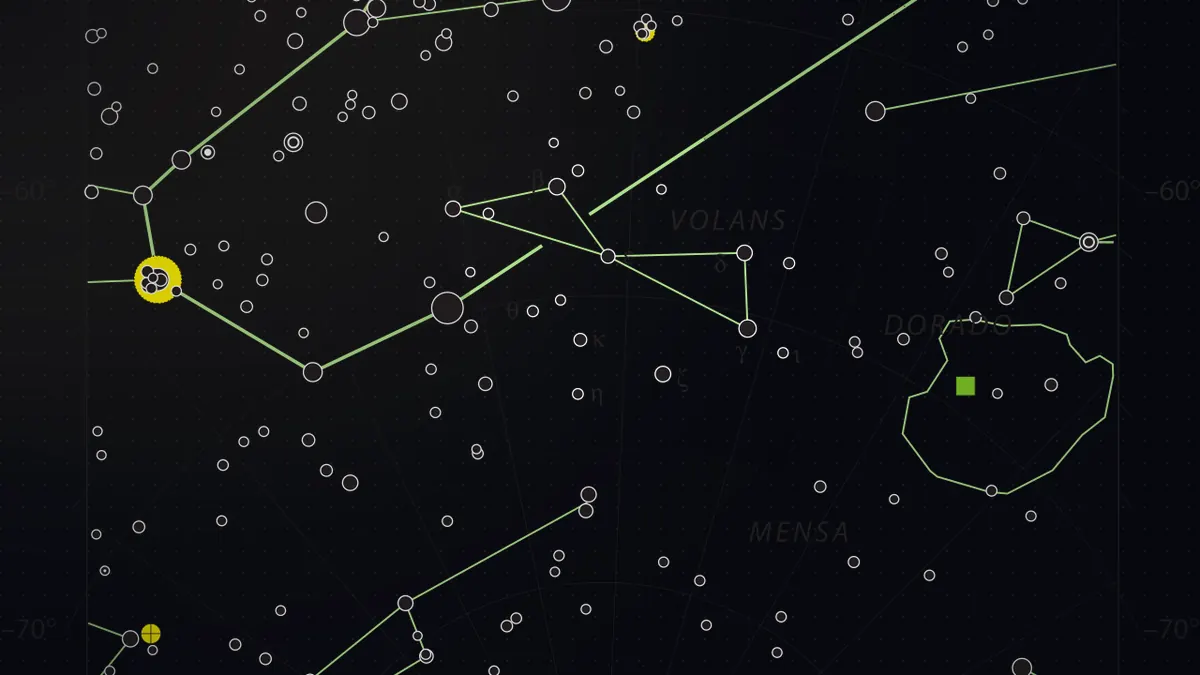
Volans sits between Carina and the Large Magellanic Cloud in Dorado, in the far southern sky.
Find Canopus, the brilliant star in Carina, then move south towards the Large Magellanic Cloud. Volans lies in the region between them.
Its stars are around magnitude 3.8 to 4, so you need a reasonably dark sky. The constellation is compact enough to hold together once you have found it, but there is no bright anchor to guide you in.
In sky coordinates Volans sits at right ascension 6h 31m and declination −64.1°. If the units look unfamiliar, the idea behind them is not: declination is the sky's latitude, right ascension is its longitude, and together they place the constellation exactly. It is a far-southern constellation, so southern observers own it and much of the northern hemisphere never sees it at all. In practice that means you can find it from anywhere south of latitude 15°N, including the whole southern hemisphere; it rides highest in the evening sky in February.
What Volans actually looks like
A small, compact group of faint stars forming a rough diamond or kite. There is no fish to be seen, though the compactness at least makes it memorable once located.
It is another of the Keyser and de Houtman constellations from the 1590s, originally named Piscis Volans, the flying fish, later shortened to Volans.
Its placement beside Carina — the keel of the ship Argo Navis — is deliberate. Flying fish were among the most memorable sights of long ocean voyages, and putting one beside the celestial ship is a nice piece of thematic mapping.
The stars of Volans
- Beta Volantis (magnitude 3.8) — the brightest star, an orange giant about 110 light years away.
- Gamma Volantis — a beautiful double star and the constellation's best telescopic target, pairing a golden-orange primary with a fainter white companion. The colour contrast is genuinely lovely and the pair splits easily in a small telescope.
- Epsilon Volantis — another multiple star system.
- HD 76700 — a Sun-like star hosting a gas giant planet on a close orbit.
Gamma Volantis is the reason to visit. It is one of the better double stars in the far southern sky and is often overlooked because the constellation containing it is so obscure.
The story behind the name
There is no mythology. Volans was created in the 1590s by Keyser and de Houtman during Dutch voyages to the East Indies, published by Plancius in 1598 and included in Bayer's Uranometria.
Flying fish are real, and they genuinely do glide: they build up speed underwater, break the surface, and use enlarged pectoral fins to sail through the air for distances of up to several hundred metres. For sailors on long tropical voyages they were a constant and striking presence, and they sometimes landed on deck.
Of all the southern constellations named after creatures the Dutch encountered, Volans is probably the one they saw most often. The peacocks, toucans and birds of paradise were exotic rarities; flying fish were simply part of the daily view from the rail.
What else is hiding in Volans
Small, faint constellation with no Messier objects, but one striking galaxy.
- NGC 2442, the Meathook Galaxy — a barred spiral with two dramatically asymmetric arms, one drawn out into a long hook. The distortion is thought to result from a past gravitational encounter with another galaxy. It is unusual enough in shape to be worth seeking out, and it is reachable in a medium telescope as a faint patch, with the hook needing photography or serious aperture.
- NGC 2397 — a spiral galaxy with a bright core and dusty arms.
- AM 0644-741 — a ring galaxy, formed when a smaller galaxy passed straight through its centre and sent a wave of star formation rippling outwards. A famous Hubble image and a genuinely rare type of object.
For a small faint constellation, that is a respectable set of galaxies.
When and where to see it
Best placed in the evening sky in March, through the southern summer and autumn.
Volans is far southern and circumpolar from most of the southern hemisphere. From the northern hemisphere it never rises.
You need a moderately dark sky for the constellation itself. Gamma Volantis is the realistic highlight and needs only a small telescope. It is one of those objects that makes an otherwise unremarkable constellation worth visiting. The galaxies want dark skies and aperture. Combine it with a look at the Large Magellanic Cloud next door and the trip pays for itself.
Volans at a glance
| Name | Volans |
| Abbreviation | Vol |
| Genitive form | Volantis |
| Meaning | the Flying Fish |
| Family | Bayer family |
| First recorded | 1598, Plancius, Keyser, de Houtman, as Piscis Volans |
| Right ascension | 6h 31m |
| Declination | −64.1° |
| Area | 141 square degrees (76th largest of 88) |
| Main stars in the figure | 6 |
| Stars brighter than magnitude 3 | 0 |
| Named Bayer / Flamsteed stars | 12 |
| Brightest star | γ 2 Vol (magnitude 3.62) |
| Messier objects | None |
| Meteor showers | None |
| Visible from | Anywhere south of latitude 15°N, including the whole southern hemisphere |
| Best seen at 9 pm in | February |
| Bordering constellations | Carina, Chamaeleon, Dorado, Mensa, Pictor |
Where to go next
Its neighbours in the sky
Everything here shares a border with Volans. Find one and the rest are a short hop away: Carina, Chamaeleon, Dorado, Mensa, Pictor.
The rest of the Bayer family
Volans belongs to the Bayer family: southern constellations charted by Dutch navigators in the 1590s. The others are: Apus, Chamaeleon, Dorado, Grus, Hydrus, Indus, Musca, Pavo, Phoenix, Tucana.
Start from the beginning
Not sure where to begin? The guide to all 88 constellations explains how the sky is divided, what a constellation really is, and links to each of the 88.
Star chart: Volans IAU chart by IAU and Sky & Telescope magazine (Roger Sinnott & Rick Fienberg), used under CC BY 3.0. Observing data cross-checked against Wikipedia's Volans entry.