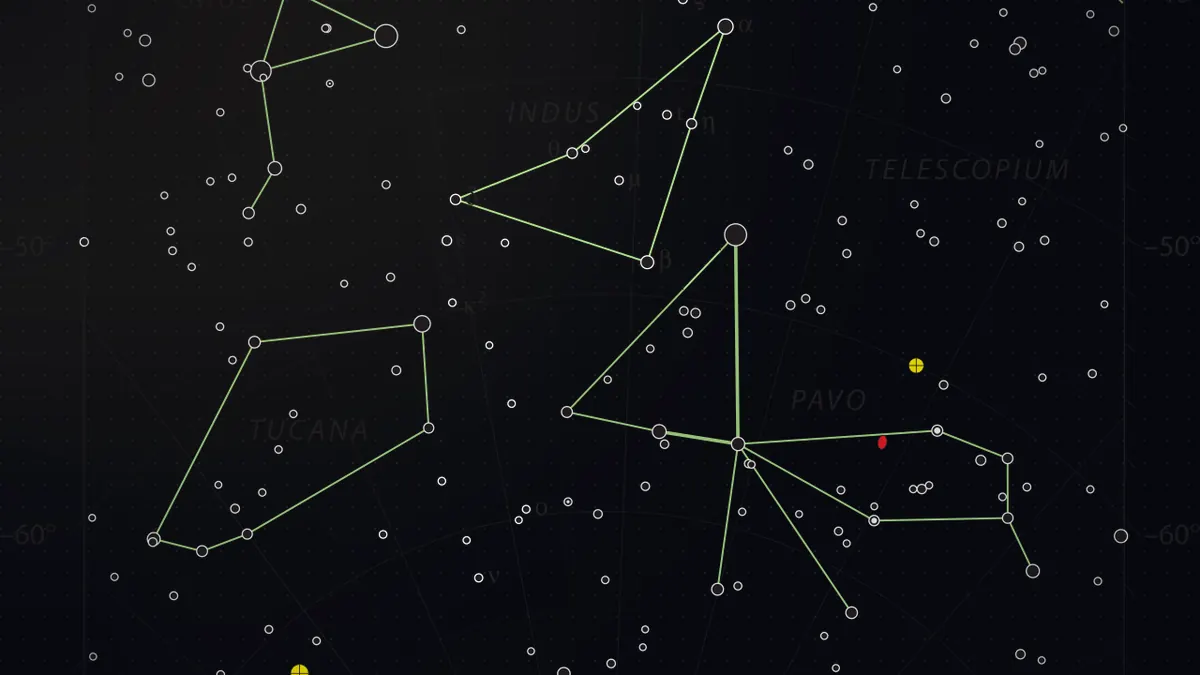
Indus is a faint southern constellation representing an Indigenous person: one of the very few constellations depicting a human figure who is not a Greek god or hero.
Its stars are unremarkable, but it contains Epsilon Indi, one of the closest star systems to the Sun at under 12 light years. That system holds a pair of brown dwarfs and at least one giant planet, and it is a regular target for studies of what our immediate galactic neighbourhood is actually like.
Where to find Indus
Indus sits between Grus and Pavo in the southern sky, south of Capricornus.
Use the bright anchors either side: find Alnair in Grus or Peacock in Pavo, and Indus is the dim region between them.
Nothing here is brighter than magnitude 3.1, so you need a reasonably dark sky. There is no distinctive shape to look for, so this is a matter of careful navigation from the neighbours rather than pattern recognition.
In sky coordinates Indus sits at right ascension 20h 28m and declination −45.0°. If the units look unfamiliar, the idea behind them is not: declination is the sky's latitude, right ascension is its longitude, and together they place the constellation exactly. It is a far-southern constellation, so southern observers own it and much of the northern hemisphere never sees it at all. You can see it from anywhere south of latitude 15°N, including the whole southern hemisphere, and it sits highest after dark in September.
What Indus actually looks like
A long, faint scatter of stars with no coherent figure. Charts draw a standing human figure holding spears or arrows, but there is nothing in the star pattern to suggest it.
Indus is one of the twelve Keyser and de Houtman constellations from the 1590s. Unlike its companions — which are almost all animals — this one depicts a person, specifically an Indigenous inhabitant of the lands the Dutch were sailing to.
Early depictions vary considerably. Bayer's Uranometria shows a naked figure holding arrows; other charts show spears. Which Indigenous people was intended was never specified, and probably never thought about very precisely.
The stars of Indus
- Alpha Indi (magnitude 3.1) — the brightest star, an orange giant about 100 light years away.
- Beta Indi — another orange giant, second brightest.
- Epsilon Indi — the significant one. An orange dwarf just 11.9 light years away, making it one of our nearest stellar neighbours and one of the closest stars visible to the naked eye. It hosts a pair of brown dwarfs — objects too massive to be planets and too light to be stars — orbiting far out, plus at least one giant planet. It is a long-standing target in the search for nearby habitable worlds and has been observed by the James Webb Space Telescope.
- Theta Indi — a double star, splittable in a small telescope.
The story behind the name
Indus has no mythology. It was created in the 1590s by Keyser and de Houtman and published by Plancius in 1598.
The figure represents an Indigenous person, and the constellation is worth pausing on for that reason. It reflects how sixteenth-century European navigators mapped their encounters onto the sky: placing the peoples they met alongside the animals they saw, all of it named from a European vantage point and none of it consulting anybody it depicted.
It is a useful counterpoint to remember that the peoples of the southern hemisphere had their own detailed and sophisticated readings of these same stars. Aboriginal Australian traditions in particular encode seasonal, navigational and ecological knowledge in the southern sky, including constellations made from dark nebulae rather than stars: a concept European astronomy did not use at all.
What else is hiding in Indus
A quiet constellation with no Messier objects and modest contents.
- NGC 7090 — an edge-on spiral galaxy appearing as a thin sliver of light, reachable in a medium telescope. It is a nice example of what a spiral looks like from the side.
- NGC 7049 — a lens-shaped galaxy with an unusual dust ring around its core, a striking Hubble subject.
- IC 5152 — a dwarf irregular galaxy on the fringes of our Local Group, faint and diffuse.
- Epsilon Indi — visible to the naked eye at magnitude 4.7 under dark skies. As with Beta Hydri, the pleasure is contextual: you are looking at one of the Sun's nearest neighbours, a system with brown dwarfs and a planet, close enough that we can study it in real detail.
When and where to see it
Best placed in the evening sky in September, through the southern spring.
Indus is a southern constellation reaching to about 15°N, so it is effectively a southern-hemisphere object, though the northern edge can be glimpsed from the tropics.
You need a reasonably dark sky, since there is no bright star to anchor on. The realistic plan is to locate Epsilon Indi and appreciate it for what it is, then pick up NGC 7090 if you have a telescope. Indus is a quiet constellation, but having one of the nearest star systems to the Sun inside it is not a bad claim.
Indus at a glance
| Name | Indus |
| Abbreviation | Ind |
| Genitive form | Indi |
| Meaning | the Indian |
| Family | Bayer family |
| First recorded | 1598, Plancius, Keyser, de Houtman |
| Right ascension | 20h 28m |
| Declination | −45.0° |
| Area | 294 square degrees (49th largest of 88) |
| Main stars in the figure | 3 |
| Stars brighter than magnitude 3 | 0 |
| Named Bayer / Flamsteed stars | 16 |
| Brightest star | α Ind (magnitude 3.11) |
| Messier objects | None |
| Meteor showers | None |
| Visible from | Anywhere south of latitude 15°N, including the whole southern hemisphere |
| Best seen at 9 pm in | September |
| Bordering constellations | Grus, Microscopium, Octans, Pavo, Sagittarius, Telescopium, Tucana |
Where to go next
Its neighbours in the sky
Indus borders all of these, which makes them the natural next targets once you can pick it out: Grus, Microscopium, Octans, Pavo, Sagittarius, Telescopium, Tucana.
The rest of the Bayer family
Indus belongs to the Bayer family: southern constellations charted by Dutch navigators in the 1590s. The others are: Apus, Chamaeleon, Dorado, Grus, Hydrus, Musca, Pavo, Phoenix, Tucana, Volans.
Start from the beginning
If you are starting from scratch, the complete beginner's guide to the 88 constellations covers what a constellation actually is, how the sky is carved up, and links to every one of them.
Star chart: Indus IAU chart by IAU and Sky & Telescope magazine (Roger Sinnott & Rick Fienberg), used under CC BY 3.0. Observing data cross-checked against Wikipedia's Indus entry.