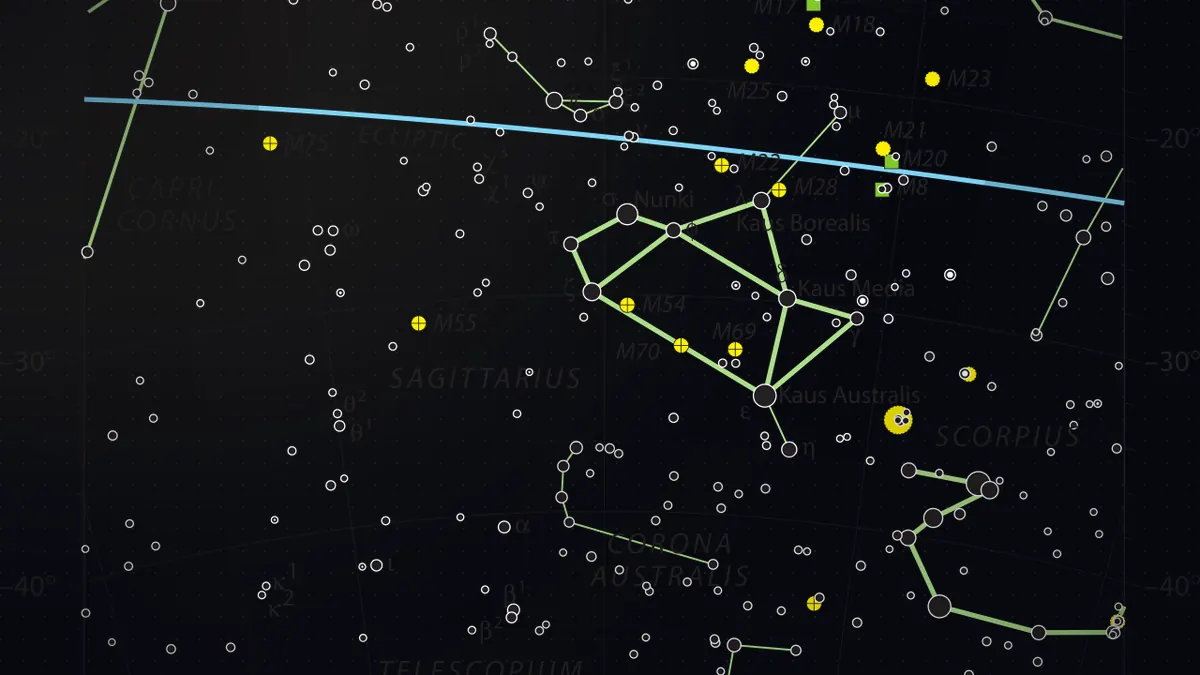
Sagittarius is officially an archer: a centaur drawing a bow. In practice almost everyone learns it as the Teapot, because the bright central stars form an unmistakable teapot with a handle, a lid and a spout.
Look just past that spout and you are looking directly at the centre of our galaxy. That is why Sagittarius contains fifteen Messier objects, more than any other constellation: you are staring down the long axis of the Milky Way, through its densest star fields.
Where to find Sagittarius
Find Scorpius first — the curve of stars with red Antares — then look immediately east of the scorpion's sting.
You are looking for eight moderately bright stars forming a teapot in profile: a triangular lid, a handle on the left, a spout on the right. Once seen it is impossible to unsee.
Under a dark sky there is a bonus that makes the identification certain: the Milky Way rises from the teapot's spout like steam. That band of light is the combined glow of billions of stars towards the galactic core.
In sky coordinates Sagittarius sits at right ascension 19h 00m and declination −25.0°. Right ascension is the sky's version of longitude and declination its version of latitude, so those two numbers pin the constellation to one spot on the celestial sphere the way a map reference pins a town. It sits in the southern half of the sky, high for southern observers and low on the horizon for northern ones. In practice you can see it from anywhere south of latitude 45°N, including the whole southern hemisphere, and it stands highest in the evening sky around August.
What Sagittarius actually looks like
The Teapot asterism is the practical constellation: eight stars, clearly arranged, easy to hold in your head.
The official figure is a centaur archer aiming his bow west at the heart of Scorpius. The teapot's handle is the archer's torso and the spout is the tip of the arrow. Frankly, the teapot is easier and no less respectable: plenty of professional astronomers navigate by it.
A smaller pattern sits within: the Little Milk Dipper, formed by the handle stars plus a couple of neighbours, which points the way to several of the best deep-sky objects.
The stars of Sagittarius
- Kaus Australis (Epsilon Sagittarii, magnitude 1.85) — the brightest star, a blue giant marking the bottom of the archer's bow. The three Kaus stars (Australis, Media and Borealis) form the bow itself.
- Nunki (Sigma Sagittarii) — the second brightest, and one of the few star names to come down to us from ancient Babylonian rather than Greek or Arabic sources.
- Sagittarius A* — not a star you can see, but the most important object here: the supermassive black hole at the centre of the Milky Way, about 4 million times the Sun's mass. Decades of tracking stars whipping around it earned a Nobel Prize, and in 2022 the Event Horizon Telescope imaged it directly. It lies roughly 26,000 light years away, just off the teapot's spout.
The story behind the name
Sagittarius is a centaur drawing a bow, usually identified as Crotus, a satyr-like figure raised by the Muses who invented archery. He is deliberately distinguished from Chiron, the wise centaur represented by Centaurus, though the two get confused constantly, including in antiquity.
The archer is older than Greece. Babylonian records describe a bow-wielding figure here, sometimes winged and with a scorpion's tail, and the arrow has always pointed at the scorpion's heart.
There is something fitting about the fact that the arrow points towards the galactic centre. The ancients had no way of knowing that this direction was special, yet they made it the focus of the sky's most purposeful figure: an archer aiming at something.
What else is hiding in Sagittarius
Fifteen Messier objects. This is the richest constellation in the sky.
- M8, the Lagoon Nebula — a huge star-forming region, visible to the naked eye under dark skies as an elongated glow, with a dark lane cutting across it. One of the best nebulae in the sky.
- M20, the Trifid Nebula — nearby, and famous for the three dark dust lanes dividing its glowing gas. Photographs show red emission and blue reflection nebulosity side by side.
- M17, the Omega or Swan Nebula — a bright nebula that really does look like a swan floating on water in a telescope.
- M22 — one of the finest globular clusters in the sky, brighter than the more famous M13 in Hercules and resolving into thousands of stars.
- M24, the Sagittarius Star Cloud — not a cluster but a window through the dust to a dense arm of the galaxy beyond. In binoculars it is a breathtaking field of uncountable stars.
When and where to see it
Best placed in the evening sky in August, and the summer months are the season for the galactic centre.
Hemisphere matters enormously. Sagittarius sits well south, so southern observers get it overhead and see the Milky Way's core at its most spectacular. Northern observers see it low in the south, and from northern Europe or Canada much of the good material never rises far enough to clear the haze.
This is the single best constellation for a pair of binoculars and a dark sky. You do not need to find specific objects: simply sweeping slowly through the region delivers cluster after nebula after star cloud. If you get one dark, moonless summer night a year, spend it here.
Sagittarius at a glance
| Name | Sagittarius |
| Abbreviation | Sgr |
| Genitive form | Sagittarii |
| Meaning | the Archer |
| Family | Zodiac family |
| First recorded | ancient (Ptolemy) |
| Right ascension | 19h 00m |
| Declination | −25.0° |
| Area | 867 square degrees (15th largest of 88) |
| Main stars in the figure | 12 |
| Stars brighter than magnitude 3 | 7 |
| Named Bayer / Flamsteed stars | 68 |
| Brightest star | ε Sgr (Kaus Australis) (magnitude 1.79) |
| Messier objects | 15 |
| Meteor showers | None |
| Visible from | Anywhere south of latitude 45°N, including the whole southern hemisphere |
| Best seen at 9 pm in | August |
| Bordering constellations | Aquila, Capricornus, Corona Australis, Indus, Microscopium, Ophiuchus, Scorpius, Scutum, Serpens, Telescopium |
Where to go next
Its neighbours in the sky
These constellations share a border with Sagittarius, so once you have found it you already know where to look next: Aquila, Capricornus, Corona Australis, Indus, Microscopium, Ophiuchus, Scorpius, Scutum, Serpens, Telescopium.
The rest of the Zodiac family
Sagittarius belongs to the Zodiac family: the twelve constellations the Sun, Moon and planets travel through. The others are: Aquarius, Aries, Cancer, Capricornus, Gemini, Leo, Libra, Pisces, Scorpius, Taurus, Virgo.
Start from the beginning
New to all this? The 88 constellations: a complete beginner's guide explains what a constellation actually is, how the sky is divided up, and lists all 88 with a link to each one.
Star chart: Sagittarius IAU chart by IAU and Sky & Telescope magazine (Roger Sinnott & Rick Fienberg), used under CC BY 3.0. Observing data cross-checked against Wikipedia's Sagittarius entry.