Aquila is the eagle that carried Zeus's thunderbolts, flying up the Milky Way with wings spread. Its brightest star, Altair, is the twelfth brightest in the night sky and the southern corner of the Summer Triangle.
Altair is also one of the strangest bright stars we know. It rotates once every nine hours, so fast that centrifugal force has visibly squashed it into an ellipsoid, with its equator over 20 percent wider than its poles.
Where to find Aquila
Find the Summer Triangle overhead on a summer evening. Vega is the brightest, Deneb the faintest, and Altair is the third: the southernmost of the three.
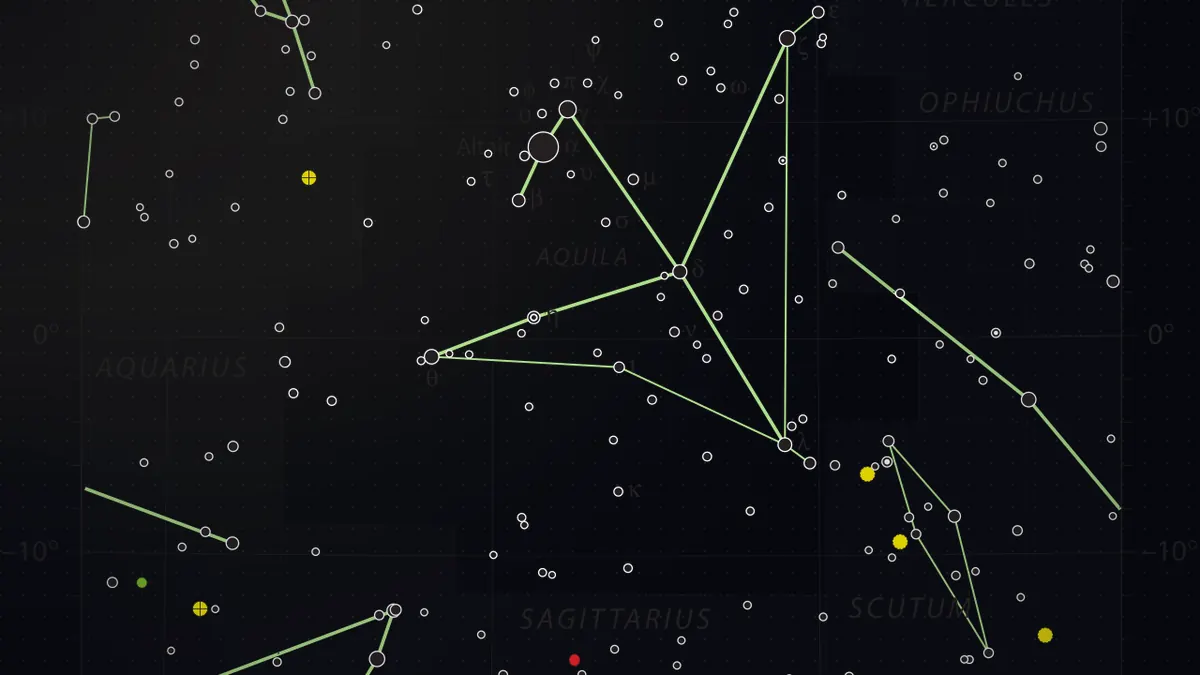
Altair has a distinctive giveaway: it sits between two fainter stars, one on each side, forming a short straight line of three. Nothing else in that part of the sky looks like it, and once you have seen the little row you will find Aquila instantly every time.
From that line, the eagle's wings and body spread out along the Milky Way to the south.
In sky coordinates Aquila sits at right ascension 18h 41m and declination +18.7°. Those two numbers work like a grid reference. Right ascension runs around the sky the way longitude runs around the Earth, and declination measures north and south the way latitude does. It sits in the northern half of the sky, riding high for northern observers and low for southern ones. Practically speaking it is visible from between latitudes 78°N and 71°S, with the best evening views around August.
What Aquila actually looks like
A bird with outstretched wings flying north up the Milky Way. Altair marks the eagle's neck or head, flanked by Tarazed and Alshain, and lines of fainter stars extend either side as wings and behind as the tail.
The three-in-a-row of Altair and its flanking stars is the practical identifier, and it is one of the tidiest small patterns in the summer sky.
Aquila sits squarely in the Milky Way, so the background is dense with stars, and the Great Rift — the dark dust lane splitting the galaxy's band — runs right through the constellation.
The stars of Aquila
- Altair (Alpha Aquilae, magnitude 0.76) — just 17 light years away, which makes it one of the closest bright stars. Its nine-hour rotation period has flattened it measurably, and interferometry has produced actual images showing the distortion: one of the few stars other than the Sun whose surface has been resolved.
- Tarazed (Gamma Aquilae) — an orange giant, and the brighter of Altair's two flanking stars.
- Alshain (Beta Aquilae) — the fainter flanker, a yellow subgiant.
- Eta Aquilae — a bright Cepheid variable, cycling between magnitude 3.5 and 4.4 over about seven days. It is one of the easiest Cepheids to follow with the naked eye, and comparing it with nearby stars over a week is a genuinely rewarding beginner project.
The story behind the name
Aquila is the eagle of Zeus, who carried the god's thunderbolts and performed his errands. Its most famous job was abducting Ganymede, the beautiful Trojan prince, and carrying him to Olympus to serve as cup-bearer to the gods, which is why the eagle sits near Aquarius, the water bearer, generally identified as Ganymede.
The eagle also appears as the bird sent to torment Prometheus, eating his liver daily as punishment for giving fire to humanity, and as the one that retrieved the lyre of Orpheus, which is why Lyra is nearby.
In Chinese astronomy, Altair and Vega play the central roles in the story of the cowherd and the weaver girl, lovers separated by the Milky Way and permitted to meet once a year, a festival still celebrated. Two traditions, two brilliant stars, and the same river of light between them.
What else is hiding in Aquila
The Milky Way makes Aquila rich in background, but it has no Messier objects.
- NGC 6709 — a pleasant open cluster, a good binocular target.
- NGC 6751, the Glowing Eye Nebula — a small planetary nebula with a striking radial structure in Hubble images.
- The Great Rift — the dark dust lanes that split the Milky Way through Aquila. Under a genuinely dark sky, these are visible to the naked eye as black channels through the star clouds, and they are one of the more affecting sights available without equipment: you are seeing dust in the galaxy's spiral arms blocking the light of everything behind it.
- Nova Aquilae 1918 — one of the brightest novae of the twentieth century, briefly outshining Altair itself before fading.
When and where to see it
Best placed in the evening sky in September, through the northern summer and early autumn.
It straddles the celestial equator, so it is visible from essentially everywhere on Earth: one of the more universally accessible constellations.
Altair and its two flankers survive city light easily. The Milky Way and the Great Rift need real darkness. If you have binoculars, sweeping from Altair south along the Milky Way through Aquila, Scutum and into Sagittarius is one of the best continuous star fields there is.
Aquila at a glance
| Name | Aquila |
| Abbreviation | Aql |
| Genitive form | Aquilae |
| Meaning | the Eagle |
| Family | Hercules family |
| First recorded | ancient (Ptolemy) |
| Right ascension | 18h 41m |
| Declination | +18.7° |
| Area | 652 square degrees (22nd largest of 88) |
| Main stars in the figure | 10 |
| Stars brighter than magnitude 3 | 3 |
| Named Bayer / Flamsteed stars | 65 |
| Brightest star | Altair (α Aql) (magnitude 0.76) |
| Messier objects | None |
| Meteor showers | June Aquilids, Epsilon Aquilids |
| Visible from | Between latitudes 78°N and 71°S |
| Best seen at 9 pm in | August |
| Bordering constellations | Aquarius, Capricornus, Delphinus, Hercules, Ophiuchus, Sagitta, Sagittarius, Scutum, Serpens |
Where to go next
Its neighbours in the sky
Aquila borders all of these, which makes them the natural next targets once you can pick it out: Aquarius, Capricornus, Delphinus, Hercules, Ophiuchus, Sagitta, Sagittarius, Scutum, Serpens.
The rest of the Hercules family
Aquila belongs to the Hercules family: the largest family — heroes, serpents and the far southern sky. The others are: Ara, Centaurus, Corona Australis, Corvus, Crater, Crux, Cygnus, Hercules, Hydra, Lupus, Lyra, Ophiuchus, Sagitta, Scutum, Serpens, Sextans, Triangulum Australe, Vulpecula.
Start from the beginning
If you are starting from scratch, the complete beginner's guide to the 88 constellations covers what a constellation actually is, how the sky is carved up, and links to every one of them.
Star chart: Aquila IAU chart by IAU and Sky & Telescope magazine (Roger Sinnott & Rick Fienberg), used under CC BY 3.0. Observing data cross-checked against Wikipedia's Aquila entry.