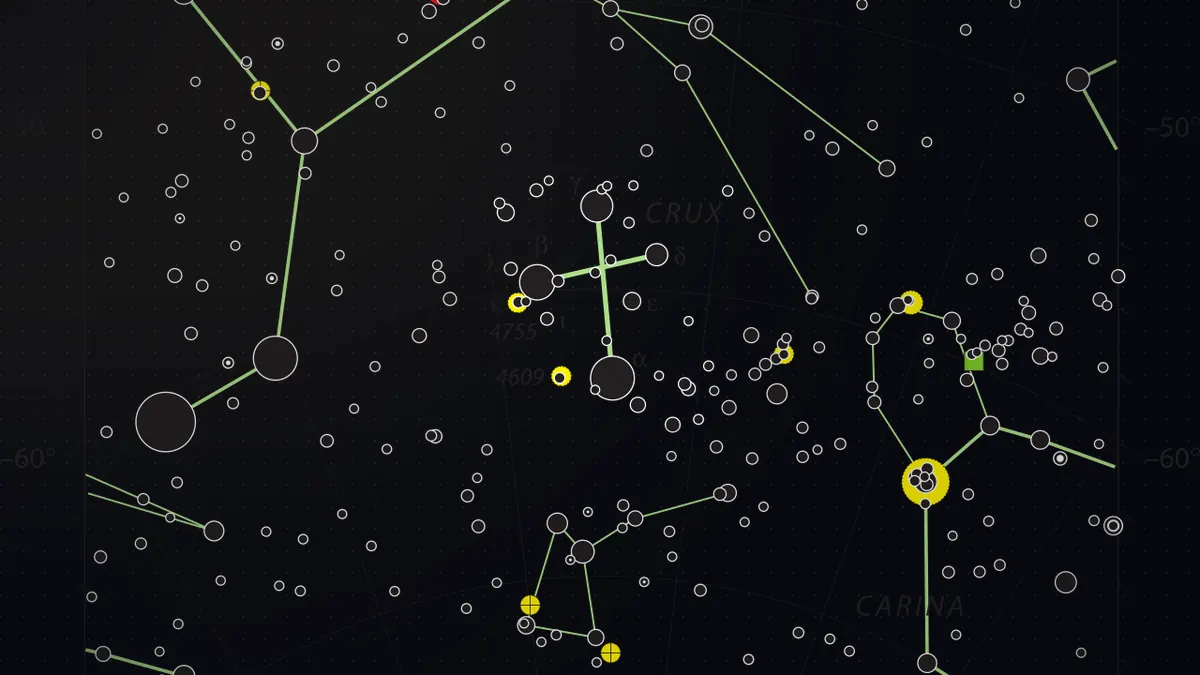
Crux is the smallest constellation in the sky, covering just 68 square degrees. It is also, by some distance, the most culturally important constellation of the southern hemisphere: it appears on the flags of Australia, New Zealand, Brazil, Samoa and Papua New Guinea.
It matters because there is no southern pole star. The Southern Cross is how you find south, and for centuries it was how navigators crossed the southern oceans.
Where to find Crux
From the southern hemisphere, look south for a compact cross of four bright stars, with a fifth fainter one inside. Beside it sit two brilliant stars, Alpha and Beta Centauri, known as the Pointers.
The Pointers are the confirmation. If you see a small cross with two bright stars pointing at it, you have the real thing.
To find south: extend the long axis of the cross about four and a half times its own length. That point is the south celestial pole. Drop straight down to the horizon and you are facing south. Do not confuse Crux with the larger False Cross in Carina and Vela: the False Cross is bigger, dimmer and has no Pointers.
In sky coordinates Crux sits at right ascension 12h 30m and declination −60.0°. Declination is latitude by another name and right ascension is longitude, so the pair fixes the constellation at one point on the celestial sphere. It is a far-southern constellation, so southern observers own it and much of the northern hemisphere never sees it at all. Practically speaking it is visible from anywhere south of latitude 20°N, including the whole southern hemisphere, with the best evening views around May.
What Crux actually looks like
Four bright stars forming a compact cross or kite, with a fifth fainter star offset inside it. It is small — you can cover it with your thumb at arm's length — but its stars are bright and the shape is unmistakable.
Crux was not always separate. Its stars were once considered part of Centaurus, and it was known to the ancient Greeks, who could see it from Mediterranean latitudes before precession carried it south. By the time European navigators reached the tropics it had become invisible from Europe, and it was 're-discovered' and defined as its own constellation in the sixteenth century.
That is a good illustration of precession at work over historical time.
The stars of Crux
- Acrux (Alpha Crucis, magnitude 0.8) — the brightest, and the southernmost first-magnitude star in the sky. A multiple system that a telescope splits into two brilliant blue components.
- Mimosa (Beta Crucis) — a blue giant and a Beta Cephei variable, pulsating slightly.
- Gacrux (Gamma Crucis) — a red giant, and the closest red giant to the Sun at about 88 light years. Its orange colour contrasts beautifully with the blue-white of the others.
- Delta Crucis — the fourth arm of the cross.
The colour contrast between orange Gacrux and the three blue stars is obvious to the naked eye and is one of the nicest things about the constellation.
The story behind the name
Crux has no Greek mythology of its own, since it was absorbed into Centaurus in antiquity. Its significance is navigational and cultural rather than mythological.
For Aboriginal Australians the cross and the dark Coalsack Nebula beside it form part of the Emu in the Sky: a figure made not from stars but from the dark dust lanes between them, which is a genuinely different way of reading the sky. The emu's head is the Coalsack, and its body stretches along the Milky Way. Its appearance and orientation through the year signalled when emus were laying eggs.
For Māori it is Te Punga, the anchor. For European navigators from the fifteenth century onwards it was the essential southern reference, and it was Portuguese and Spanish sailors who fixed the Christian cross interpretation that gave it its modern name.
What else is hiding in Crux
Small constellation, superb contents, thanks to the Milky Way running straight through it.
- The Jewel Box (NGC 4755) — one of the finest open clusters in the sky. John Herschel described it as resembling a casket of coloured gems, and the name stuck. Its stars show real colour contrast, including a prominent red supergiant among blue-white companions. Excellent in binoculars, better in a small telescope.
- The Coalsack Nebula — a large dark nebula silhouetted against the bright Milky Way beside the cross. It is one of the most obvious dark nebulae in the sky, visible to the naked eye as a distinct black hole in the star clouds. You are looking at dust blocking the light of stars behind it.
Crux packs more into 68 square degrees than most constellations manage in ten times the area.
When and where to see it
Best placed in the evening sky in May, though from much of the southern hemisphere Crux is circumpolar and visible every night of the year.
This is a southern constellation and there is no way around that. It is visible from the southern hemisphere, the tropics, and as far north as about 25°N, so from Hawaii, southern India or the southern tip of Florida you can catch it low. From Europe, most of North America and northern Asia it never rises.
You need nothing but your eyes. Learn the south-finding trick, learn to distinguish it from the False Cross, and then use binoculars on the Jewel Box. It is the first thing to look for on any trip south of the equator.
Crux at a glance
| Name | Crux |
| Abbreviation | Cru |
| Genitive form | Crucis |
| Meaning | Southern Cross |
| Family | Hercules family |
| First recorded | 1589, Plancius, split from Centaurus |
| Right ascension | 12h 30m |
| Declination | −60.0° |
| Area | 68 square degrees (88th largest of 88) |
| Main stars in the figure | 4 |
| Stars brighter than magnitude 3 | 5 |
| Named Bayer / Flamsteed stars | 19 |
| Brightest star | Acrux (α Cru) (magnitude 0.87) |
| Messier objects | None |
| Meteor showers | Crucids |
| Visible from | Anywhere south of latitude 20°N, including the whole southern hemisphere |
| Best seen at 9 pm in | May |
| Bordering constellations | Centaurus, Musca |
Where to go next
Its neighbours in the sky
These constellations share a border with Crux, so once you have found it you already know where to look next: Centaurus, Musca.
The rest of the Hercules family
Crux belongs to the Hercules family: the largest family — heroes, serpents and the far southern sky. The others are: Aquila, Ara, Centaurus, Corona Australis, Corvus, Crater, Cygnus, Hercules, Hydra, Lupus, Lyra, Ophiuchus, Sagitta, Scutum, Serpens, Sextans, Triangulum Australe, Vulpecula.
Start from the beginning
If you are starting from scratch, the complete beginner's guide to the 88 constellations covers what a constellation actually is, how the sky is carved up, and links to every one of them.
Star chart: Crux IAU chart by IAU and Sky & Telescope magazine (Roger Sinnott & Rick Fienberg), used under CC BY 3.0. Observing data cross-checked against Wikipedia's Crux entry.