Sagitta is the third smallest constellation in the sky, covering just 80 square degrees. It is four faint stars, and yet it is one of the most convincing figures up there, because those four stars genuinely look like an arrow, complete with a shaft and feathered flights.
That is why it survived. Ptolemy included it among his original 48 despite its size, and it has held its place for nearly two thousand years on the strength of the shape alone.
Where to find Sagitta
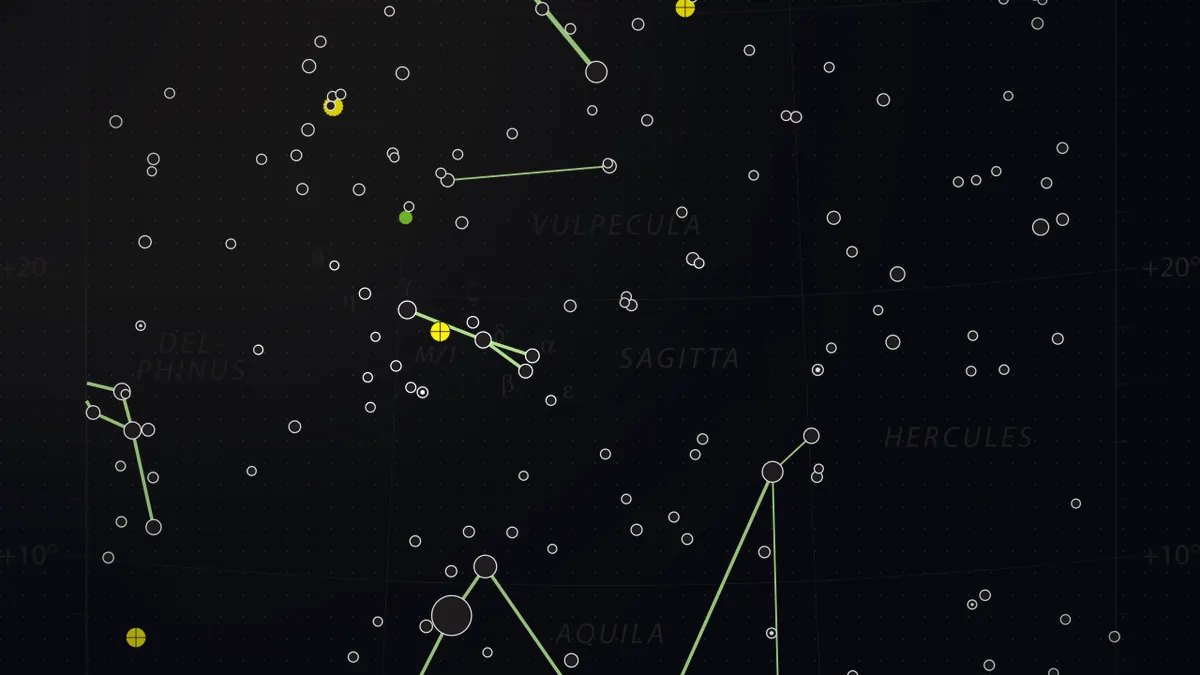
Sagitta sits inside the Summer Triangle, between Altair in Aquila and Albireo in Cygnus.
Find Altair, then look north — towards Cygnus — about a hand's width. You are looking for a small, distinct arrow shape: a short line of stars with a little V at one end.
Its stars are around magnitude 3.5 to 4.5, so you need a reasonably dark sky. But the shape is so specific that once you glimpse it, identification is instant. There is nothing else nearby that could be confused for an arrow.
In sky coordinates Sagitta sits at right ascension 18h 57m and declination +16.1°. Those two numbers work like a grid reference. Right ascension runs around the sky the way longitude runs around the Earth, and declination measures north and south the way latitude does. It sits in the northern half of the sky, riding high for northern observers and low for southern ones. You can see it from anywhere north of latitude 70°S, including the whole northern hemisphere, and it sits highest after dark in August.
What Sagitta actually looks like
An arrow, and unusually for the sky, a convincing one. Two stars form a short shaft, and two more at the western end splay slightly apart as the feathered flights.
It is tiny — the whole constellation spans only a few degrees — but the figure is complete and unambiguous. Among the 88 constellations, Sagitta is probably in the top three for how well the pattern matches the name.
It sits in the Milky Way, so the surrounding star field is rich, which makes the little arrow appear to be flying through a crowd of stars.
The stars of Sagitta
- Gamma Sagittae (magnitude 3.5) — the brightest star, a red giant at the arrow's tip.
- Delta Sagittae — the second brightest, a red giant with a hot companion, forming the shaft.
- Alpha Sagittae (Sham) and Beta Sagittae — the two stars of the flights. The name Sham comes from the Arabic for 'arrow'.
- WZ Sagittae — a recurrent nova that erupts roughly every 20 to 30 years, in 1913, 1946, 1978 and 2001. Between eruptions it is extremely faint; during them it jumps to around magnitude 7.
- V Sagittae — a peculiar binary that some astronomers predict will merge in the coming centuries, producing a nova bright enough to be one of the most conspicuous stars in the sky.
The story behind the name
Several arrows compete for the honour, and all of them belong to famous shots.
The most common identification is the arrow Hercules used to kill the eagle that tormented Prometheus, which fits, since Aquila the eagle is right beside it. In another version it is one of the arrows Hercules used against the Stymphalian Birds during his labours.
Alternatively it is the arrow of Eros, or the one Apollo used to kill the Cyclopes in revenge for the death of his son Asclepius.
The recurring theme is an arrow in flight between the eagle and the swan, which is exactly where the constellation sits. Whatever the story, the staging is good: a small arrow caught mid-flight between two large birds.
What else is hiding in Sagitta
Small constellation, but the Milky Way location helps.
- M71 — a loose globular cluster, and an object with an identity crisis. For decades astronomers argued about whether it was a very concentrated open cluster or a very loose globular; it is now classified as a globular. It is easy to find and pleasant in a small telescope, appearing as a granular patch that begins to resolve with aperture.
- Harvard 20 — a small, sparse open cluster nearby, a reasonable secondary target.
- The Milky Way background — sweeping the area with binoculars is worthwhile in its own right, since Sagitta sits in a dense star field.
For a constellation this small, having a Messier object at all is a respectable return.
When and where to see it
Best placed in the evening sky in September, through the northern summer.
It sits just north of the celestial equator and is visible from nearly everywhere on Earth.
You need a moderately dark sky, from a bright city the arrow disappears. From a decent suburb it emerges once your eyes adapt, and it is a genuinely charming little find. Because it sits inside the Summer Triangle, it is easy to return to: three bright stars frame it, and the arrow is always in the same place between Altair and Albireo.
Sagitta at a glance
| Name | Sagitta |
| Abbreviation | Sge |
| Genitive form | Sagittae |
| Meaning | the Arrow |
| Family | Hercules family |
| First recorded | ancient (Ptolemy) |
| Right ascension | 18h 57m |
| Declination | +16.1° |
| Area | 79 square degrees (86th largest of 88) |
| Main stars in the figure | 4 |
| Stars brighter than magnitude 3 | 0 |
| Named Bayer / Flamsteed stars | 19 |
| Brightest star | γ Sge (Telum) (magnitude 3.51) |
| Messier objects | 1 |
| Meteor showers | None |
| Visible from | Anywhere north of latitude 70°S, including the whole northern hemisphere |
| Best seen at 9 pm in | August |
| Bordering constellations | Aquila, Delphinus, Hercules, Vulpecula |
Where to go next
Its neighbours in the sky
Everything here shares a border with Sagitta. Find one and the rest are a short hop away: Aquila, Delphinus, Hercules, Vulpecula.
The rest of the Hercules family
Sagitta belongs to the Hercules family: the largest family — heroes, serpents and the far southern sky. The others are: Aquila, Ara, Centaurus, Corona Australis, Corvus, Crater, Crux, Cygnus, Hercules, Hydra, Lupus, Lyra, Ophiuchus, Scutum, Serpens, Sextans, Triangulum Australe, Vulpecula.
Start from the beginning
Not sure where to begin? The guide to all 88 constellations explains how the sky is divided, what a constellation really is, and links to each of the 88.
Star chart: Sagitta IAU chart by IAU and Sky & Telescope magazine (Roger Sinnott & Rick Fienberg), used under CC BY 3.0. Observing data cross-checked against Wikipedia's Sagitta entry.