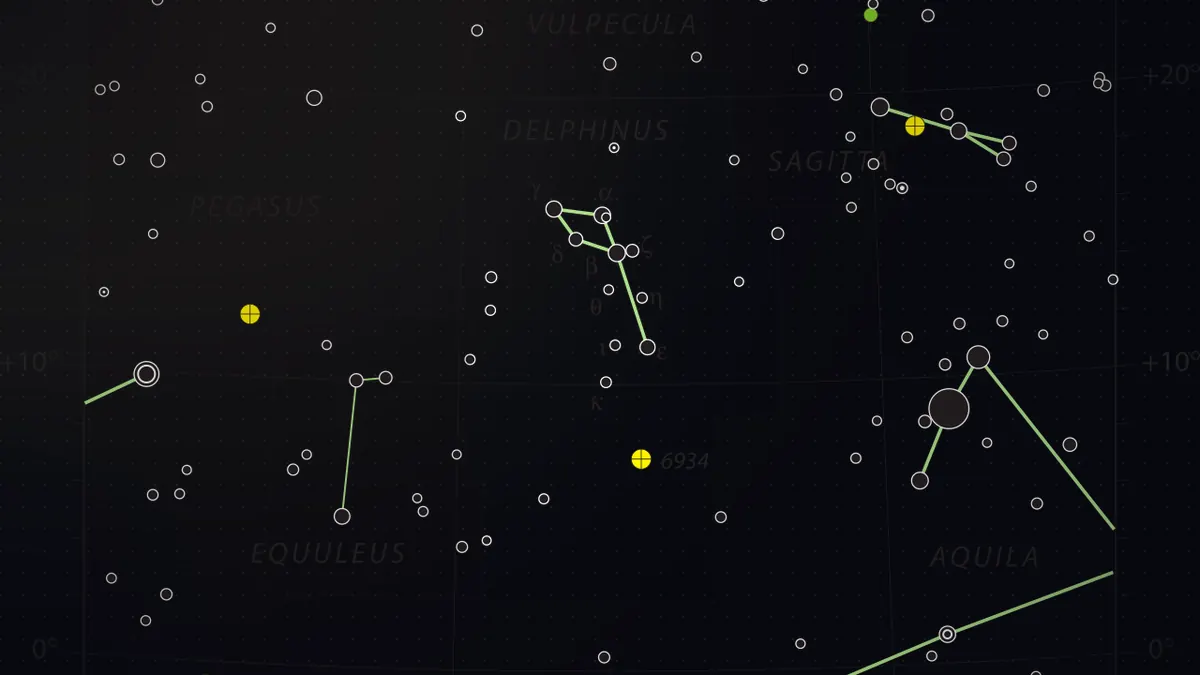
Delphinus is one of the sky's small delights. It is a compact diamond of four stars with a fifth trailing behind, and it really does look like a little dolphin leaping out of the water. For a constellation this small and this faint, that is a remarkable hit rate.
It also contains one of astronomy's better in-jokes. Two of its stars are named Sualocin and Rotanev, which meant nothing to anyone until somebody thought to spell them backwards.
Where to find Delphinus
Delphinus sits just east of the Summer Triangle, in the region below Cygnus and beside Aquila.
Find Altair in Aquila, the southern corner of the Summer Triangle, and move east about a hand's width. You are looking for a small, tight diamond of four faint stars with one more extending from a corner like a tail.
Its compactness is the giveaway. Nothing else nearby is that small and that neatly arranged, and once you have found it, the dolphin shape makes it instantly re-findable. It is sometimes called Job's Coffin for the diamond of four.
In sky coordinates Delphinus sits at right ascension 20h 14m and declination +2.4°. Right ascension is the sky's version of longitude and declination its version of latitude, so those two numbers pin the constellation to one spot on the celestial sphere the way a map reference pins a town. It straddles the celestial equator, which is the happy case: essentially everyone on Earth can see it. In practice that means you can find it from anywhere north of latitude 69°S, including the whole northern hemisphere; it rides highest in the evening sky in September.
What Delphinus actually looks like
A small diamond of four stars — the dolphin's body — with a fifth star extending from one corner as the tail. The whole thing spans only a few degrees.
It is genuinely one of the best figure-to-name matches in the sky. The diamond reads as an arched, leaping body and the tail star completes it. Unlike most constellations, you do not need to be told what to see.
Because it is small and distinctive, Delphinus is a good confidence builder for beginners. It is easy to be certain you have found it, which is not true of larger faint constellations.
The stars of Delphinus
- Sualocin (Alpha Delphini, magnitude 3.8) and Rotanev (Beta Delphini, magnitude 3.6) — the two brightest stars, and the source of the joke. The names appeared without explanation in the 1814 Palermo star catalogue and puzzled astronomers for decades. Spelled backwards they read Nicolaus Venator, the Latinised name of Niccolò Cacciatore, assistant to the catalogue's compiler Giuseppe Piazzi. He named two stars after himself and got away with it permanently: the names are still official.
- Gamma Delphini — a beautiful double star and the best telescopic target in the constellation, showing a clear gold-and-white or gold-and-green colour contrast in a small telescope.
- Rho Aquilae — a star that actually crossed the border from Aquila into Delphinus in 1992 due to its own proper motion, a rare case of a star changing constellations within living memory.
The story behind the name
Two Greek stories attach to the dolphin, and both are good.
In the first, Poseidon wanted to marry the sea nymph Amphitrite, who fled and hid. Poseidon sent messengers to find her, and a dolphin not only located her but persuaded her to accept the marriage. In gratitude Poseidon placed the dolphin among the stars.
In the second, the poet and musician Arion was sailing home with a fortune when the crew decided to rob and kill him. He asked to sing one last song, then threw himself overboard, and a dolphin, drawn by the music, carried him safely to shore. The sailors were later caught out when Arion turned up alive.
Both stories cast the dolphin as intelligent and benevolent, which matches how the Greeks generally regarded them, and gives Delphinus an unusually cheerful place in a sky full of punishments.
What else is hiding in Delphinus
Small constellation, no Messier objects, but a few worthwhile targets.
- Gamma Delphini — the standout. A wide, colourful double that splits easily in a small telescope. If you observe one thing in Delphinus, make it this.
- NGC 6934 — a compact globular cluster, faint but reachable in a medium telescope as a small fuzzy ball.
- NGC 7006 — a very distant globular cluster, around 135,000 light years away in the outer halo of the Milky Way. It looks like almost nothing, and the interest is entirely in its remoteness.
- Nova Delphini 2013 — a nova that erupted here in August 2013, reaching magnitude 4.3 and becoming briefly visible to the naked eye. It was discovered by a Japanese amateur astronomer, a good reminder that amateurs still find these things first.
When and where to see it
Best placed in the evening sky in September, through the northern summer and early autumn alongside the Summer Triangle.
It sits just north of the celestial equator, so it is visible from essentially everywhere on Earth: one of the more accessible small constellations.
The dolphin needs a moderately dark sky; from a bright city the fourth-magnitude stars wash out. From a decent suburb it appears readily once you know where to look. It is a lovely binocular object — the diamond and tail fit neatly in one field — and Gamma Delphini rewards a telescope. For its size, Delphinus offers more pleasure than it has any right to.
Delphinus at a glance
| Name | Delphinus |
| Abbreviation | Del |
| Genitive form | Delphini |
| Meaning | dolphin |
| Family | Heavenly Waters family |
| First recorded | ancient (Ptolemy) |
| Right ascension | 20h 14m |
| Declination | +2.4° |
| Area | 189 square degrees (69th largest of 88) |
| Main stars in the figure | 5 |
| Stars brighter than magnitude 3 | 0 |
| Named Bayer / Flamsteed stars | 19 |
| Brightest star | Rotanev (β Del) (magnitude 3.63) |
| Messier objects | None |
| Meteor showers | None |
| Visible from | Anywhere north of latitude 69°S, including the whole northern hemisphere |
| Best seen at 9 pm in | September |
| Bordering constellations | Aquarius, Aquila, Equuleus, Pegasus, Sagitta, Vulpecula |
Where to go next
Its neighbours in the sky
These constellations share a border with Delphinus, so once you have found it you already know where to look next: Aquarius, Aquila, Equuleus, Pegasus, Sagitta, Vulpecula.
The rest of the Heavenly Waters family
Delphinus belongs to the Heavenly Waters family: constellations tied to water, ships and the sea. The others are: Carina, Columba, Equuleus, Eridanus, Piscis Austrinus, Puppis, Pyxis, Vela.
Start from the beginning
If you are starting from scratch, the complete beginner's guide to the 88 constellations covers what a constellation actually is, how the sky is carved up, and links to every one of them.
Star chart: Delphinus IAU chart by IAU and Sky & Telescope magazine (Roger Sinnott & Rick Fienberg), used under CC BY 3.0. Observing data cross-checked against Wikipedia's Delphinus entry.