Aquarius is one of the oldest and largest constellations in the sky, and one of the hardest to actually see. It is big, sprawling and faint, with nothing brighter than magnitude 2.9.
It is worth the effort for one object above all: the Helix Nebula, the closest planetary nebula to Earth. Photographed, it looks unnervingly like a giant eye staring back, which has earned it the popular nickname the Eye of God. It is a preview of what will happen to our own Sun.
Where to find Aquarius
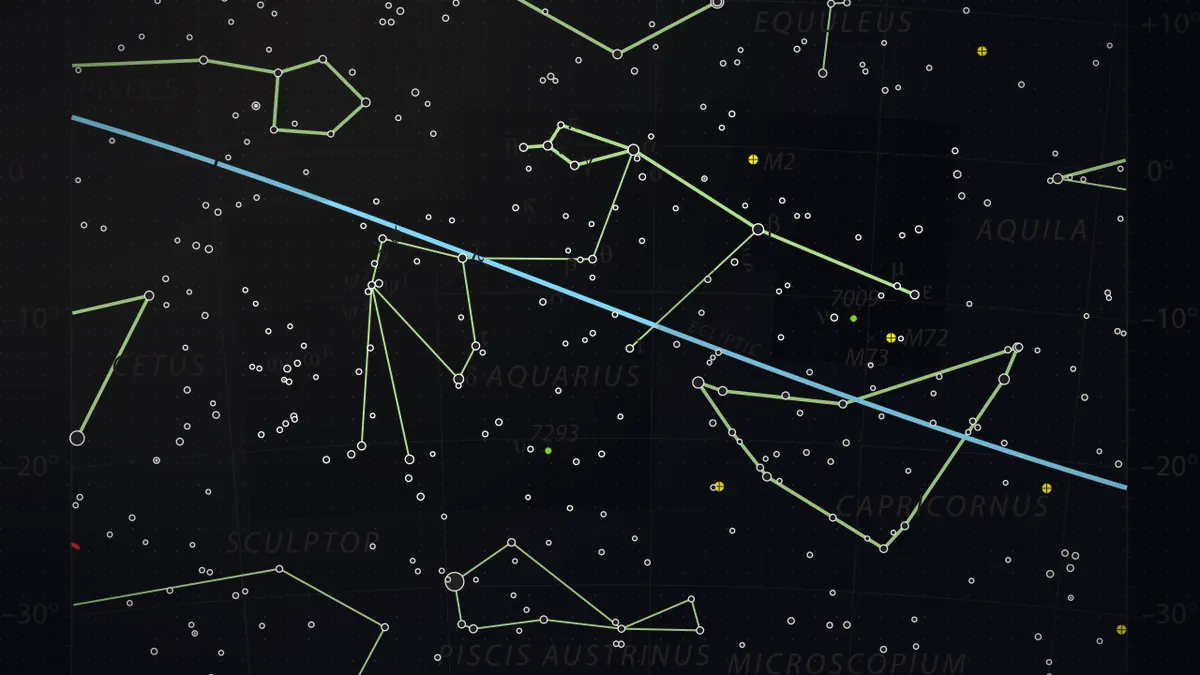
Aquarius sits in the watery region of sky south of Pegasus, between Capricornus and Pisces.
The most reliable approach is the Water Jar: a small, distinctive Y-shaped group of four stars near the constellation's centre, marking the jar the water bearer is pouring from. Find the Great Square of Pegasus, then look south and slightly west for that little Y.
Another good anchor is Fomalhaut, the bright solitary star well to the south in Piscis Austrinus. Aquarius's stream of water flows down towards it, and Fomalhaut is bright enough to find easily.
In sky coordinates Aquarius sits at right ascension 20h 38m and declination +3.3°. If the units look unfamiliar, the idea behind them is not: declination is the sky's latitude, right ascension is its longitude, and together they place the constellation exactly. It straddles the celestial equator, which is the happy case: essentially everyone on Earth can see it. In practice you can see it from between latitudes 65°N and 87°S, and it stands highest in the evening sky around October.
What Aquarius actually looks like
A large, loose scatter with two features worth knowing. The Water Jar is the compact Y near the middle. From it, a meandering line of faint stars runs south and east: the stream of water, ending near Fomalhaut.
The figure of a man pouring a jar is drawn on charts but is not realistic to trace. The jar itself, however, is a genuine and satisfying little asterism, and finding it is the practical goal.
This whole region (Aquarius, Capricornus, Pisces, Cetus, Eridanus) was known to the Babylonians as the Sea, a stretch of sky populated entirely by water-related figures. It may relate to the rainy season falling when the Sun was here.
The stars of Aquarius
- Sadalsuud (Beta Aquarii, magnitude 2.87) — the brightest star, a yellow supergiant. Its name means 'luckiest of the lucky', reflecting an association with the rains.
- Sadalmelik (Alpha Aquarii) — 'the lucky one of the king', another yellow supergiant, both of them enormously luminous but distant.
- Sadachbia (Gamma Aquarii) — part of the Water Jar.
- TRAPPIST-1 — a small red dwarf about 40 light years away hosting seven Earth-sized planets, several in the habitable zone. It is one of the most studied exoplanet systems in existence and a prime target for the James Webb Space Telescope. Far too faint to see, but it is in Aquarius.
The story behind the name
Aquarius is a water bearer pouring from a jar, most often identified as Ganymede, a Trojan prince so beautiful that Zeus, in the form of an eagle, carried him off to Olympus to serve as cup-bearer to the gods. The eagle is the neighbouring constellation Aquila.
The figure is much older than that. Babylonian astronomy placed a water-pouring god here, and in Egypt the constellation was associated with the annual flooding of the Nile: the water bearer was said to dip his jar into the river and cause it to rise.
The recurring theme across cultures is water arriving at a particular point in the year, which suggests these stars served as a seasonal marker for rains long before anyone told a story about a Trojan prince.
What else is hiding in Aquarius
- The Helix Nebula (NGC 7293) — the nearest planetary nebula to Earth at about 650 light years, and one of the largest in apparent size, roughly half the width of the full Moon. That size is also the problem: its light is spread so thin that it is easier in binoculars than in a telescope. It is a dying Sun-like star that has puffed off its outer layers, which is precisely what our own Sun will do in about five billion years.
- The Saturn Nebula (NGC 7009) — a small, bright planetary nebula with two side extensions that give it a passing resemblance to Saturn and its rings. Much easier than the Helix in a telescope.
- M2 — a fine, rich globular cluster, one of the more compact ones and a good target for small instruments.
- The Eta Aquariids — a strong May meteor shower produced by Halley's Comet, best from the southern hemisphere. The Delta Aquariids add a second, gentler shower in late July.
When and where to see it
Best placed in the evening sky in October, with autumn being the season for this whole watery region.
It straddles the celestial equator, so it is visible from everywhere on Earth, though southern observers get the Helix Nebula considerably higher.
Faintness is the challenge. From a city Aquarius is essentially invisible and the Helix is out of reach. Under a dark, moonless sky, use binoculars or a low-power wide-field eyepiece for the Helix and do not expect the Hubble picture: visually it is a large, soft, ghostly ring. Knowing you are looking at a star's death, and your own Sun's future, is what makes it worth finding.
Aquarius at a glance
| Name | Aquarius |
| Abbreviation | Aqr |
| Genitive form | Aquarii |
| Meaning | the Water-Bearer |
| Family | Zodiac family |
| First recorded | ancient (Ptolemy) |
| Right ascension | 20h 38m |
| Declination | +3.3° |
| Area | 980 square degrees (10th largest of 88) |
| Main stars in the figure | 10 |
| Stars brighter than magnitude 3 | 2 |
| Named Bayer / Flamsteed stars | 97 |
| Brightest star | β Aqr (Sadalsuud) (magnitude 2.87) |
| Messier objects | 3 |
| Meteor showers | March Aquariids, Eta Aquariids, Delta Aquariids, Iota Aquariids |
| Visible from | Between latitudes 65°N and 87°S |
| Best seen at 9 pm in | October |
| Bordering constellations | Aquila, Capricornus, Cetus, Delphinus, Equuleus, Pegasus, Pisces, Piscis Austrinus, Sculptor |
Where to go next
Its neighbours in the sky
Everything here shares a border with Aquarius. Find one and the rest are a short hop away: Aquila, Capricornus, Cetus, Delphinus, Equuleus, Pegasus, Pisces, Piscis Austrinus, Sculptor.
The rest of the Zodiac family
Aquarius belongs to the Zodiac family: the twelve constellations the Sun, Moon and planets travel through. The others are: Aries, Cancer, Capricornus, Gemini, Leo, Libra, Pisces, Sagittarius, Scorpius, Taurus, Virgo.
Start from the beginning
If you are starting from scratch, the complete beginner's guide to the 88 constellations covers what a constellation actually is, how the sky is carved up, and links to every one of them.
Star chart: Aquarius IAU chart by IAU and Sky & Telescope magazine (Roger Sinnott & Rick Fienberg), used under CC BY 3.0. Observing data cross-checked against Wikipedia's Aquarius entry.