Libra is the odd one out in the zodiac: the only sign that is not an animal or a person, but an object, a set of scales.
That is because Libra is a relatively late arrival. For most of ancient history these stars were the claws of Scorpius next door, and the two brightest still carry the names Zubenelgenubi and Zubeneschamali: Arabic for 'the southern claw' and 'the northern claw'. The scorpion lost its pincers to a pair of scales, and the star names never got the memo.
Where to find Libra
Libra sits between Virgo and Scorpius, and the easiest approach is from the scorpion.
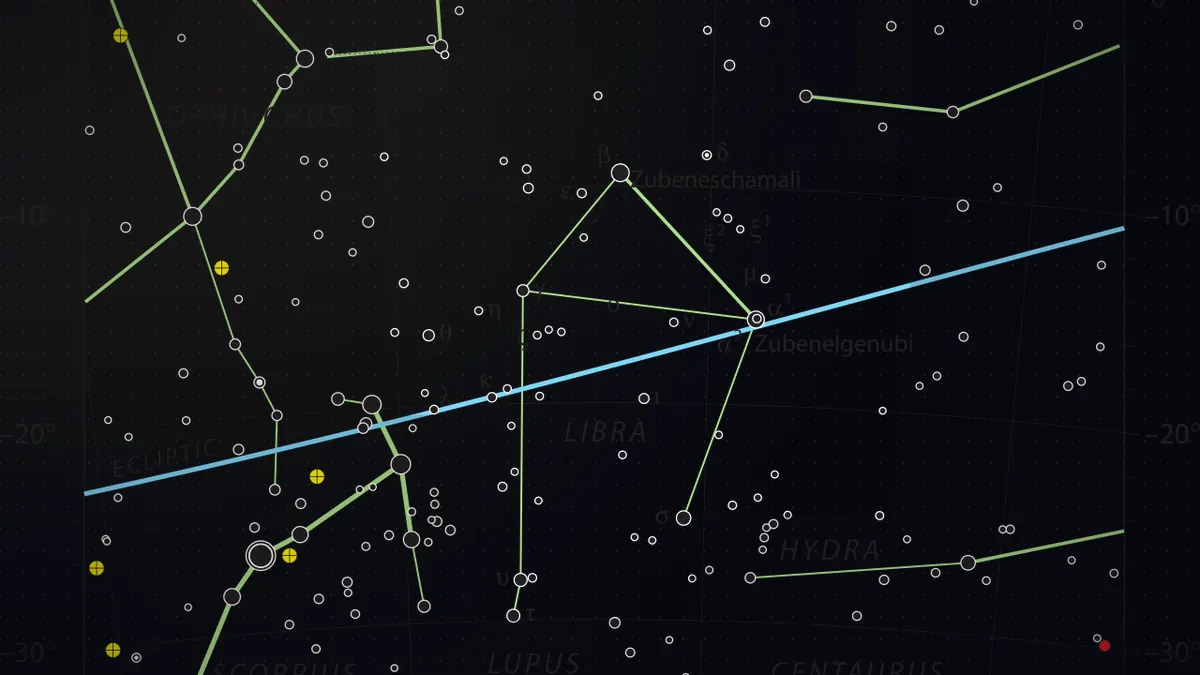
Find bright red Antares in Scorpius, then look west: the direction the scorpion's head faces. The next reasonably bright pair of stars you reach, forming a wide, shallow quadrilateral with two fainter ones, is Libra.
Alternatively, continue past Spica in Virgo heading east and south. Libra is not bright — nothing tops magnitude 2.6 — so give your eyes time. Its position between two much more recognisable constellations is the most reliable identifier.
In sky coordinates Libra sits at right ascension 15h 00m and declination −15.0°. Declination is latitude by another name and right ascension is longitude, so the pair fixes the constellation at one point on the celestial sphere. It sits in the southern half of the sky, high for southern observers and low on the horizon for northern ones. You can see it from anywhere south of latitude 65°N, including the whole southern hemisphere, and it sits highest after dark in June.
What Libra actually looks like
A lopsided quadrilateral, sometimes described as a crooked box or a kite. Four stars mark the corners, with the two brightest at the top representing the beam of the balance and two fainter ones below suggesting the hanging pans.
Once you know it is meant to be scales, the shape does work: the two bright stars really do sit like the ends of a balance beam. It is more convincing than most.
The older reading is equally visible: those two stars as the outstretched claws of a scorpion reaching west, with Antares as its heart. Both pictures fit the same stars.
The stars of Libra
- Zubeneschamali (Beta Librae, magnitude 2.6) — the brightest star here, and the subject of a genuine astronomical curiosity: it is the only star widely reported as looking green. Stars should not appear green to the eye for straightforward physical reasons, and most observers see it as white or blue-white. Whether the green is real, an optical effect, or suggestion, remains an open and enjoyable argument.
- Zubenelgenubi (Alpha Librae) — a wide double star that sharp eyes can split without any optics, and binoculars separate easily. A good test object.
- Brachium (Sigma Librae) — a red giant, once counted as part of Scorpius.
- Gliese 581 — a nearby red dwarf whose planetary system was one of the earliest to raise serious discussion of potentially habitable worlds beyond the Solar System.
The story behind the name
Libra's history is a takeover. To the Greeks these stars were Chelae Scorpionis, the scorpion's claws. The Romans separated them out and made them a balance, partly because the autumn equinox fell here: the moment when day and night are in balance.
The scales were also associated with Astraea, the goddess of justice who became neighbouring Virgo. She weighs human deeds; the imagery of justice holding scales runs from Egyptian judgement-of-the-dead scenes through to the statue on top of the Old Bailey.
Precession has since moved the equinox out of Libra and into Virgo, so the balance no longer marks the balance point. As with Aries, the name is a fossil of where the sky used to be.
What else is hiding in Libra
Libra is a quiet constellation with no Messier objects and modest deep-sky offerings.
- NGC 5897 — a large, loose globular cluster. It is unusually sparse for a globular, so it looks more like a rich open cluster in the eyepiece. The constellation's best telescope target.
- Gliese 581 — not much to see, but worth knowing where to point. The system attracted enormous attention in the 2000s and 2010s as candidate habitable-zone planets were proposed, debated and in some cases withdrawn. It is a good illustration of how exoplanet science actually proceeds.
- Zubenelgenubi — the realistic naked-eye project. Try to split the pair unaided, then confirm with binoculars.
Libra is a constellation you visit for its history rather than its contents, and that is a perfectly good reason.
When and where to see it
Best placed in the evening sky in June, with a season through the northern spring and summer.
It lies south of the celestial equator, so southern observers get it higher and clearer, but it is comfortably visible from most northern latitudes too: it rides low in the south on summer evenings.
Because nothing here is brighter than magnitude 2.6, light pollution hurts. From a city Libra is easy to lose entirely between its brighter neighbours. From a decent suburban sky the quadrilateral appears readily enough once you know where to look, and splitting Zubenelgenubi with the naked eye is a satisfying way to test your vision.
Libra at a glance
| Name | Libra |
| Abbreviation | Lib |
| Genitive form | Librae |
| Meaning | the balance |
| Family | Zodiac family |
| First recorded | ancient (Ptolemy) |
| Right ascension | 15h 00m |
| Declination | −15.0° |
| Area | 538 square degrees (29th largest of 88) |
| Main stars in the figure | 4 |
| Stars brighter than magnitude 3 | 2 |
| Named Bayer / Flamsteed stars | 56 |
| Brightest star | β Lib (magnitude 2.61) |
| Messier objects | None |
| Meteor showers | May Librids |
| Visible from | Anywhere south of latitude 65°N, including the whole southern hemisphere |
| Best seen at 9 pm in | June |
| Bordering constellations | Centaurus, Hydra, Lupus, Ophiuchus, Scorpius, Serpens, Virgo |
Where to go next
Its neighbours in the sky
These constellations share a border with Libra, so once you have found it you already know where to look next: Centaurus, Hydra, Lupus, Ophiuchus, Scorpius, Serpens, Virgo.
The rest of the Zodiac family
Libra belongs to the Zodiac family: the twelve constellations the Sun, Moon and planets travel through. The others are: Aquarius, Aries, Cancer, Capricornus, Gemini, Leo, Pisces, Sagittarius, Scorpius, Taurus, Virgo.
Start from the beginning
New to all this? The 88 constellations: a complete beginner's guide explains what a constellation actually is, how the sky is divided up, and lists all 88 with a link to each one.
Star chart: Libra IAU chart by IAU and Sky & Telescope magazine (Roger Sinnott & Rick Fienberg), used under CC BY 3.0. Observing data cross-checked against Wikipedia's Libra entry.