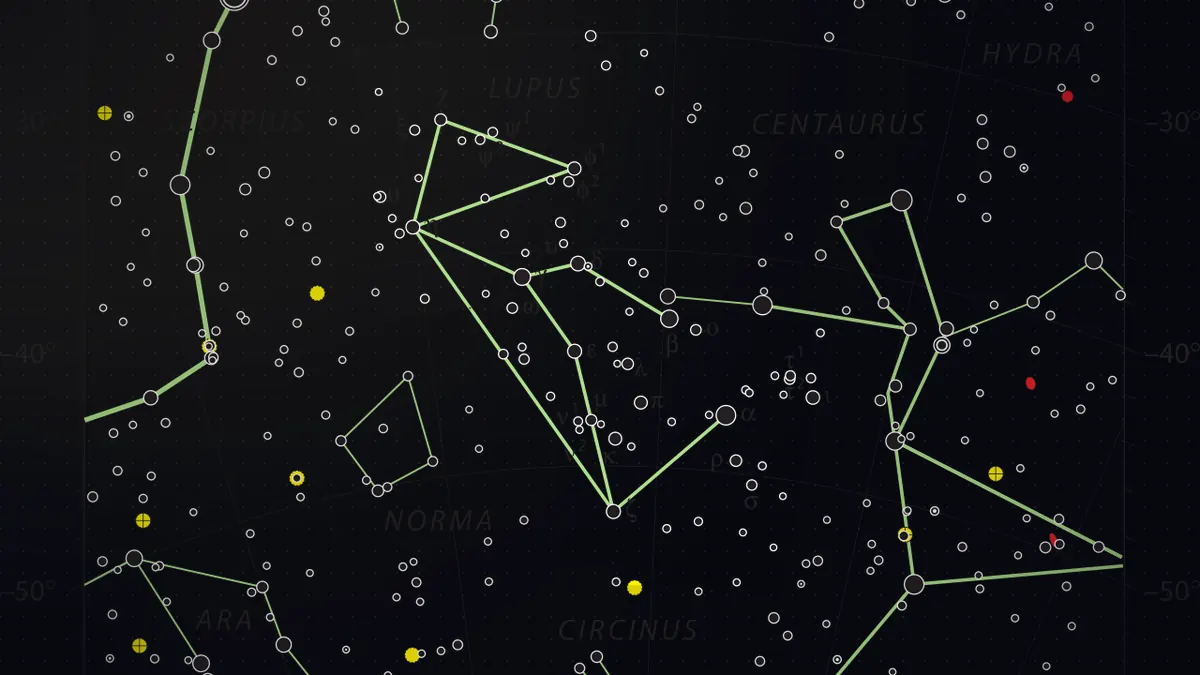
Lupus is a moderately bright southern constellation squeezed between Centaurus and Scorpius, in a rich stretch of the Milky Way. It gets overlooked because its neighbours are so spectacular.
It has one enormous claim to fame. In the year 1006, a star exploded here and became the brightest stellar event in recorded human history: bright enough to read by, bright enough to cast shadows, and recorded by observers in China, Japan, Egypt, Iraq and Europe.
Where to find Lupus
Lupus lies directly east of Centaurus and west of Scorpius. From the southern hemisphere it is comfortably placed on autumn and winter evenings.
Use the Pointers. Find Alpha and Beta Centauri, then move east and north. Alternatively, find red Antares in Scorpius and move west.
You are looking for a moderately bright, somewhat scattered group of stars with no single dominant member: nothing here is brighter than magnitude 2.3. Under a dark sky it is easy enough; from a city it disappears between its brighter neighbours.
In sky coordinates Lupus sits at right ascension 15h 18m and declination −45.0°. Those two numbers work like a grid reference. Right ascension runs around the sky the way longitude runs around the Earth, and declination measures north and south the way latitude does. It is a far-southern constellation, so southern observers own it and much of the northern hemisphere never sees it at all. In practice that means you can find it from anywhere south of latitude 35°N, including the whole southern hemisphere; it rides highest in the evening sky in June.
What Lupus actually looks like
A loose, roughly triangular scatter of second and third magnitude stars. There is no compelling figure, and drawing a wolf out of it requires generosity.
In antiquity these stars were not a wolf at all. They were seen as an unspecified wild animal, often a beast being carried on a spear by the neighbouring centaur, as an offering. The Greek word was simply Therion, 'the beast'. Only later, in Latin translations, did it become specifically a wolf.
The connection to Centaurus is still visible in the geometry: Lupus sits right where the centaur's outstretched arms would hold something.
The stars of Lupus
- Alpha Lupi (magnitude 2.3) — the brightest star, a blue giant and a Beta Cephei variable, pulsating slightly. It is a member of the Scorpius-Centaurus association, the nearest group of massive young stars to the Sun.
- Beta Lupi — another blue giant of the same association.
- Gamma Lupi — a close binary, a challenging split.
- Mu Lupi — a fine multiple star for small telescopes.
Most of Lupus's bright stars belong to the Scorpius-Centaurus association, a loose group of hot young stars a few hundred light years away that formed together. That shared origin is why this stretch of sky has so many similar blue-white stars at similar distances.
The story behind the name
The constellation began as a generic wild beast rather than a wolf. Greek sources call it Therion, an animal held by the centaur, and Babylonian records also show an animal figure here. The Romans made it Lupus, the wolf, and the name stuck.
The interpretation is usually that the centaur Chiron is carrying the beast to sacrifice on the Ara, the altar, which is the constellation immediately to the south. Three constellations (centaur, beast and altar) form one continuous scene of sacrifice, which is a genuinely coherent piece of celestial staging.
SN 1006 gave Lupus a different kind of significance. Contemporary accounts across three continents describe a new star of extraordinary brightness; the Egyptian astronomer Ali ibn Ridwan wrote that it was between a quarter and a third the brightness of the Moon. Modern estimates put it at magnitude −7.5, making it the brightest supernova in recorded history.
What else is hiding in Lupus
Sitting in the Milky Way, Lupus is richer than its reputation.
- SN 1006 remnant — the expanding shell of that historic explosion, about 7,200 light years away. It is a strong radio and X-ray source, and extremely faint optically: a photographic target rather than a visual one, but a remarkable thing to have a location for.
- NGC 5822 — a large, rich open cluster, one of the better binocular targets in this part of the sky.
- NGC 5986 — a decent globular cluster, resolvable in a medium telescope.
- The Dark Wolf Nebula — a striking dark nebula silhouetted against the Milky Way, popular with astrophotographers.
There are no Messier objects here, simply because Messier observed from Paris and Lupus never rose high enough for him to see it properly.
When and where to see it
Best placed in the evening sky in June, through the southern autumn and winter.
Lupus is a southern constellation reaching to about 35°N, so it is visible low from southern Europe and the southern United States, but southern observers get it far higher and clearer.
It needs a reasonably dark sky, since it has no standout bright star to anchor it. NGC 5822 is the easiest worthwhile target. And it is worth pausing to think about SN 1006, for a few weeks a thousand years ago, people on three continents looked at this patch of sky and saw something brighter than any star has been since.
Lupus at a glance
| Name | Lupus |
| Abbreviation | Lup |
| Genitive form | Lupi |
| Meaning | The Wolf |
| Family | Hercules family |
| First recorded | ancient (Ptolemy) |
| Right ascension | 15h 18m |
| Declination | −45.0° |
| Area | 334 square degrees (46th largest of 88) |
| Main stars in the figure | 9 |
| Stars brighter than magnitude 3 | 3 |
| Named Bayer / Flamsteed stars | 41 |
| Brightest star | α Lup (Uridim) (magnitude 2.30) |
| Messier objects | None |
| Meteor showers | Theta Centaurids |
| (border) | |
| Visible from | Anywhere south of latitude 35°N, including the whole southern hemisphere |
| Best seen at 9 pm in | June |
| Bordering constellations | Centaurus, Circinus, Hydra, Libra, Norma, Scorpius |
Where to go next
Its neighbours in the sky
Everything here shares a border with Lupus. Find one and the rest are a short hop away: Centaurus, Circinus, Hydra, Libra, Norma, Scorpius.
The rest of the Hercules family
Lupus belongs to the Hercules family: the largest family — heroes, serpents and the far southern sky. The others are: Aquila, Ara, Centaurus, Corona Australis, Corvus, Crater, Crux, Cygnus, Hercules, Hydra, Lyra, Ophiuchus, Sagitta, Scutum, Serpens, Sextans, Triangulum Australe, Vulpecula.
Start from the beginning
Not sure where to begin? The guide to all 88 constellations explains how the sky is divided, what a constellation really is, and links to each of the 88.
Star chart: Lupus IAU chart by IAU and Sky & Telescope magazine (Roger Sinnott & Rick Fienberg), used under CC BY 3.0. Observing data cross-checked against Wikipedia's Lupus entry.