Johannes Hevelius named this constellation Lynx in the 1680s with a joke attached: he said you would need the eyes of a lynx to see it. Three and a half centuries later, that remains the single most accurate thing anyone has said about it.
Lynx fills a large, dim gap between Ursa Major, Auriga and Gemini. Its brightest star is magnitude 3.1 and the rest fall away sharply. It is the twenty-eighth largest constellation in the sky and one of the least noticed.
Where to find Lynx
Look for the region between Capella in Auriga, the twins of Gemini, and the front of the Big Dipper's bowl. Lynx occupies that long, faint stretch.
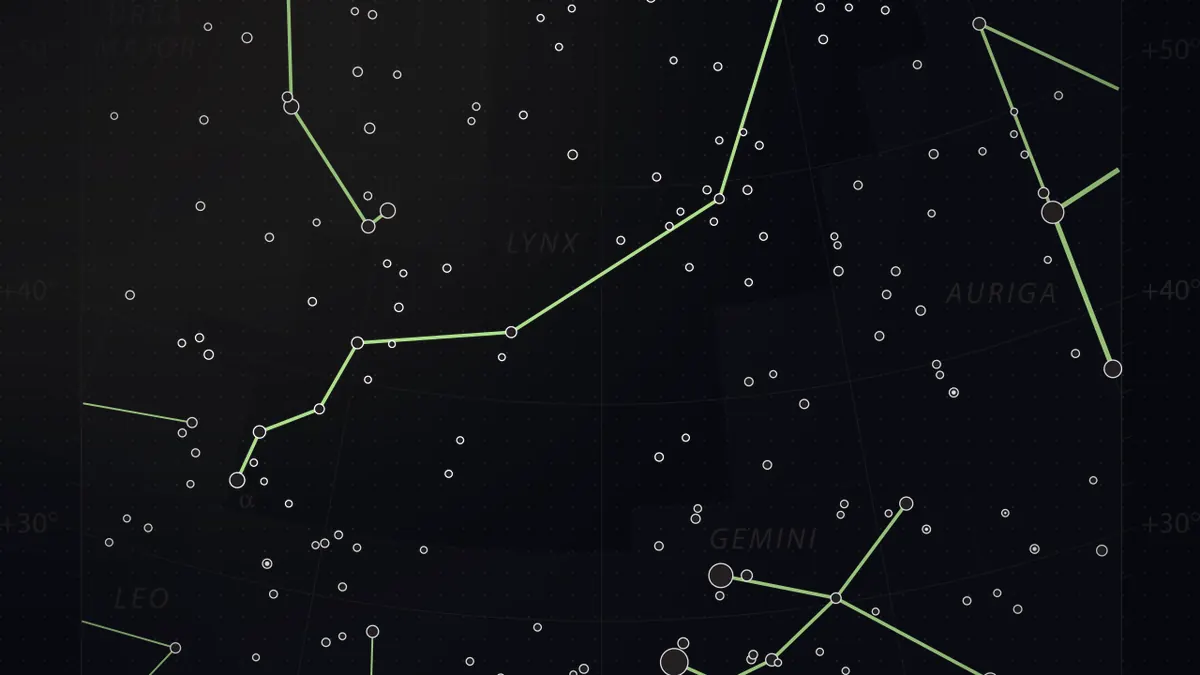
What you are hunting for is a zigzag line of faint stars running roughly north-east to south-west. Alpha Lyncis, the brightest, sits at the southern end nearest Leo. Under a good sky the zigzag is traceable; under a mediocre one you will see two or three stars and lose the thread.
Give your eyes a full twenty minutes to dark-adapt before deciding the constellation is not there. With Lynx, it usually is. You just are not ready to see it yet.
In sky coordinates Lynx sits at right ascension 8h 00m and declination +45.0°. If the units look unfamiliar, the idea behind them is not: declination is the sky's latitude, right ascension is its longitude, and together they place the constellation exactly. It sits in the northern half of the sky, riding high for northern observers and low for southern ones. You can see it from anywhere north of latitude 55°S, including the whole northern hemisphere, and it sits highest after dark in February.
What Lynx actually looks like
A zigzag. That is genuinely the whole figure: a broken line of four main stars kinking back and forth across a long stretch of sky, with no enclosed shape and no obvious animal.
Hevelius drew a lynx, but he was filling space rather than recording a tradition. There is no ancient asterism here because there was nothing bright enough for anyone to bother naming. Of all 88 constellations, Lynx is probably the one where the gap between the drawn figure and the observable reality is widest.
The stars of Lynx
- Alpha Lyncis (magnitude 3.14) — an orange giant and the only star here that most people will ever see. It is the constellation's sole star with a Bayer letter, which tells you something about how little there was to label.
- 38 Lyncis — a fine close double star, and a rewarding target for a small telescope.
- Y Lyncis — a semiregular variable red giant, popular with amateur observers who track brightness changes over months.
- 6 Lyncis and HD 75898 — both host exoplanets found by the Doppler method; XO-2, XO-4, XO-5 and WASP-13 host planets caught by the transit method. Six planetary systems in a constellation most people cannot find is a nice piece of trivia.
The story behind the name
Like Camelopardalis and Canes Venatici, Lynx has no classical myth. Johannes Hevelius created it in his 1687 star catalogue to fill the gap between Ursa Major and Auriga.
His naming was deliberately wry. Hevelius was an exceptional naked-eye observer (famously he refused to use telescopic sights for position measurements, trusting his own vision instead), and calling the constellation Lynx was a nod to how sharp your eyesight had to be to make out the stars he had just catalogued. Some accounts add that the lynx's reputation for keen sight made the choice doubly apt.
It is one of the few constellation names that is essentially a comment on the observer rather than a story about the sky.
What else is hiding in Lynx
Faint constellation, genuinely interesting contents.
- NGC 2419, the Intergalactic Wanderer — a globular cluster about 300,000 light years away, far beyond most of the Milky Way's globulars and further from us than the Magellanic Clouds. It was long thought to be escaping the galaxy entirely, hence the name; it is now believed to be bound, but on an enormous orbit. It looks like a faint fuzzy spot, and the interest is entirely in knowing what you are looking at.
- NGC 2770, the Supernova Factory — a spiral galaxy that has produced three Type Ib supernovae in recent decades, an unusual rate.
- APM 08279+5255 — an extremely distant quasar whose light is bent and split into multiple images by the gravity of an intervening galaxy. A textbook gravitational lens.
- The Lynx Arc — a gravitationally lensed region of intense star formation seen as it was billions of years ago.
When and where to see it
Best placed in the evening sky in February, and reasonably available through the northern winter and spring.
It reaches to about 55°S, so it is not exclusively northern, but it is high and comfortable only from northern latitudes.
This is the constellation where honesty about light pollution matters most. From a suburb you will see Alpha Lyncis and nothing else, and there is no technique that fixes that. From a dark site with a telescope, NGC 2419 is a genuinely satisfying target precisely because it is unimpressive to look at and extraordinary to think about.
Lynx at a glance
| Name | Lynx |
| Abbreviation | Lyn |
| Genitive form | Lyncis |
| Meaning | the Lynx |
| Family | Ursa Major family |
| First recorded | 1690, Hevelius |
| Right ascension | 8h 00m |
| Declination | +45.0° |
| Area | 545 square degrees (28th largest of 88) |
| Main stars in the figure | 4 |
| Stars brighter than magnitude 3 | 0 |
| Named Bayer / Flamsteed stars | 42 |
| Brightest star | α Lyn (magnitude 3.14) |
| Messier objects | None |
| Meteor showers | Alpha Lyncids, September Lyncids |
| Visible from | Anywhere north of latitude 55°S, including the whole northern hemisphere |
| Best seen at 9 pm in | February |
| Bordering constellations | Auriga, Camelopardalis, Cancer, Gemini, Leo, Leo Minor, Ursa Major |
Where to go next
Its neighbours in the sky
These constellations share a border with Lynx, so once you have found it you already know where to look next: Auriga, Camelopardalis, Cancer, Gemini, Leo, Leo Minor, Ursa Major.
The rest of the Ursa Major family
Lynx belongs to the Ursa Major family: the circumpolar northern group anchored by the Big Dipper. The others are: Boötes, Camelopardalis, Canes Venatici, Coma Berenices, Corona Borealis, Draco, Leo Minor, Ursa Major, Ursa Minor.
Start from the beginning
If you are starting from scratch, the complete beginner's guide to the 88 constellations covers what a constellation actually is, how the sky is carved up, and links to every one of them.
Star chart: Lynx IAU chart by IAU and Sky & Telescope magazine (Roger Sinnott & Rick Fienberg), used under CC BY 3.0. Observing data cross-checked against Wikipedia's Lynx entry.