Coma Berenices is the only modern constellation named after a real historical person: Queen Berenice II of Egypt, who cut off her hair as an offering to the gods.
It is also one of the more unusual sights in the sky. Rather than a pattern of bright stars, the constellation's defining feature is a loose, shimmering scatter of faint stars that genuinely does look like strands of hair spread across the dark. And behind that scatter lies one of the richest galaxy fields anywhere: eight Messier objects, more than almost any constellation of its size.
Where to find Coma Berenices
Look for the triangle of sky between Leo, Boötes and the tail of Ursa Major. Coma Berenices fills that gap.
The trick is not to hunt for bright stars, because there are none above magnitude 4.2. Instead, let your eyes relax and look for a faint hazy patch, roughly the size of your fist at arm's length. Under a dark sky it resolves into dozens of individual stars. That is the Coma Star Cluster: one of the nearest open clusters to us, and one of the few genuinely visible without optics.
If you can see it, your sky is dark enough for galaxy hunting.
In sky coordinates Coma Berenices sits at right ascension 11h 58m and declination +33.3°. Those two numbers work like a grid reference. Right ascension runs around the sky the way longitude runs around the Earth, and declination measures north and south the way latitude does. It sits in the northern half of the sky, riding high for northern observers and low for southern ones. You can see it from anywhere north of latitude 70°S, including the whole northern hemisphere, and it sits highest after dark in May.
What Coma Berenices actually looks like
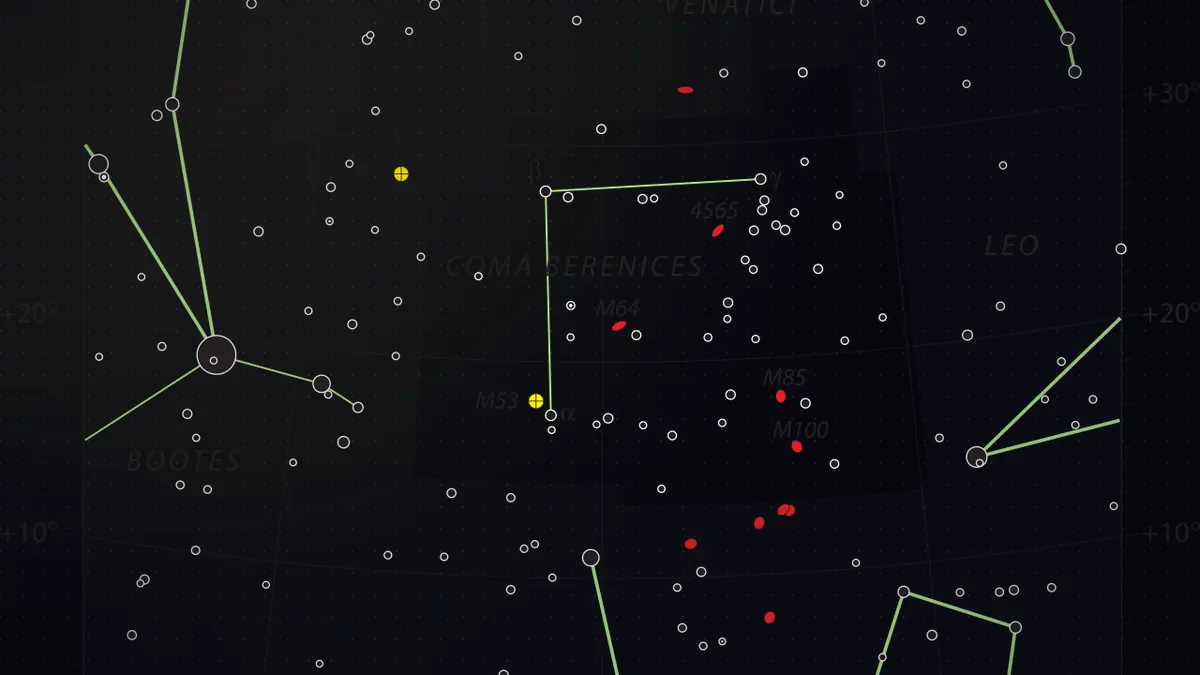
Three stars (Alpha, Beta and Gamma Comae Berenices) form a wide, faint right angle, like a half-drawn square. Along the diagonal of that shape runs the Coma Star Cluster, and it is that spray of stars, rather than the corner points, that the constellation is really about.
This is the rare case where the figure and the object are the same thing. You are not being asked to imagine hair from a few bright dots; you are looking at an actual diffuse scatter that behaves visually like loose strands. Of all 88 constellations, it may be the one whose name best matches what you actually see.
The stars of Coma Berenices
- Beta Comae Berenices (magnitude 4.26) — the brightest star here, and a close solar analogue: a yellow main-sequence star about 30 light years away, slightly hotter and younger than the Sun. If you want to see roughly what our Sun looks like from interstellar distance, this is it.
- Alpha Comae Berenices (Diadem) — a binary whose two nearly identical stars orbit almost exactly edge-on to us, which means they may eclipse each other, though the events are extremely hard to catch.
- Gamma Comae Berenices — an orange giant sitting at the edge of the Coma Star Cluster.
There is nothing here brighter than magnitude 4, which is the whole character of the constellation: it is faint, wide and diffuse, and it rewards dark skies rather than good eyesight.
The story behind the name
Berenice II, queen of Egypt in the third century BC, vowed to sacrifice her long hair if her husband Ptolemy III returned safely from war. He did, and she cut it off and placed it in a temple. The hair then vanished.
With the king furious and the priests in danger, the court astronomer Conon of Samos produced a diplomatic masterpiece of an explanation: the gods had been so pleased with the offering that they had placed it in the sky, and he pointed to the faint spray of stars between Leo and Boötes. Everyone survived, and the name stuck for over two thousand years.
Before that the stars were considered part of Leo: the tuft at the end of the lion's tail. Gerardus Mercator and Tycho Brahe later formalised Coma Berenices as a constellation in its own right.
What else is hiding in Coma Berenices
Coma Berenices looks directly out of our galaxy towards the Virgo Cluster, and part of the Coma Cluster lies here too. The result is an extraordinary density of galaxies.
- M64, the Black Eye Galaxy — a spiral with a dramatic dark band of dust across its bright nucleus. Its inner and outer regions rotate in opposite directions, evidence of a merger with another galaxy.
- M53 — a rich globular cluster, and a rewarding target in a small telescope.
- M85, M88, M91, M98, M99, M100 — a run of galaxies belonging to the Virgo Cluster. On a dark night you can sweep the field and drift from one to the next, which is an experience worth having at least once.
- The Coma Cluster — over a thousand galaxies about 320 million light years away. It was here in the 1930s that Fritz Zwicky noticed the galaxies were moving too fast for the visible mass, producing the first real evidence for dark matter.
When and where to see it
Best in the evening sky in May, with spring being the season for this whole region of galaxies.
It is visible from both hemispheres — down to about 70°S — so almost everyone can reach it, though northern observers get it higher.
Everything about this constellation depends on sky darkness. From a suburb you will not see the Coma Star Cluster at all, and the galaxies are hopeless. From a genuinely dark site, the cluster is a naked-eye pleasure and the galaxy field is one of the best sweeping targets in the sky. Use binoculars for the star cluster — a telescope magnifies too much — and a telescope for the galaxies.
Coma Berenices at a glance
| Name | Coma Berenices |
| Abbreviation | Com |
| Genitive form | Comae Berenices |
| Meaning | Berenice's hair |
| Family | Ursa Major family |
| First recorded | ancient (Ptolemy); 1536, Caspar Vopel, split from Leo |
| Right ascension | 11h 58m |
| Declination | +33.3° |
| Area | 386 square degrees (42nd largest of 88) |
| Main stars in the figure | 3 |
| Stars brighter than magnitude 3 | 0 |
| Named Bayer / Flamsteed stars | 44 |
| Brightest star | β Com (magnitude 4.26) |
| Messier objects | 8 |
| Meteor showers | Coma Berenicids |
| Visible from | Anywhere north of latitude 70°S, including the whole northern hemisphere |
| Best seen at 9 pm in | May |
| Bordering constellations | Boötes, Canes Venatici, Leo, Ursa Major, Virgo |
Where to go next
Its neighbours in the sky
Coma Berenices borders all of these, which makes them the natural next targets once you can pick it out: Boötes, Canes Venatici, Leo, Ursa Major, Virgo.
The rest of the Ursa Major family
Coma Berenices belongs to the Ursa Major family: the circumpolar northern group anchored by the Big Dipper. The others are: Boötes, Camelopardalis, Canes Venatici, Corona Borealis, Draco, Leo Minor, Lynx, Ursa Major, Ursa Minor.
Start from the beginning
Not sure where to begin? The guide to all 88 constellations explains how the sky is divided, what a constellation really is, and links to each of the 88.
Star chart: Coma Berenices IAU chart by IAU and Sky & Telescope magazine (Roger Sinnott & Rick Fienberg), used under CC BY 3.0. Observing data cross-checked against Wikipedia's Coma Berenices entry.