Virgo is the largest constellation of the zodiac and the second largest in the entire sky. It is also, by a wide margin, the richest hunting ground for galaxies that amateur astronomers have.
The Virgo Cluster — a swarm of well over a thousand galaxies about 54 million light years away — sits mostly within its borders. One of its members, M87, became the most famous galaxy in the world in 2019 when the Event Horizon Telescope produced the first direct image of a black hole.
Where to find Virgo
Finish the star-hop you started at the Big Dipper. Arc from the Dipper's handle to Arcturus in Boötes, then carry straight on: spike to Spica. That brilliant blue-white star is Virgo's anchor.
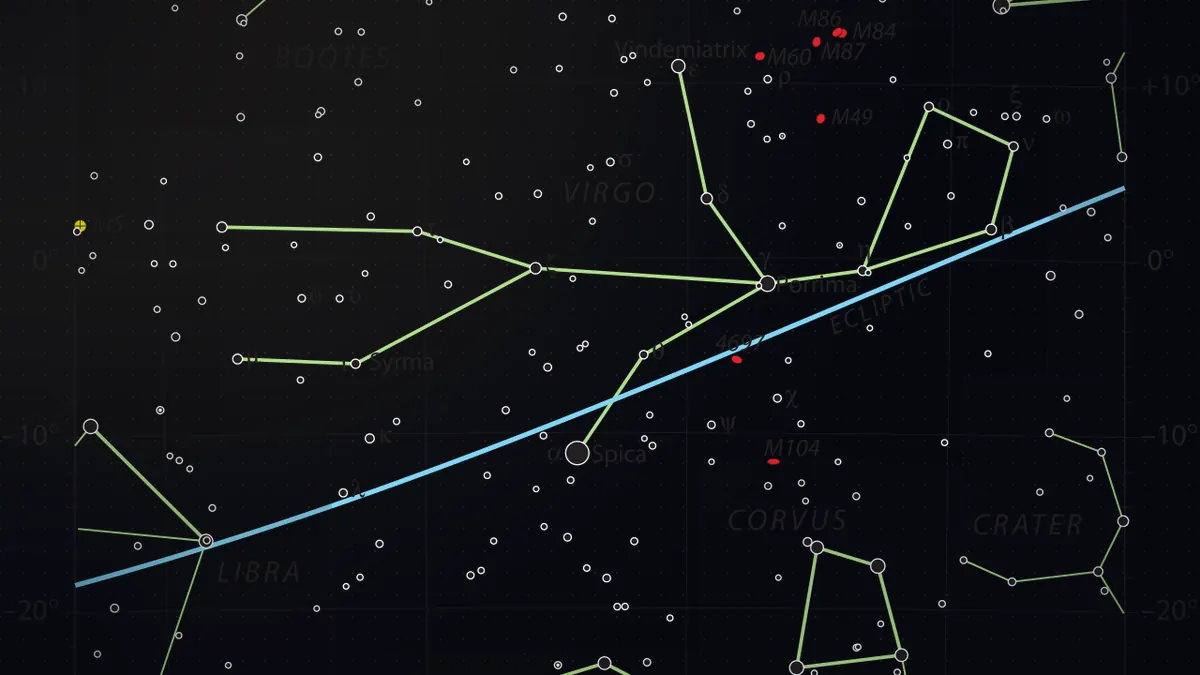
From Spica the constellation spreads out to the north and west as a large, sprawling and much fainter Y-shape. It covers an enormous area of sky, so do not expect a compact figure.
For the galaxies, work in the region between Denebola in Leo and Vindemiatrix in Virgo. That patch is the heart of the Virgo Cluster, and sweeping it slowly with a telescope on a dark night is a genuinely memorable experience.
In sky coordinates Virgo sits at right ascension 13h 00m and declination −4.0°. If the units look unfamiliar, the idea behind them is not: declination is the sky's latitude, right ascension is its longitude, and together they place the constellation exactly. It straddles the celestial equator, which is the happy case: essentially everyone on Earth can see it. In practice that means you can find it from between latitudes 68°N and 77°S; it rides highest in the evening sky in May.
What Virgo actually looks like
A large, lopsided Y. Spica sits at the bottom as the ear of wheat the maiden holds, with the arms of the Y opening upwards to form her body and outstretched arms.
Being honest: apart from Spica, Virgo is faint and diffuse, and its sheer size works against it. Tracing the maiden takes a dark sky and some determination. Most people learn to find Spica and treat the rest as a region rather than a picture.
The name Spica means 'ear of grain', and Virgo has been associated with harvest goddesses across many cultures: the constellation was in the evening sky at harvest time in the ancient Mediterranean.
The stars of Virgo
- Spica (Alpha Virginis, magnitude 1.0) — the sixteenth brightest star in the sky and one of the hottest you can easily see, with a distinctly blue-white colour. It is actually a very close binary: two stars orbiting each other in just four days, so near that their mutual gravity distorts both into eggs.
- Porrima (Gamma Virginis) — a beautiful binary of two near-identical yellow-white stars. Their separation changes visibly over decades as they orbit, so how easy it is to split depends on when you look.
- Vindemiatrix (Epsilon Virginis) — 'the grape gatherer', so named because its dawn rising marked the start of the grape harvest.
- 70 Virginis — one of the earliest stars found to host an exoplanet, back in 1996.
The story behind the name
Virgo is a harvest goddess, and which one depends on the tradition: Demeter, goddess of the grain harvest; her daughter Persephone, whose annual descent into the underworld explains winter; or Astraea, goddess of justice, who fled the corrupt world of humans and became the constellation next to Libra's scales.
The link to agriculture is not decorative. It is functional. Virgo's appearance in the sky corresponded to the harvest season in the Mediterranean, and Spica's 'ear of wheat' name preserves that. Egyptian, Babylonian and Greek traditions all attach a female harvest figure to these stars.
Spica has a further claim to fame. Around 130 BC, Hipparchus compared Spica's measured position with older Babylonian records, found a discrepancy, and from it deduced the precession of the equinoxes: one of the most important discoveries in ancient science.
What else is hiding in Virgo
Eleven Messier objects, nearly all galaxies.
- M87 — a colossal elliptical galaxy at the centre of the Virgo Cluster, containing trillions of stars and a supermassive black hole of about 6.5 billion solar masses. In April 2019 the Event Horizon Telescope released the first direct image of a black hole's shadow, and it was this one. In an amateur telescope M87 is an unremarkable fuzzy ball, but you are looking at the most famous black hole in history.
- M104, the Sombrero Galaxy — an edge-on spiral with a huge central bulge and a knife-sharp dust lane across it. One of the most striking galaxies visible in a modest telescope, and easily recognisable.
- Markarian's Chain — a curving line of galaxies through the cluster's heart that appear to be physically moving together. Sweeping along it gives you galaxy after galaxy in the same eyepiece.
- 3C 273 — the first quasar ever identified, and the optically brightest known. At around magnitude 13 it is reachable with a large amateur telescope: light from 2.4 billion years ago.
When and where to see it
Best placed in the evening sky in May, and the whole spring galaxy season belongs to Virgo and its neighbours.
It straddles the celestial equator, so it is visible from everywhere on Earth, which is fortunate given how much it contains.
Spica is easy from anywhere, including cities. The galaxies are the opposite: they need genuinely dark skies, and moonlight alone is enough to wipe them out. Plan around the new Moon. A wide-field eyepiece beats high magnification: the pleasure of the Virgo Cluster is drifting from one galaxy to the next and realising how many there are.
Virgo at a glance
| Name | Virgo |
| Abbreviation | Vir |
| Genitive form | Virginis |
| Meaning | the Maiden |
| Family | Zodiac family |
| First recorded | ancient (Ptolemy) |
| Right ascension | 13h 00m |
| Declination | −4.0° |
| Area | 1294 square degrees (2nd largest of 88) |
| Main stars in the figure | 9 |
| Stars brighter than magnitude 3 | 3 |
| Named Bayer / Flamsteed stars | 96 |
| Brightest star | Spica (α Vir) (magnitude 0.98) |
| Messier objects | 11 |
| Meteor showers | Virginids, Mu Virginids |
| Visible from | Between latitudes 68°N and 77°S |
| Best seen at 9 pm in | May |
| Bordering constellations | Boötes, Coma Berenices, Corvus, Crater, Hydra, Leo, Libra, Serpens |
Where to go next
Its neighbours in the sky
Everything here shares a border with Virgo. Find one and the rest are a short hop away: Boötes, Coma Berenices, Corvus, Crater, Hydra, Leo, Libra, Serpens.
The rest of the Zodiac family
Virgo belongs to the Zodiac family: the twelve constellations the Sun, Moon and planets travel through. The others are: Aquarius, Aries, Cancer, Capricornus, Gemini, Leo, Libra, Pisces, Sagittarius, Scorpius, Taurus.
Start from the beginning
Not sure where to begin? The guide to all 88 constellations explains how the sky is divided, what a constellation really is, and links to each of the 88.
Star chart: Virgo IAU chart by IAU and Sky & Telescope magazine (Roger Sinnott & Rick Fienberg), used under CC BY 3.0. Observing data cross-checked against Wikipedia's Virgo entry.