Corvus is a small constellation with a surprisingly clear shape: four stars forming a distinct, slightly skewed quadrilateral, sometimes called Spica's Spanker because it sits beside Spica in Virgo.
It is the crow of Apollo, placed in the sky as punishment for lying. And just off one corner sits one of the most photographed objects in the sky: the Antennae Galaxies, two spirals caught mid-collision, flinging out enormous streamers of stars.
Where to find Corvus
Use Spica in Virgo, which is easy to find by arcing from the Big Dipper's handle to Arcturus and spiking onward to Spica.
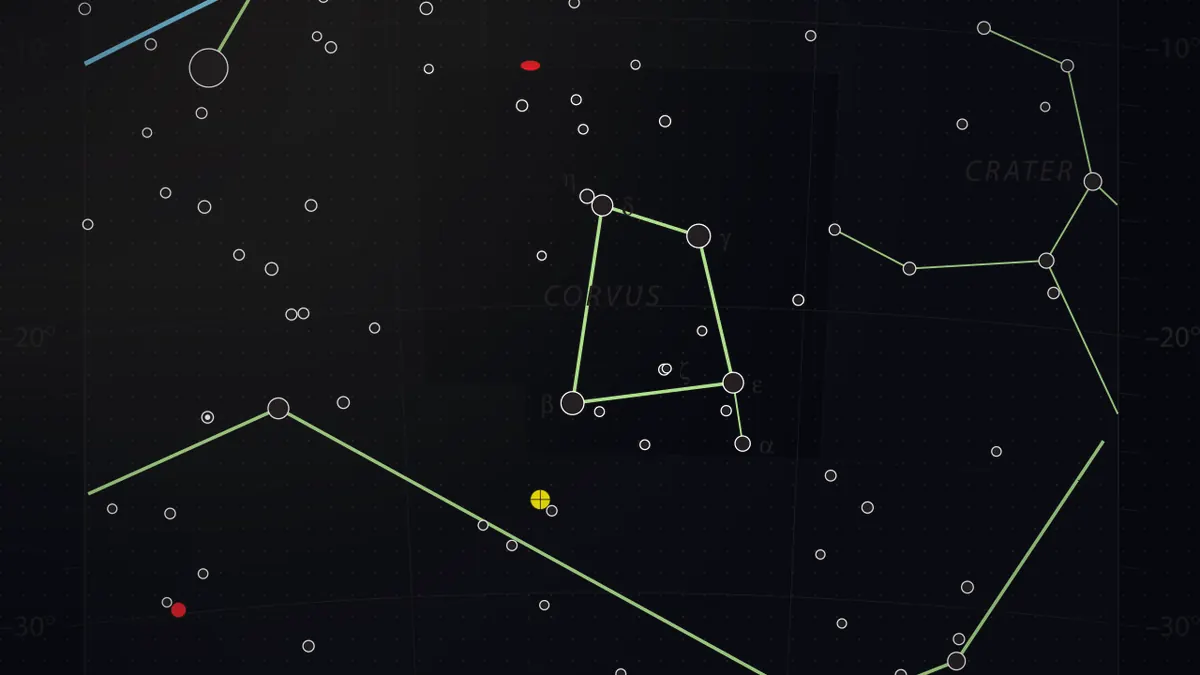
From Spica, look south-west a short distance. The compact, clearly defined quadrilateral of four stars you find there is Corvus. Its stars are around magnitude 2.6 to 3, bright enough to see from a suburb, and the shape is tidy enough that identification is immediate.
It sits on the back of Hydra, the long water snake, and it is far easier to see than the section of Hydra beneath it.
In sky coordinates Corvus sits at right ascension 12h 00m and declination −20.0°. Declination is latitude by another name and right ascension is longitude, so the pair fixes the constellation at one point on the celestial sphere. It sits in the southern half of the sky, high for southern observers and low on the horizon for northern ones. You can see it from anywhere south of latitude 60°N, including the whole southern hemisphere, and it sits highest after dark in May.
What Corvus actually looks like
A quadrilateral — four stars forming a slightly lopsided box or sail. There is no attempt at a bird visible in the pattern, but the box is clear, compact and easy to remember.
Some observers call it the Sail, which fits the shape better than the crow does. The nickname Spica's Spanker plays on the same idea, a spanker being a type of sail.
It is one of those small constellations that punches above its weight simply by being unambiguous: unlike sprawling faint neighbours such as Hydra and Virgo, you can be certain you have found Corvus.
The stars of Corvus
- Gienah (Gamma Corvi, magnitude 2.6) — the brightest star, a blue giant. The name means 'the wing'.
- Kraz (Beta Corvi) — a yellow-white giant, second brightest.
- Algorab (Delta Corvi) — a double star, splittable in a small telescope, with a noticeable colour difference between the components. The name means 'the crow'.
- Alchiba (Alpha Corvi) — despite the Alpha designation, one of the fainter stars of the figure, which is a common quirk in constellations where Bayer's letters were assigned loosely.
Nothing here is exceptional individually, but the four together make a genuinely useful signpost in an otherwise sparse region of spring sky.
The story behind the name
Apollo sent the crow to fetch water in a cup. The bird found a fig tree with unripe fruit and waited several days for the figs to ripen instead of doing its job.
Returning late, it grabbed a water snake in its claws and blamed the snake for blocking the spring. Apollo saw through the lie immediately and placed all three in the sky: the crow (Corvus), the cup (Crater) and the snake (Hydra) — arranging them so that the snake forever keeps the thirsty crow from reaching the cup.
You can still see the punishment. Corvus and Crater sit side by side on Hydra's back, and the cup is always just out of the crow's reach. Apollo also turned the crow's feathers from white to black, which is the Greek explanation for why crows are the colour they are.
What else is hiding in Corvus
Corvus looks out of the galactic plane and has no Messier objects, but it contains one genuinely famous target.
-
The Antennae Galaxies (NGC 4038 and NGC 4039) — two spiral galaxies in the middle of a collision that began a few hundred million years ago. The gravitational interaction has flung out two enormous curved streamers of stars and gas, which look like an insect's antennae and give the pair their name. The collision has triggered a burst of star formation, creating thousands of new clusters.
In a modest telescope you see two faint merged patches; the antennae themselves need photography or serious aperture. It is one of the best-studied galaxy mergers and a preview of what will happen when the Milky Way meets Andromeda.
-
NGC 4361 — a planetary nebula near the centre of the quadrilateral, reachable in a medium telescope.
When and where to see it
Best placed in the evening sky in May, through the spring.
Corvus sits south of the celestial equator but is comfortably visible from both hemispheres, reaching well into northern skies. Southern observers get it higher.
The quadrilateral survives suburban light and is a useful marker in a region where Hydra and Virgo are both hard to trace. The Antennae need dark skies and patience, but they are worth finding once, because knowing you are looking at two galaxies tearing each other apart changes how the faint smudge feels.
Corvus at a glance
| Name | Corvus |
| Abbreviation | Crv |
| Genitive form | Corvi |
| Meaning | the Crow/Raven |
| Family | Hercules family |
| First recorded | ancient (Ptolemy) |
| Right ascension | 12h 00m |
| Declination | −20.0° |
| Area | 184 square degrees (70th largest of 88) |
| Main stars in the figure | 4 |
| Stars brighter than magnitude 3 | 3 |
| Named Bayer / Flamsteed stars | 10 |
| Brightest star | γ Crv (Gienah) (magnitude 2.59) |
| Messier objects | None |
| Meteor showers | Corvids, Eta Corvids |
| Visible from | Anywhere south of latitude 60°N, including the whole southern hemisphere |
| Best seen at 9 pm in | May |
| Bordering constellations | Crater, Hydra, Virgo |
Where to go next
Its neighbours in the sky
Everything here shares a border with Corvus. Find one and the rest are a short hop away: Crater, Hydra, Virgo.
The rest of the Hercules family
Corvus belongs to the Hercules family: the largest family — heroes, serpents and the far southern sky. The others are: Aquila, Ara, Centaurus, Corona Australis, Crater, Crux, Cygnus, Hercules, Hydra, Lupus, Lyra, Ophiuchus, Sagitta, Scutum, Serpens, Sextans, Triangulum Australe, Vulpecula.
Start from the beginning
Not sure where to begin? The guide to all 88 constellations explains how the sky is divided, what a constellation really is, and links to each of the 88.
Star chart: Corvus IAU chart by IAU and Sky & Telescope magazine (Roger Sinnott & Rick Fienberg), used under CC BY 3.0. Observing data cross-checked against Wikipedia's Corvus entry.