Ophiuchus is the constellation that periodically makes headlines as the thirteenth zodiac sign. The stories are usually breathless and slightly confused, but the underlying fact is real: the Sun does pass through Ophiuchus every year, from roughly 29 November to 17 December, spending more time here than in Scorpius.
It is a large constellation — eleventh biggest — holding the serpent of Serpens, and it contains Barnard's Star, which moves across the sky faster than any other.
Where to find Ophiuchus
Ophiuchus sits above Scorpius and below Hercules, filling a large area of the summer sky.
Find red Antares in Scorpius, then look north. The large, somewhat faint region above it is Ophiuchus. Its brightest star, Rasalhague, sits at the northern end, near the head of Hercules: the two 'head' stars Rasalhague and Rasalgethi are close together and named as a pair.
The shape to look for is a large, elongated coffin or house outline. It is big, so do not expect to take it in at a glance.
In sky coordinates Ophiuchus sits at right ascension 17h 00m and declination −8.0°. Right ascension is the sky's version of longitude and declination its version of latitude, so those two numbers pin the constellation to one spot on the celestial sphere the way a map reference pins a town. It straddles the celestial equator, which is the happy case: essentially everyone on Earth can see it. You can see it from between latitudes 60°N and 75°S, and it sits highest after dark in July.
What Ophiuchus actually looks like
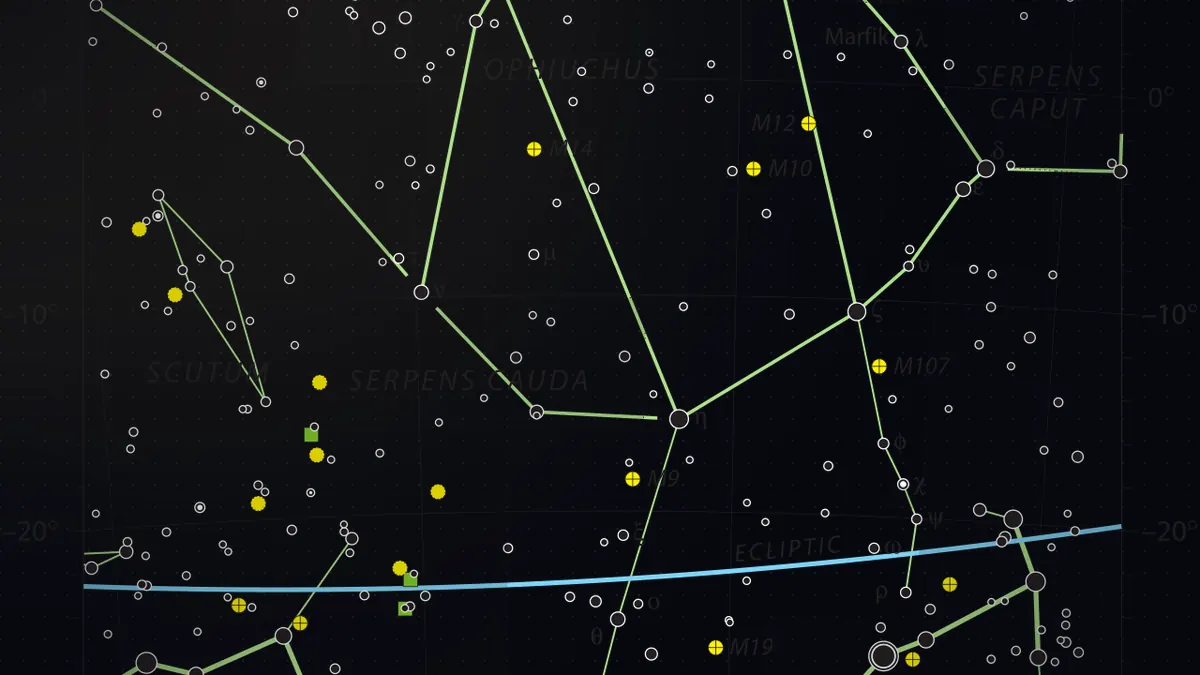
A large, roughly hexagonal shape, often described as a coffin or a wide house with a pointed roof. Rasalhague marks the head at the top, and the body spreads out below towards Scorpius.
The figure is a man gripping a huge snake, with the head of the serpent (Serpens Caput) to his west and the tail (Serpens Cauda) to his east. The man and the snake were treated as a single figure by Ptolemy, and the modern split into two constellations is a bookkeeping decision rather than a change of story.
Its southern portion dips into the Milky Way, which is where the constellation's deep-sky riches are concentrated.
The stars of Ophiuchus
- Rasalhague (Alpha Ophiuchi, magnitude 2.1) — the brightest star, a white star about 48 light years away that spins fast enough to be noticeably flattened. Its name means 'the head of the serpent charmer'.
- Sabik (Eta Ophiuchi) — a binary, second brightest.
- Barnard's Star — the star with the largest proper motion of any known: it moves about ten seconds of arc per year, crossing the width of the full Moon in roughly 180 years. It is a red dwarf just six light years away, the fourth-closest star system to the Sun, and although far too faint for the naked eye it is famous among astronomers.
- Kepler's Supernova (SN 1604) — the last supernova observed in our own galaxy with the naked eye. It appeared in October 1604, was brighter than any star, and was studied carefully by Johannes Kepler. Along with Tycho's star of 1572, it helped dismantle the idea of an unchanging heaven.
The story behind the name
Ophiuchus is Asclepius, son of Apollo and the greatest physician of Greek myth. He learned to raise the dead after observing one snake use herbs to revive another, and his skill became a problem: Hades objected that nobody was dying any more.
Zeus killed him with a thunderbolt to preserve the natural order, then placed him among the stars in recognition of his greatness. The serpent stayed with him.
About the 'thirteenth sign': astrology uses twelve equal 30-degree divisions of the ecliptic that were fixed around 2,000 years ago and no longer match the actual constellations, which are unequal in size and have shifted due to precession. Ophiuchus was never left out as a conspiracy: it simply was not part of a scheme that divides the sky into twelve equal slices regardless of what is actually there.
What else is hiding in Ophiuchus
The southern part of Ophiuchus reaches into the Milky Way and is thick with globular clusters: seven Messier objects, most of them globulars.
- M10 and M12 — a fine pair of globular clusters only a few degrees apart, both good in a small telescope and easy to compare in one session.
- M9, M14, M19, M62, M107 — the rest of the Messier globulars here, varying in concentration and all worth a look.
- The Rho Ophiuchi Cloud Complex — one of the most colourful regions in the sky, a swirl of emission, reflection and dark nebulae near Antares. It is among the most photographed areas in astrophotography and is close enough to be studied in detail as a stellar nursery.
- Barnard's Star — worth photographing a year apart if you have the setup. Seeing a star visibly shift position against its background is one of the few amateur projects that reveals stellar motion directly.
When and where to see it
Best placed in the evening sky in July, through the northern summer.
It straddles the celestial equator, so it is visible from everywhere on Earth, with southern observers getting the rich southern globulars higher.
The main figure is large and moderately faint, so it needs a reasonably dark sky to trace. The globular clusters are more forgiving: M10 and M12 are reachable from a suburb with a small telescope. If you are working through the Messier list, Ophiuchus and neighbouring Sagittarius will occupy several good summer nights between them.
Ophiuchus at a glance
| Name | Ophiuchus |
| Abbreviation | Oph |
| Genitive form | Ophiuchi |
| Meaning | the serpent-bearer |
| Family | Hercules family |
| First recorded | ancient (Ptolemy) |
| Right ascension | 17h 00m |
| Declination | −8.0° |
| Area | 948 square degrees (11th largest of 88) |
| Main stars in the figure | 10 |
| Stars brighter than magnitude 3 | 5 |
| Named Bayer / Flamsteed stars | 65 |
| Brightest star | α Oph (Rasalhague) (magnitude 2.08) |
| Messier objects | 7 |
| Meteor showers | None |
| Visible from | Between latitudes 60°N and 75°S |
| Best seen at 9 pm in | July |
| Bordering constellations | Aquila, Hercules, Libra, Sagittarius, Scorpius, Serpens |
Where to go next
Its neighbours in the sky
These constellations share a border with Ophiuchus, so once you have found it you already know where to look next: Aquila, Hercules, Libra, Sagittarius, Scorpius, Serpens.
The rest of the Hercules family
Ophiuchus belongs to the Hercules family: the largest family — heroes, serpents and the far southern sky. The others are: Aquila, Ara, Centaurus, Corona Australis, Corvus, Crater, Crux, Cygnus, Hercules, Hydra, Lupus, Lyra, Sagitta, Scutum, Serpens, Sextans, Triangulum Australe, Vulpecula.
Start from the beginning
If you are starting from scratch, the complete beginner's guide to the 88 constellations covers what a constellation actually is, how the sky is carved up, and links to every one of them.
Star chart: Ophiuchus IAU chart by IAU and Sky & Telescope magazine (Roger Sinnott & Rick Fienberg), used under CC BY 3.0. Observing data cross-checked against Wikipedia's Ophiuchus entry.