If you only ever learn one constellation, make it this one. Orion is the single best starting point in the entire sky: three bright stars in a perfectly straight row, framed by four more that mark the corners of a giant. Once you have seen it you cannot un-see it, and from that one pattern you can find half the winter sky.
It is also genuinely spectacular. Orion holds two of the ten brightest stars in the night sky, a nebula where new stars are being born right now, and the radiant of a meteor shower fed by debris from Halley's Comet. Beginners love it because it is obvious. Astronomers love it because there is so much going on inside it.
Where to find Orion
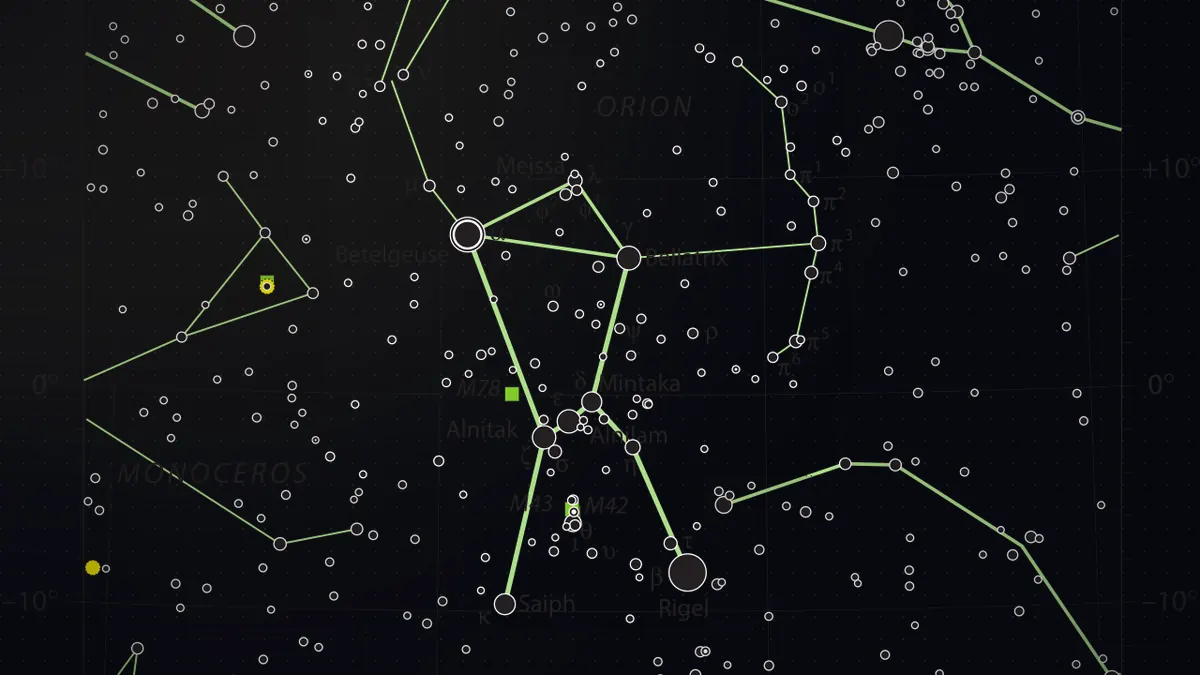
Face south on a winter evening if you are in the northern hemisphere, or north on a summer evening if you are in the southern one, and look for three bright stars in a short, straight, evenly-spaced line. Nothing else in the sky looks like that. Those three are Orion's Belt, and they are your anchor.
From the Belt, everything else falls into place:
- Up and left (from the northern hemisphere) is a distinctly orange star — that is Betelgeuse, Orion's shoulder.
- Down and right is a brilliant blue-white star — Rigel, his foot.
- Follow the Belt down-left and you run straight into Sirius, the brightest star in the whole night sky.
- Follow the Belt up-right and you reach the orange eye of Taurus, the star Aldebaran.
That last trick is why Orion matters so much: it is a signpost. Southern hemisphere observers see the whole figure upside down, and the Belt with the sword hanging above it is often called the Saucepan or the Pot.
In sky coordinates Orion sits at right ascension 5h 00m and declination +5.0°. If the units look unfamiliar, the idea behind them is not: declination is the sky's latitude, right ascension is its longitude, and together they place the constellation exactly. It straddles the celestial equator, which is the happy case: essentially everyone on Earth can see it. Practically speaking it is visible from between latitudes 80°N and 68°S, with the best evening views around January.
What Orion actually looks like
Orion is drawn as a hunter facing you, and unusually for a constellation, the figure genuinely looks like the thing it is named after.
Four stars mark the corners of his body: Betelgeuse and Bellatrix for the shoulders, Rigel and Saiph for the knees or feet. Across the middle, the three Belt stars (Alnitak, Alnilam and Mintaka) form the waist. A faint little triangle above the shoulders marks the head, centred on the star Meissa.
Hanging down from the Belt is a shorter, fainter line of three: Orion's Sword. Look at the middle 'star' of the sword and it will not look quite sharp. It is not a star at all. It is a nebula, and it is the reason Orion is worth coming back to with binoculars.
The stars of Orion
- Rigel (Beta Orionis, magnitude 0.12) — technically the brightest star here, despite carrying the Beta label. A blue supergiant roughly 860 light years away and tens of thousands of times more luminous than the Sun.
- Betelgeuse (Alpha Orionis) — a red supergiant so large that if you dropped it where the Sun is, it would swallow the orbit of Jupiter. It visibly varies in brightness, and in 2019–2020 it dimmed so dramatically that astronomers wondered publicly whether it was about to explode. It was dust, not death, but it will go supernova eventually.
- Alnitak, Alnilam and Mintaka — the Belt. All three are hot, massive blue stars, and all three are far more distant and far more luminous than they look.
- Bellatrix and Saiph — the remaining corners, both blue-white giants that would be headline stars in any less crowded constellation.
Orion contains eight stars brighter than magnitude 3, which is more than almost any other constellation. That density is exactly why it stands out even from a light-polluted city.
The story behind the name
In Greek myth Orion was a giant hunter: boastful, gifted, and ultimately undone by it. The most-repeated version has him claiming he could kill every animal on Earth, at which point the goddess Gaia sent a scorpion to deal with him. Both were placed in the sky, and they were placed carefully: Orion and Scorpius sit on opposite sides of the celestial sphere, so as one rises the other sets. The hunter is still running from the scorpion.
He is far older than the Greeks, though. The Babylonians knew the same stars as a shepherd figure connected to the god Anu. In ancient Egypt the pattern was linked to Osiris, god of the afterlife. And the story travels well beyond Europe: to some Aboriginal Australian groups the Belt and Sword are a canoe or a group of hunters, and across South Asia the grouping is read as a deer or an arrow. Different cultures, the same three stars, which tells you how hard they are to miss.
What else is hiding in Orion
This is where Orion stops being a beginner's constellation and starts being a lifelong one.
- The Orion Nebula (M42) — the middle 'star' of the Sword. It is a vast cloud of gas and dust about 1,300 light years away where stars are actively forming. It is visible to the unaided eye as a fuzzy patch, resolves into a glowing cloud in binoculars, and shows structure in even a small telescope. It is comfortably the finest nebula in the sky for beginners.
- M43 — a smaller nebula tucked against M42, separated from it by a dark lane of dust.
- M78 — a reflection nebula north of the Belt, fainter, and a good next target once M42 feels easy.
- The Horsehead Nebula — the famous dark silhouette near Alnitak. Be warned: it photographs beautifully and is genuinely difficult to see visually. It needs dark skies and usually a filter.
- The Orionids — a meteor shower peaking around 21 October, made of debris shed by Halley's Comet. Expect roughly 20 meteors an hour under good conditions.
When and where to see it
Orion is a winter constellation for the northern hemisphere and a summer one for the southern. It is highest in the evening sky in January, and realistically visible from about November through to March.
Because it straddles the celestial equator, almost everyone on Earth can see it, which is rare for a constellation this bright. From the tropics it passes almost directly overhead. From southern latitudes it appears flipped, with Rigel above and Betelgeuse below: the same stars, upside down.
You need nothing but your eyes for the main figure. For the Orion Nebula, a cheap pair of binoculars transforms it, and any telescope will show you the four young stars of the Trapezium sitting inside the glow.
Orion at a glance
| Name | Orion |
| Abbreviation | Ori |
| Genitive form | Orionis |
| Meaning | Orion, the Hunter |
| Family | Orion family |
| First recorded | ancient (Ptolemy) |
| Right ascension | 5h 00m |
| Declination | +5.0° |
| Area | 594 square degrees (26th largest of 88) |
| Main stars in the figure | 7 |
| Stars brighter than magnitude 3 | 8 |
| Named Bayer / Flamsteed stars | 81 |
| Brightest star | Rigel (β Ori) (magnitude 0.12) |
| Messier objects | 3 |
| Meteor showers | Orionids, Chi Orionids |
| Visible from | Between latitudes 80°N and 68°S |
| Best seen at 9 pm in | January |
| Bordering constellations | Eridanus, Gemini, Lepus, Monoceros, Taurus |
Where to go next
Its neighbours in the sky
Everything here shares a border with Orion. Find one and the rest are a short hop away: Eridanus, Gemini, Lepus, Monoceros, Taurus.
The rest of the Orion family
Orion belongs to the Orion family: the Hunter and the animals around him, the brightest patch of sky. The others are: Canis Major, Canis Minor, Lepus, Monoceros.
Start from the beginning
If you are starting from scratch, the complete beginner's guide to the 88 constellations covers what a constellation actually is, how the sky is carved up, and links to every one of them.
Star chart: Orion IAU chart by IAU and Sky & Telescope magazine (Roger Sinnott & Rick Fienberg), used under CC BY 3.0. Observing data cross-checked against Wikipedia's Orion entry.