Monoceros is the constellation you have definitely looked at and never once noticed. It fills the large gap in the middle of the Winter Triangle (the space bounded by Betelgeuse, Sirius and Procyon), and to the naked eye that space looks essentially empty. Its brightest star only reaches magnitude 3.8.
Point a camera or a telescope at that emptiness, though, and the picture flips completely. The Milky Way runs straight through Monoceros, and the constellation turns out to be packed with nebulae and star clusters. Few constellations reward equipment as dramatically as this one.
Where to find Monoceros
The honest answer is that you find Monoceros by finding everything around it. Locate the Winter Triangle — Betelgeuse in Orion, Sirius in Canis Major, Procyon in Canis Minor. Monoceros is the region inside and around that triangle.
Under city skies you will see almost nothing there. Under a genuinely dark sky, the area fills in with the faint glow of the Milky Way and a scatter of fourth-magnitude stars. If you are trying to track down the nebulae, work outward from Orion's Belt eastwards rather than trying to star-hop within Monoceros itself: there simply are not enough bright waypoints.
In sky coordinates Monoceros sits at right ascension 7h 09m and declination −5.7°. Those two numbers work like a grid reference. Right ascension runs around the sky the way longitude runs around the Earth, and declination measures north and south the way latitude does. It straddles the celestial equator, which is the happy case: essentially everyone on Earth can see it. Practically speaking it is visible from between latitudes 79°N and 79°S, with the best evening views around February.
What Monoceros actually looks like
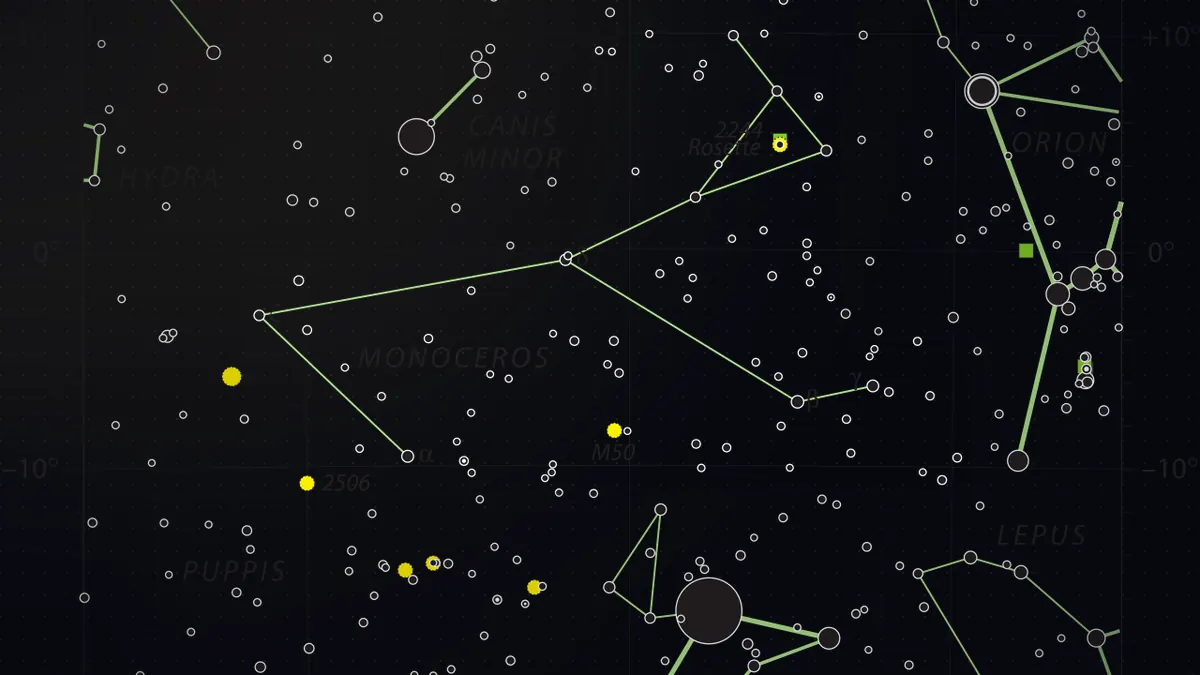
There is no traditional figure to trace, and no ancient asterism to fall back on. Charts draw a unicorn (head down, horn forward, facing Orion) using stars that are all around magnitude 4. Even in good conditions the outline is a matter of faith rather than observation.
This is because Monoceros is a modern invention. It was not one of Ptolemy's 48; it was added by the Dutch cartographer Petrus Plancius in 1613 to fill an awkward blank between four famous constellations. Filling gaps was exactly what it was for.
The stars of Monoceros
- Beta Monocerotis (magnitude 3.76) — the brightest star here, and a genuine showpiece. It is a triple star system whose three components form a fixed triangle in the eyepiece. William Herschel discovered it in 1781 and called it 'one of the most beautiful sights in the heavens', which is a strong claim from a man who saw a great many things.
- Alpha Monocerotis (magnitude 3.93) — an orange giant, and despite the Alpha label, not the brightest.
- S Monocerotis — a hot, massive multiple star sitting at the top of the Christmas Tree Cluster.
- Plaskett's Star — a binary of two enormous, very hot stars orbiting one another, together among the most massive binary systems known.
- V838 Monocerotis — in 2002 this star brightened enormously and then faded. The expanding shell of light reflecting off surrounding dust produced one of the most striking image sequences Hubble has ever returned.
The story behind the name
Monoceros has no classical mythology, because it did not exist in classical times. It is a seventeenth-century creation, credited to Petrus Plancius, who put a unicorn in a piece of sky that had no figure of its own.
The choice of animal was not random. The unicorn appears in some early translations of the Hebrew Bible, and Plancius was working in an era when several new constellations were given biblical or emblematic themes rather than Greek ones. There is a persistent claim that the unicorn was mapped here much earlier by Persian astronomers, but the evidence is thin. Monoceros is best understood for what it is: a practical piece of cartography that stuck.
What else is hiding in Monoceros
This is Monoceros's whole case, and it is a strong one.
- The Rosette Nebula (NGC 2237) — an enormous ring of glowing hydrogen with the young open cluster NGC 2244 sitting at its centre, the cluster's radiation having blown the hole in the middle. It is a photographic icon. Visually it is large and faint, so it needs dark skies and a wide field.
- The Christmas Tree Cluster and Cone Nebula (NGC 2264) — an open cluster whose stars really do form a triangular tree shape, with a dark pillar of dust at its tip.
- M50 — a pleasant open cluster, and the constellation's only Messier object. A good binocular target.
- Hubble's Variable Nebula (NGC 2261) — a fan-shaped reflection nebula that visibly changes shape over weeks and months as shadows move across it. One of very few deep-sky objects that changes on a human timescale.
When and where to see it
Monoceros is best placed in the evening sky in February, and shares Orion's season either side of that.
It sits almost exactly on the celestial equator, so it is visible from virtually everywhere on Earth. There is no hemisphere that misses out.
Be realistic about conditions, though. This is the constellation where light pollution hurts most: from a city there is genuinely nothing to see. Take it somewhere dark, bring binoculars or a wide-field telescope, and it becomes one of the best areas in the winter sky. It also photographs extremely well, which is why it appears in far more images than it does in observing notes.
Monoceros at a glance
| Name | Monoceros |
| Abbreviation | Mon |
| Genitive form | Monocerotis |
| Meaning | the Unicorn |
| Family | Orion family |
| First recorded | 1613, Plancius |
| Right ascension | 7h 09m |
| Declination | −5.7° |
| Area | 482 square degrees (35th largest of 88) |
| Main stars in the figure | 4 |
| Stars brighter than magnitude 3 | 0 |
| Named Bayer / Flamsteed stars | 32 |
| Brightest star | β Mon (magnitude 3.76) |
| Messier objects | 1 |
| Meteor showers | December Monocerids, Alpha Monocerids |
| Visible from | Between latitudes 79°N and 79°S |
| Best seen at 9 pm in | February |
| Bordering constellations | Canis Major, Canis Minor, Gemini, Hydra, Lepus, Orion, Puppis |
Where to go next
Its neighbours in the sky
These constellations share a border with Monoceros, so once you have found it you already know where to look next: Canis Major, Canis Minor, Gemini, Hydra, Lepus, Orion, Puppis.
The rest of the Orion family
Monoceros belongs to the Orion family: the Hunter and the animals around him, the brightest patch of sky. The others are: Canis Major, Canis Minor, Lepus, Orion.
Start from the beginning
If you are starting from scratch, the complete beginner's guide to the 88 constellations covers what a constellation actually is, how the sky is carved up, and links to every one of them.
Star chart: Monoceros IAU chart by IAU and Sky & Telescope magazine (Roger Sinnott & Rick Fienberg), used under CC BY 3.0. Observing data cross-checked against Wikipedia's Monoceros entry.