Canis Minor is proof that a constellation does not need many stars to matter. It has two of any real brightness. That is it. And yet you will use it constantly, because one of those two — Procyon — is the eighth brightest star in the night sky and one corner of the Winter Triangle.
It is the Lesser Dog to Canis Major's Greater Dog, and like its larger partner it trails after Orion. If Canis Major is the hound, Canis Minor is the puppy that never quite keeps up.
Where to find Canis Minor
Start with Orion again. Find Betelgeuse, the orange shoulder star, then look east — away from the Belt — for a bright, slightly yellowish star sitting on its own with very little around it. That isolation is the giveaway: Procyon has no bright neighbours to confuse it with.
The reliable method is the Winter Triangle. Betelgeuse in Orion, Sirius in Canis Major and Procyon in Canis Minor form a large, nearly equal-sided triangle. Once you can see two corners, the third tells you exactly where to look.
In sky coordinates Canis Minor sits at right ascension 7h 06m and declination +13.2°. Right ascension is the sky's version of longitude and declination its version of latitude, so those two numbers pin the constellation to one spot on the celestial sphere the way a map reference pins a town. It sits in the northern half of the sky, riding high for northern observers and low for southern ones. In practice that means you can find it from anywhere north of latitude 77°S, including the whole northern hemisphere; it rides highest in the evening sky in February.
What Canis Minor actually looks like
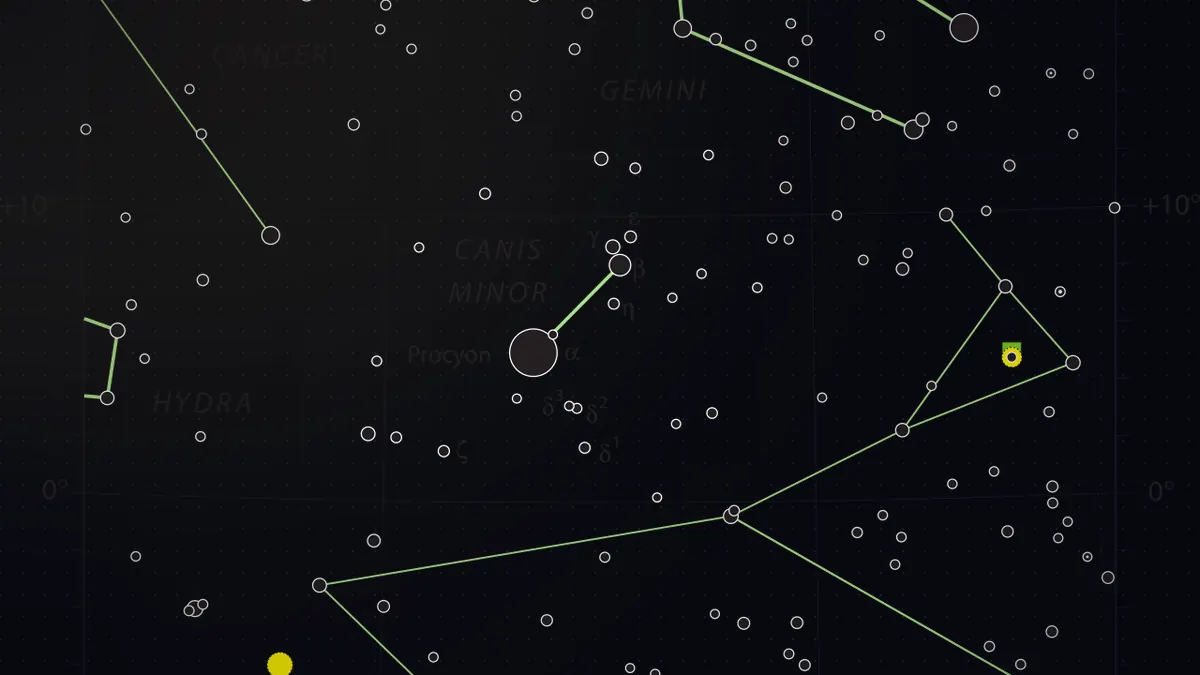
There is not much shape to speak of, and it is more honest to say so than to pretend otherwise. Canis Minor is a short line: Procyon at one end, Gomeisa at the other, about four degrees apart. Star charts draw a dog around them, but you are supplying most of that from imagination.
Ptolemy listed it as a two-star asterism rather than a proper figure, and that is genuinely what it still looks like. Johann Bayer later labelled eight stars here and John Flamsteed numbered fourteen, but nothing beyond the first two is easy without a dark sky.
The stars of Canis Minor
- Procyon (Alpha Canis Minoris, magnitude 0.34) — a yellow-white main-sequence star just 11.5 light years away, which makes it one of our closest stellar neighbours. Like Sirius, it has a white dwarf companion, Procyon B. The name comes from Greek meaning 'before the dog', because it rises shortly before Sirius does.
- Gomeisa (Beta Canis Minoris, magnitude 2.9) — a hot blue star and the only other member of the constellation you will notice without trying. It spins fast enough to have flung out a disc of gas around its equator.
After those two, the drop-off is steep: nothing else here reaches magnitude 4. It is a constellation with a very short guest list.
The story behind the name
Canis Minor is usually cast as the second of Orion's hunting dogs, running alongside Canis Major after the hare. In another Greek story it is Maera, the dog of Icarius: a man taught to make wine by Dionysus, who was killed by shepherds who thought he had poisoned them. The dog led his daughter to the body, and all three were placed among the stars.
The Babylonians had already grouped these stars long before, and the name Procyon — 'before the dog' — is a small piece of practical astronomy preserved as a word. It tells you what these stars were actually used for: a warning that Sirius, and with it the calendar's turning point, was about to appear.
What else is hiding in Canis Minor
Canis Minor is the quiet one. It contains no Messier objects at all, and there is no point pretending it is a rich field for a small telescope.
What it does have is worth knowing about:
- The edge of the Milky Way clips the constellation, so sweeping through it with binoculars under a dark sky gives you a pleasant, faint scatter of background stars.
- NGC 2485 — a small, faint spiral galaxy, strictly a target for larger instruments.
- Procyon B — the white dwarf companion. It is a genuinely hard visual target because Procyon itself is so bright, but it is one of the nearest white dwarfs to the Sun.
Treat Canis Minor as a signpost rather than a destination, and it earns its place.
When and where to see it
Best seen in the evening sky in February, alongside Orion and Canis Major, and visible from roughly December to April.
It sits just north of the celestial equator, so it is available to essentially the whole populated world, from the far north down to southern latitudes. There is no real 'wrong' place to see it.
You need only your eyes. Procyon is bright enough to punch through city light pollution without complaint, which makes Canis Minor one of the more useful constellations for urban stargazers: it still works when the faint stuff has been washed out.
Canis Minor at a glance
| Name | Canis Minor |
| Abbreviation | CMi |
| Genitive form | Canis Minoris |
| Meaning | The Lesser Dog |
| Family | Orion family |
| First recorded | ancient (Ptolemy) |
| Right ascension | 7h 06m |
| Declination | +13.2° |
| Area | 183 square degrees (71st largest of 88) |
| Main stars in the figure | 2 |
| Stars brighter than magnitude 3 | 2 |
| Named Bayer / Flamsteed stars | 14 |
| Brightest star | Procyon (α CMi) (magnitude 0.34) |
| Messier objects | None |
| Meteor showers | Canis-Minorids |
| Visible from | Anywhere north of latitude 77°S, including the whole northern hemisphere |
| Best seen at 9 pm in | February |
| Bordering constellations | Cancer, Gemini, Hydra, Monoceros |
Where to go next
Its neighbours in the sky
Canis Minor borders all of these, which makes them the natural next targets once you can pick it out: Cancer, Gemini, Hydra, Monoceros.
The rest of the Orion family
Canis Minor belongs to the Orion family: the Hunter and the animals around him, the brightest patch of sky. The others are: Canis Major, Lepus, Monoceros, Orion.
Start from the beginning
New to all this? The 88 constellations: a complete beginner's guide explains what a constellation actually is, how the sky is divided up, and lists all 88 with a link to each one.
Star chart: Canis Minor IAU chart by IAU and Sky & Telescope magazine (Roger Sinnott & Rick Fienberg), used under CC BY 3.0. Observing data cross-checked against Wikipedia's Canis Minor entry.