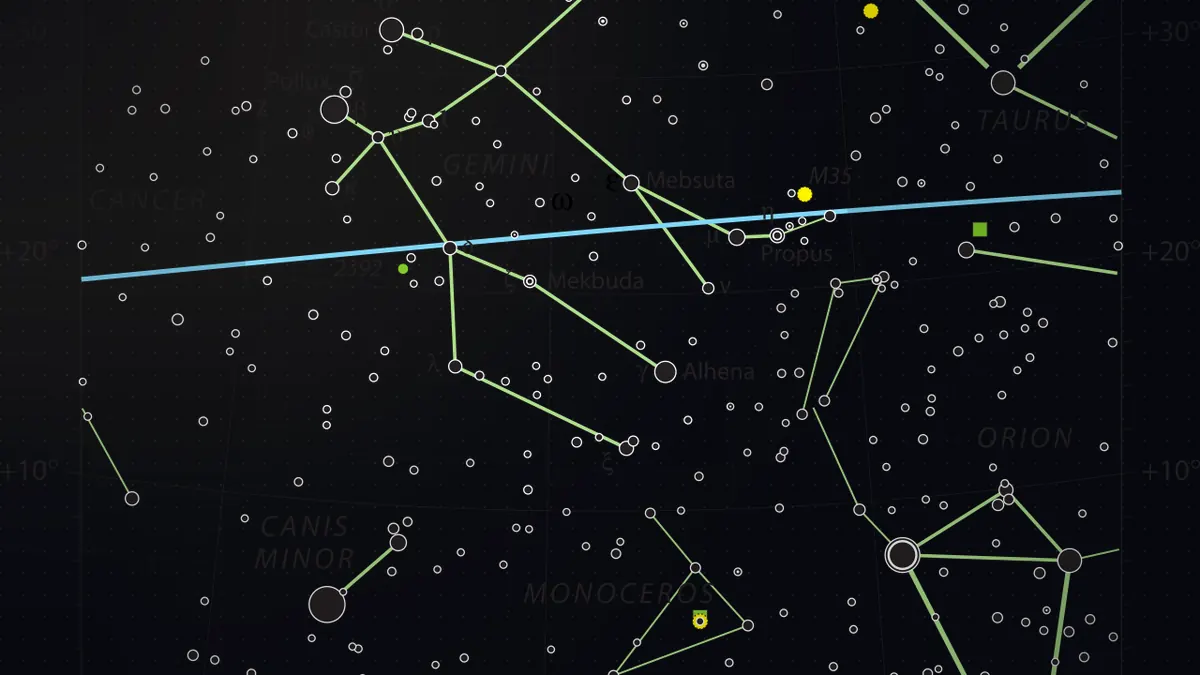
Gemini is one of the easiest constellations to identify because its two brightest stars sit side by side, almost equally bright, like a pair of eyes. Castor and Pollux are the heads of the twins, and once you see them together you cannot mistake them for anything else.
Gemini also owns the best meteor shower of the year. The Geminids, in mid-December, reliably deliver over a hundred meteors an hour, and unlike almost every other shower, they do not come from a comet.
Where to find Gemini
Use Orion. Draw a line from Rigel through Betelgeuse and keep going, and you arrive at two bright stars close together. That is Gemini.
Pollux is the slightly brighter of the two and has a warm orange tint; Castor is white and sits closer to Polaris. From the two heads, two roughly parallel lines of fainter stars run back towards Orion: the bodies of the twins.
Another route: Gemini sits north-east of Orion and directly above Canis Minor's Procyon. Between Capella in Auriga and Procyon, the two bright companions are unmistakable.
In sky coordinates Gemini sits at right ascension 7h 00m and declination +20.0°. Those two numbers work like a grid reference. Right ascension runs around the sky the way longitude runs around the Earth, and declination measures north and south the way latitude does. It sits in the northern half of the sky, riding high for northern observers and low for southern ones. In practice that means you can find it from anywhere north of latitude 55°S, including the whole northern hemisphere; it rides highest in the evening sky in February.
What Gemini actually looks like
Two stick figures standing side by side, holding hands. It is one of the more literal figures in the sky: two parallel lines of stars running from the bright head stars down towards Orion, ending in the feet.
The whole shape spans a good chunk of sky and holds together well under moderate light pollution, because the constituent stars are reasonably bright. If you can see the two heads and the two roughly parallel bodies, you have the whole constellation. There is no obscure faint remainder to chase.
The feet of the twins rest in the Milky Way, which is why the deep-sky objects here cluster at that end.
The stars of Gemini
- Pollux (Beta Geminorum, magnitude 1.14) — the brighter twin despite the Beta label, an orange giant just 34 light years away. It hosts a confirmed planet, making it the nearest giant star known to have one.
- Castor (Alpha Geminorum, magnitude 1.58) — one of the great surprises of the sky. It looks like one star, splits into two in a small telescope, and is actually a six-star system: three binary pairs gravitationally bound together.
- Alhena (Gamma) — a bright white star marking Pollux's foot.
- Mekbuda (Zeta) — a Cepheid variable that pulses over about ten days.
Gemini has serious discovery history. William Herschel found Uranus here in 1781, and Clyde Tombaugh found Pluto in this constellation in 1930. Two of the three planets discovered in modern times were first spotted against these stars.
The story behind the name
Castor and Pollux were twin brothers with different fathers: Pollux was the immortal son of Zeus, Castor the mortal son of a Spartan king. When Castor was killed, Pollux was so distraught that he asked Zeus to let him share his immortality. Zeus placed them both in the sky, together permanently.
They were the patron gods of sailors, and the electrical glow sometimes seen on ships' masts during storms — St Elmo's fire — was read as the twins appearing to protect the crew. Seeing one light rather than two was considered a bad omen.
The pairing is older than Greece. Babylonian records name these two stars as the Great Twins, and the idea of two divine brothers linked to horses and to sailors turns up across Indo-European traditions, from the Vedic Ashvins onwards.
What else is hiding in Gemini
- M35 — a large, rich open cluster near Castor's foot, roughly the size of the full Moon, containing several hundred stars. One of the finest open clusters in the northern sky and superb in binoculars. Right beside it, a small telescope picks up NGC 2158, a much older and more distant cluster that makes a beautiful contrast.
- NGC 2392, the Eskimo or Clown Face Nebula — a small, bright planetary nebula with a distinctive layered structure. It takes high magnification well and is one of the better planetary nebulae for small telescopes.
- The Medusa Nebula (Abell 21) — a large, very faint supernova remnant, strictly for dark skies and big apertures.
- The Geminids — peaking around 13–14 December with 120 or more meteors an hour. Their parent body is 3200 Phaethon, an asteroid rather than a comet, which makes them genuinely unusual. The meteors are slow, bright and often colourful, and the shower has been strengthening over the past century.
When and where to see it
Best placed in the evening sky in February, with a season running from December through April.
Gemini sits in the northern sky but reaches far enough south to be visible from nearly everywhere. Northern observers get the twins high overhead; southern observers see them low and upside down, with Castor below Pollux.
The main figure needs nothing but your eyes and survives city skies. M35 wants binoculars. For the Geminids, the good news is that the radiant is high for most of the night from the northern hemisphere. You can start watching by mid-evening rather than waiting until the small hours, which is unusual and very welcome in December.
Gemini at a glance
| Name | Gemini |
| Abbreviation | Gem |
| Genitive form | Geminorum |
| Meaning | the Twins, Castor and Pollux |
| Family | Zodiac family |
| First recorded | ancient (Ptolemy) |
| Right ascension | 7h 00m |
| Declination | +20.0° |
| Area | 514 square degrees (30th largest of 88) |
| Main stars in the figure | 8 |
| Stars brighter than magnitude 3 | 4 |
| Named Bayer / Flamsteed stars | 80 |
| Brightest star | Pollux (β Gem) (magnitude 1.15) |
| Messier objects | 1 |
| Meteor showers | Geminids, Rho Geminids |
| Visible from | Anywhere north of latitude 55°S, including the whole northern hemisphere |
| Best seen at 9 pm in | February |
| Bordering constellations | Auriga, Cancer, Canis Minor, Lynx, Monoceros, Orion, Taurus |
Where to go next
Its neighbours in the sky
These constellations share a border with Gemini, so once you have found it you already know where to look next: Auriga, Cancer, Canis Minor, Lynx, Monoceros, Orion, Taurus.
The rest of the Zodiac family
Gemini belongs to the Zodiac family: the twelve constellations the Sun, Moon and planets travel through. The others are: Aquarius, Aries, Cancer, Capricornus, Leo, Libra, Pisces, Sagittarius, Scorpius, Taurus, Virgo.
Start from the beginning
Not sure where to begin? The guide to all 88 constellations explains how the sky is divided, what a constellation really is, and links to each of the 88.
Star chart: Gemini IAU chart by IAU and Sky & Telescope magazine (Roger Sinnott & Rick Fienberg), used under CC BY 3.0. Observing data cross-checked against Wikipedia's Gemini entry.