Scorpius is, along with Orion, one of the two constellations that genuinely looks like the thing it is named after. A curving line of bright stars sweeps down and hooks back up into a distinct sting. There is no imagination required.
At its heart sits Antares, a red supergiant so large it would swallow the orbit of Mars. Its name means 'rival of Mars', because ancient observers kept confusing the two: both are conspicuously red, and they regularly pass close to each other in the sky.
Where to find Scorpius
Look low in the south on a summer evening from the northern hemisphere, or high overhead in winter from the southern one. You are looking for a bright red star with two fainter stars flanking it, and a long curve of stars trailing away below.
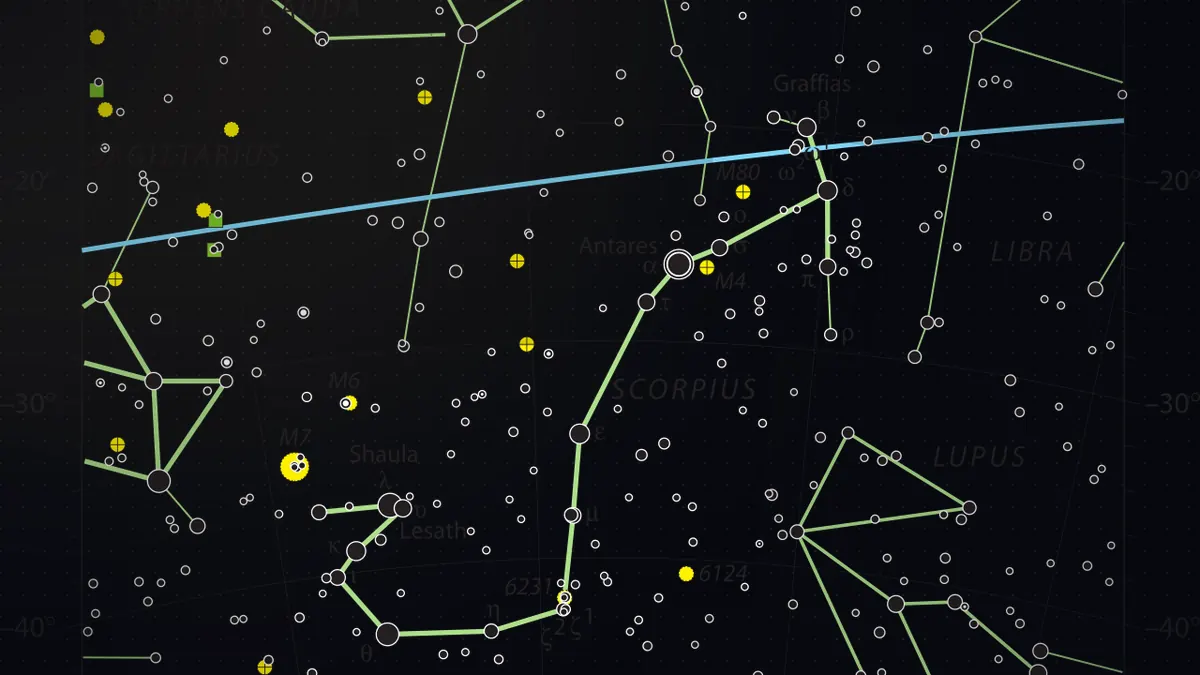
Antares is the giveaway. Its colour is obvious — a distinct orange-red — and nothing else nearby competes. Once you have it, follow the curve down and left and it hooks back up into the sting, marked by Shaula and Lesath sitting close together.
The Milky Way runs right through the scorpion's tail, which under dark skies makes this one of the most beautiful regions in the sky.
In sky coordinates Scorpius sits at right ascension 16h 53m and declination −30.7°. Right ascension is the sky's version of longitude and declination its version of latitude, so those two numbers pin the constellation to one spot on the celestial sphere the way a map reference pins a town. It sits in the southern half of the sky, high for southern observers and low on the horizon for northern ones. In practice that means you can find it from anywhere south of latitude 40°N, including the whole southern hemisphere; it rides highest in the evening sky in July.
What Scorpius actually looks like
A long, elegant curve — arguably the most graceful figure in the sky. The head is a short vertical line of three stars to the west, then the body runs down through Antares before sweeping east and hooking sharply upwards into a two-star sting.
In Hawaii the same stars are seen as Maui's fishhook, which fits the shape at least as well as the scorpion does. Polynesian navigators used it extensively.
One thing is missing: the claws. They were separated off to form Libra, which is why the scorpion's head now ends rather abruptly at three stars where pincers should be.
The stars of Scorpius
- Antares (Alpha Scorpii, magnitude ~1.0, variable) — a red supergiant roughly 700 times the Sun's diameter and one of the largest stars visible to the naked eye. It is nearing the end of its life and will eventually explode as a supernova, which will be spectacular from here.
- Shaula (Lambda Scorpii, magnitude 1.6) — the sting, and the twenty-fifth brightest star in the sky. The name means 'the raised tail'.
- Lesath (Upsilon) — sits beside Shaula, and the two together are sometimes called the Cat's Eyes.
- Graffias (Beta Scorpii) — a fine double star in the scorpion's head, easily split in a small telescope.
A curiosity: the Sun spends only about seven days in Scorpius each year, less than in any other zodiac constellation, because the constellation's boundaries clip only a short stretch of the ecliptic.
The story behind the name
The scorpion killed Orion. In the most common version, Orion boasted he could kill every animal on Earth, and Gaia sent a scorpion to stop him. Both were placed in the sky on opposite sides, so that as Scorpius rises Orion is already setting, the hunter forever fleeing.
That opposition is real and observable: you can never see Orion and Scorpius well at the same time. It is one of the few myths whose narrative logic is actually enforced by the geometry of the sky.
Antares was one of the four Royal Stars of Persia, the watcher of the west. In Maori tradition the sting is the prow of a canoe, and across Polynesia the fishhook reading supported real navigation. Chinese astronomy placed Antares at the heart of the Azure Dragon of the East.
What else is hiding in Scorpius
The Milky Way runs through Scorpius, and the constellation is packed.
- M4 — one of the closest globular clusters to Earth at about 7,200 light years, sitting conveniently just beside Antares. Loose enough that small telescopes resolve individual stars, which is unusual and satisfying.
- M6, the Butterfly Cluster — an open cluster whose stars really do spread into a butterfly shape. Excellent in binoculars.
- M7, Ptolemy's Cluster — a large, bright open cluster recorded by Ptolemy in 130 AD, hence the name. It is the southernmost Messier object and superb to the naked eye under dark skies.
- The Cat's Paw Nebula (NGC 6334) and the War and Peace Nebula — vast star-forming regions, primarily photographic targets.
- The Rho Ophiuchi cloud complex, just over the border, wraps colourful nebulosity around Antares and is one of the most photographed regions in the sky.
When and where to see it
Best placed in the evening sky in July, with a season through the northern summer and the southern winter.
This is where hemisphere really matters. Scorpius sits well south of the celestial equator, so southern observers get it overhead in full glory, while northern observers see it low in the south, its sting sometimes cut off by the horizon. From northern Europe the tail barely clears the skyline. If you have only seen Scorpius from the north, seeing it from the tropics or the southern hemisphere is a genuine revelation.
Antares handles city light. The clusters want binoculars and a dark southern horizon, and the whole Milky Way region around the sting is one of the best wide-field sweeps available.
Scorpius at a glance
| Name | Scorpius |
| Abbreviation | Sco |
| Genitive form | Scorpii |
| Meaning | the Scorpion |
| Family | Zodiac family |
| First recorded | ancient (Ptolemy) |
| Right ascension | 16h 53m |
| Declination | −30.7° |
| Area | 497 square degrees (33rd largest of 88) |
| Main stars in the figure | 18 |
| Stars brighter than magnitude 3 | 13 |
| Named Bayer / Flamsteed stars | 47 |
| Brightest star | Antares (α Sco) (magnitude 0.96) |
| Messier objects | 4 |
| Meteor showers | Alpha Scorpiids, Omega Scorpiids |
| Visible from | Anywhere south of latitude 40°N, including the whole southern hemisphere |
| Best seen at 9 pm in | July |
| Bordering constellations | Ara, Corona Australis, Libra, Lupus, Norma, Ophiuchus, Sagittarius |
Where to go next
Its neighbours in the sky
These constellations share a border with Scorpius, so once you have found it you already know where to look next: Ara, Corona Australis, Libra, Lupus, Norma, Ophiuchus, Sagittarius.
The rest of the Zodiac family
Scorpius belongs to the Zodiac family: the twelve constellations the Sun, Moon and planets travel through. The others are: Aquarius, Aries, Cancer, Capricornus, Gemini, Leo, Libra, Pisces, Sagittarius, Taurus, Virgo.
Start from the beginning
Not sure where to begin? The guide to all 88 constellations explains how the sky is divided, what a constellation really is, and links to each of the 88.
Star chart: Scorpius IAU chart by IAU and Sky & Telescope magazine (Roger Sinnott & Rick Fienberg), used under CC BY 3.0. Observing data cross-checked against Wikipedia's Scorpius entry.