Ara is the altar on which the gods swore their alliance before overthrowing the Titans. It is a small, compact southern constellation sitting just below the sting of Scorpius, in a dense and rewarding stretch of the Milky Way.
It is one of Ptolemy's original 48, which tells you that the Greeks could see it from the Mediterranean, and that precession has since carried it further south, out of reach of most northern observers.
Where to find Ara
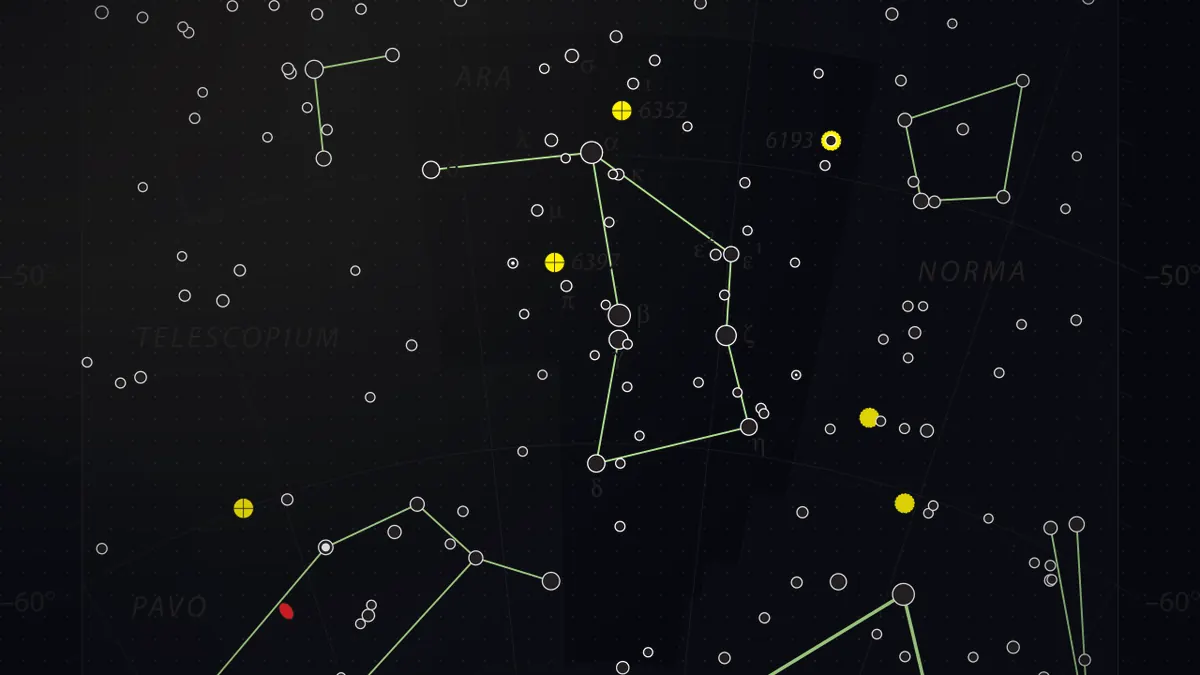
Find the sting of Scorpius — the two close stars Shaula and Lesath at the end of the curving tail — and look south. The compact group of stars you find below is Ara.
It is small but reasonably bright, with several stars around magnitude 2.8 to 3, so it holds together well once located.
From the southern hemisphere this is straightforward. From mid-northern latitudes it is very low or below the horizon entirely, and you will need a clear southern view and a transparent night.
In sky coordinates Ara sits at right ascension 16h 34m and declination −45.5°. Right ascension is the sky's version of longitude and declination its version of latitude, so those two numbers pin the constellation to one spot on the celestial sphere the way a map reference pins a town. It is a far-southern constellation, so southern observers own it and much of the northern hemisphere never sees it at all. In practice you can see it from anywhere south of latitude 22°N, including the whole southern hemisphere, and it stands highest in the evening sky around July.
What Ara actually looks like
A small, roughly rectangular arrangement of stars, sometimes read as an altar with smoke or flames rising from it. Given that the Milky Way runs right behind it, the 'smoke' reading has some visual justification: there genuinely is a band of light rising from the altar.
Ancient depictions show the altar upside down as we see it, with the flames pointing south, which is how it appeared from Mediterranean latitudes.
It sits directly south of Scorpius and west of Corona Australis, forming part of a coherent southern group: the centaur, the beast and the altar.
The stars of Ara
- Beta Arae (magnitude 2.8) — the brightest star, an orange supergiant around 600 light years away.
- Alpha Arae — a hot blue star that rotates rapidly and is surrounded by a disc of expelled gas, making it a Be-type star.
- Gamma Arae — a blue supergiant, extremely luminous.
- Mu Arae — a Sun-like star hosting a system of at least four planets, one of the earlier multi-planet systems found and a notable target in exoplanet surveys.
Several of Ara's brighter stars are hot blue giants at considerable distance, which is typical for a constellation lying along the Milky Way. You are looking down a spiral arm at genuinely luminous stars.
The story behind the name
Ara is the altar on which the Olympian gods swore their oath of allegiance before going to war against the Titans, the previous generation of gods led by Cronus. Zeus placed it in the sky to commemorate the victory that established the Olympian order.
In another reading it is the altar on which the centaur Centaurus sacrifices the beast Lupus: the three constellations sit adjacent and were understood as a single scene, with the centaur carrying the animal towards the altar's fire.
Some accounts identify the Milky Way rising behind Ara as the smoke from the altar's fire, which is a lovely piece of observation folded into myth. When you see it from a dark southern site, the band of the galaxy really does appear to rise directly out of the constellation.
What else is hiding in Ara
The Milky Way makes Ara richer than its size suggests, and it contains no Messier objects only because Messier could not see it from Paris.
- NGC 6397 — one of the two closest globular clusters to Earth at about 7,800 light years. That proximity makes it unusually easy to resolve: even a small telescope breaks it into individual stars, which is much harder with more distant globulars. It contains some of the oldest stars known.
- NGC 6193 — a bright open cluster embedded in the emission nebula NGC 6188, whose dark, sculpted dust ridges photograph beautifully.
- NGC 6362 — another good globular cluster, looser and fainter.
- Westerlund 1 — a super star cluster containing some of the most massive stars known, heavily obscured by dust but of major interest to professional astronomers.
When and where to see it
Best placed in the evening sky in July, through the southern winter.
Ara is firmly southern, reaching only to about 25°N. Southern observers get it high and clear; northern observers at mid-latitudes will not see it at all, and even from the southern United States or the Mediterranean it scrapes the horizon.
If you have a southern sky, NGC 6397 is the priority: a globular cluster close enough to resolve properly in modest equipment is a genuinely different experience from the usual fuzzy ball. The whole region between Scorpius, Ara and Corona Australis rewards slow sweeping with binoculars.
Ara at a glance
| Name | Ara |
| Abbreviation | Ara |
| Genitive form | Arae |
| Meaning | the Altar |
| Family | Hercules family |
| First recorded | ancient (Ptolemy) |
| Right ascension | 16h 34m |
| Declination | −45.5° |
| Area | 237 square degrees (63rd largest of 88) |
| Main stars in the figure | 8 |
| Stars brighter than magnitude 3 | 2 |
| Named Bayer / Flamsteed stars | 17 |
| Brightest star | β Ara (magnitude 2.84) |
| Messier objects | None |
| Meteor showers | None |
| Visible from | Anywhere south of latitude 22°N, including the whole southern hemisphere |
| Best seen at 9 pm in | July |
| Bordering constellations | Apus, Corona Australis, Norma, Pavo, Scorpius, Telescopium, Triangulum Australe |
Where to go next
Its neighbours in the sky
Everything here shares a border with Ara. Find one and the rest are a short hop away: Apus, Corona Australis, Norma, Pavo, Scorpius, Telescopium, Triangulum Australe.
The rest of the Hercules family
Ara belongs to the Hercules family: the largest family — heroes, serpents and the far southern sky. The others are: Aquila, Centaurus, Corona Australis, Corvus, Crater, Crux, Cygnus, Hercules, Hydra, Lupus, Lyra, Ophiuchus, Sagitta, Scutum, Serpens, Sextans, Triangulum Australe, Vulpecula.
Start from the beginning
New to all this? The 88 constellations: a complete beginner's guide explains what a constellation actually is, how the sky is divided up, and lists all 88 with a link to each one.
Star chart: Ara IAU chart by IAU and Sky & Telescope magazine (Roger Sinnott & Rick Fienberg), used under CC BY 3.0. Observing data cross-checked against Wikipedia's Ara entry.