Sextans is a faint, unremarkable-looking patch of sky below Leo, with nothing brighter than magnitude 4.5. There is no figure to trace and no mythology to tell.
But it has one of the best stories behind its name. Johannes Hevelius created it in 1687 in memory of the brass sextant he had used for decades to measure star positions: an instrument destroyed when his observatory in Gdańsk burned to the ground in 1679, taking his life's equipment with it.
Where to find Sextans
Sextans sits directly south of Leo and north of Hydra, in the gap between them.
Find Regulus at the base of Leo's Sickle, then look south. The dim region between Regulus and the body of Hydra is Sextans. There is no shape to look for. You are identifying an area, not a pattern.
You will need a genuinely dark sky and well-adapted eyes to see anything here at all. From a suburb, Sextans is an empty patch of sky between two much more obvious constellations.
In sky coordinates Sextans sits at right ascension 9h 41m and declination +6.4°. Declination is latitude by another name and right ascension is longitude, so the pair fixes the constellation at one point on the celestial sphere. It straddles the celestial equator, which is the happy case: essentially everyone on Earth can see it. In practice you can see it from between latitudes 78°N and 84°S, and it stands highest in the evening sky around April.
What Sextans actually looks like
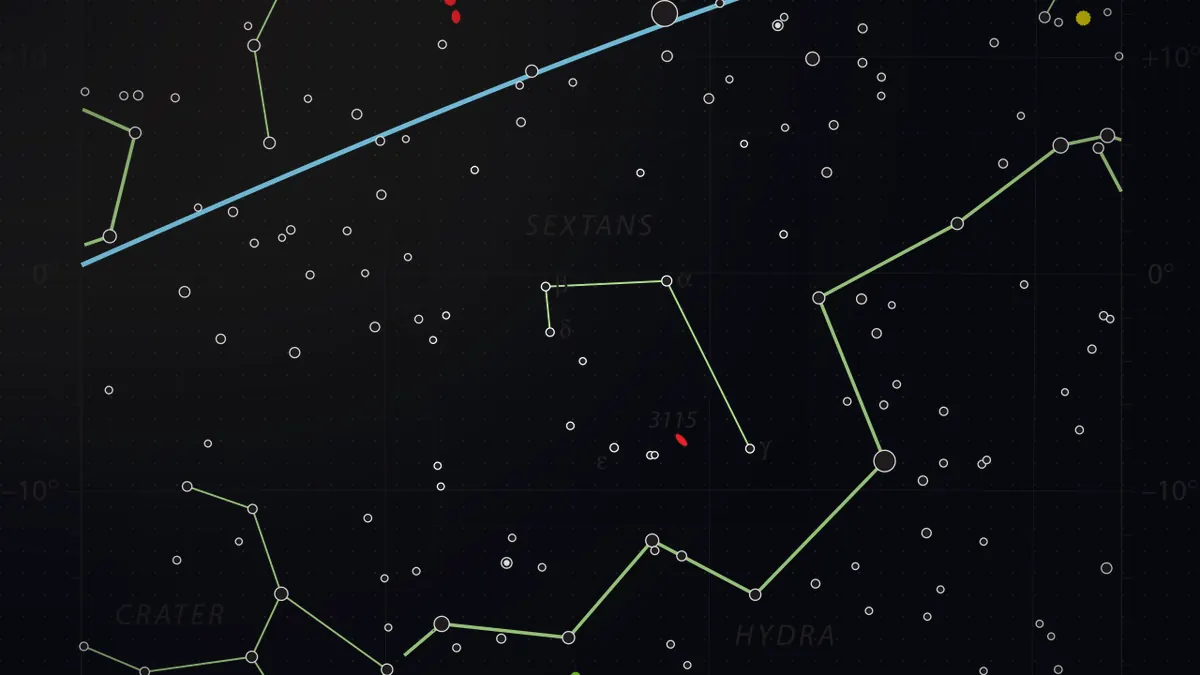
There is effectively no figure. A handful of fifth-magnitude stars are scattered across the area with no discernible pattern, and charts draw a sextant across them as a formality.
Hevelius placed it here deliberately: the region between Leo and Hydra was empty, and empty regions were what he spent his career filling. He introduced seven constellations that survive today, most of them faint fillers like this one.
It is worth being clear that Sextans is a completist's constellation. You find it because you are working through all 88, not because there is something to see.
The stars of Sextans
- Alpha Sextantis (magnitude 4.5) — the brightest star, a white giant about 280 light years away. It sits almost exactly on the celestial equator, which makes it a useful, if faint, reference point.
- Beta Sextantis — a variable blue-white star, slightly fainter.
- Gamma Sextantis — a close triple star system.
- LHS 292 — a very nearby red dwarf, about 14 light years away, and far too faint to see without a decent telescope.
That the brightest star in an entire constellation is magnitude 4.5 tells you everything you need to know about how much light pollution it can tolerate, which is essentially none.
The story behind the name
There is no mythology. Johannes Hevelius named Sextans in 1687 after the sextant he had used to measure stellar positions.
The naming was a memorial. In September 1679 a fire destroyed Hevelius's observatory in Gdańsk, along with his instruments, his printing press and many of his books and observations. He was 68 years old. He rebuilt, continued observing, and later named this constellation for the lost instrument.
There is a further layer worth knowing. Hevelius was famous for refusing to use telescopic sights on his measuring instruments, insisting that careful naked-eye observation with good mechanical instruments was more reliable. He was, by the standards of his time, extraordinarily accurate, and he was also on the losing side of a technological argument. Naming a constellation after his sextant memorialises both the instrument and the method.
What else is hiding in Sextans
Sextans looks out of the galactic plane and has no Messier objects. What it does have is galaxies, most of them faint.
- NGC 3115, the Spindle Galaxy — the best target here by a wide margin. It is a lens-shaped galaxy seen almost exactly edge-on, appearing as a sharp sliver of light. It is bright enough for a small telescope and hosts a supermassive black hole of around two billion solar masses: one of the first galaxies where such a black hole was convincingly identified.
- NGC 3169 and NGC 3166 — a pair of interacting spiral galaxies, visibly distorted by each other's gravity.
- The Sextans Dwarf Galaxy — an extremely faint satellite of the Milky Way, essentially undetectable to amateurs.
- CL J1001+0220 — a very distant galaxy cluster, one of the most remote ever found.
When and where to see it
Best placed in the evening sky in April, alongside Leo through the spring.
It straddles the celestial equator, so it is visible from everywhere on Earth, which is somewhat academic given how faint it is.
Darkness is non-negotiable. From anywhere with streetlights, Sextans simply does not appear. From a dark rural site the scattered stars emerge and NGC 3115 becomes a worthwhile telescope target. Treat it as an exercise in careful star-hopping from Regulus, and take some satisfaction in finding one of the sky's genuinely difficult constellations.
Sextans at a glance
| Name | Sextans |
| Abbreviation | Sex |
| Genitive form | Sextantis, Sextansis |
| Meaning | the Sextant |
| Family | Hercules family |
| First recorded | 1690, Hevelius |
| Right ascension | 9h 41m |
| Declination | +6.4° |
| Area | 314 square degrees (47th largest of 88) |
| Main stars in the figure | 3 |
| Stars brighter than magnitude 3 | 0 |
| Named Bayer / Flamsteed stars | 28 |
| Brightest star | α Sex (magnitude 4.49) |
| Messier objects | None |
| Meteor showers | Sextantids |
| Visible from | Between latitudes 78°N and 84°S |
| Best seen at 9 pm in | April |
| Bordering constellations | Crater, Hydra, Leo |
Where to go next
Its neighbours in the sky
These constellations share a border with Sextans, so once you have found it you already know where to look next: Crater, Hydra, Leo.
The rest of the Hercules family
Sextans belongs to the Hercules family: the largest family — heroes, serpents and the far southern sky. The others are: Aquila, Ara, Centaurus, Corona Australis, Corvus, Crater, Crux, Cygnus, Hercules, Hydra, Lupus, Lyra, Ophiuchus, Sagitta, Scutum, Serpens, Triangulum Australe, Vulpecula.
Start from the beginning
If you are starting from scratch, the complete beginner's guide to the 88 constellations covers what a constellation actually is, how the sky is carved up, and links to every one of them.
Star chart: Sextans IAU chart by IAU and Sky & Telescope magazine (Roger Sinnott & Rick Fienberg), used under CC BY 3.0. Observing data cross-checked against Wikipedia's Sextans entry.