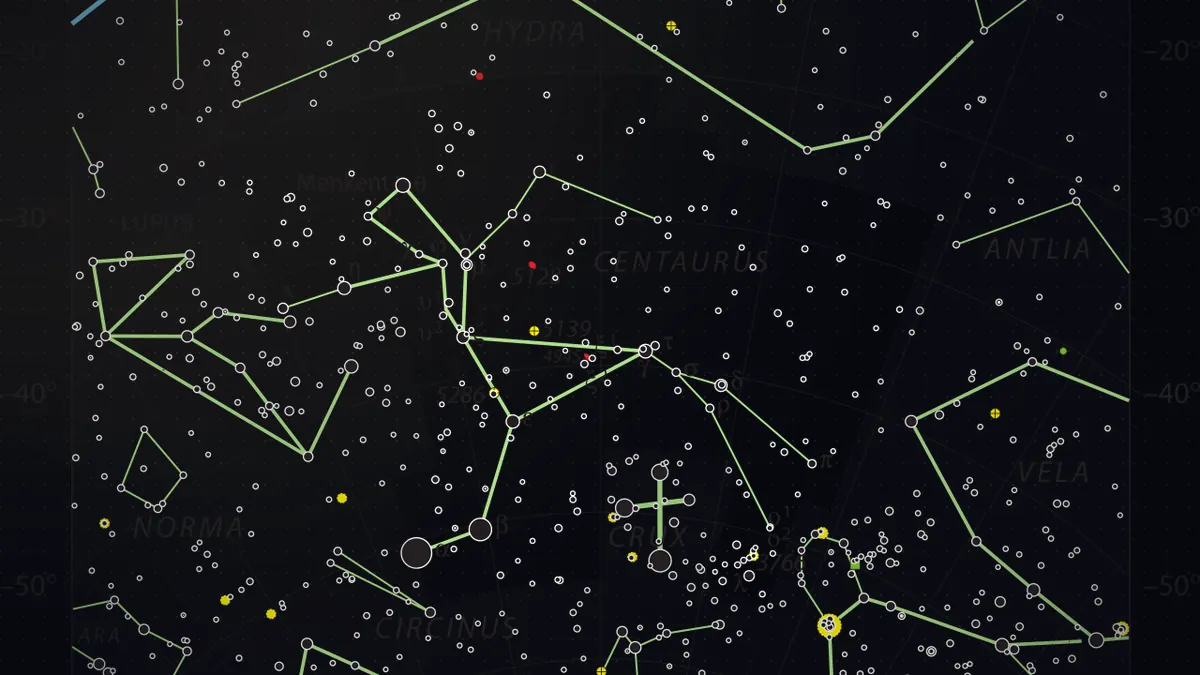
Centaurus is the ninth largest constellation and one of the richest in the sky. It contains Alpha Centauri, the closest star system to the Sun at 4.4 light years, and Omega Centauri, the largest and brightest globular cluster there is.
It also wraps around Crux on three sides, and its two brightest stars are the Pointers that identify the Southern Cross. If you are learning the southern sky, Centaurus is where most of the good material lives.
Where to find Centaurus
From the southern hemisphere, find the Southern Cross, then look for the two brilliant stars beside it: Alpha and Beta Centauri, the Pointers. Those are the centaur's front hooves.
From there the constellation spreads north and west in a large arc, wrapping around Crux. It is big, so trace it in sections.
For Omega Centauri, look about a third of the way from Beta Centauri towards Spica in Virgo. Under a dark sky it is visible to the naked eye as a distinctly fuzzy 'star', in fact it was catalogued as a star before anyone realised what it was.
In sky coordinates Centaurus sits at right ascension 11h 05m and declination −30.0°. Declination is latitude by another name and right ascension is longitude, so the pair fixes the constellation at one point on the celestial sphere. It sits in the southern half of the sky, high for southern observers and low on the horizon for northern ones. Practically speaking it is visible from anywhere south of latitude 25°N, including the whole southern hemisphere, with the best evening views around May.
What Centaurus actually looks like
A large figure of a centaur: the upper body of a man on a horse's body. The Pointers mark the front legs, and the body and human torso extend north and west from there.
It is one of the larger and more coherent southern figures, and unlike many big constellations it has enough bright stars to actually trace.
Centaurus originally included the stars of Crux, which sat between the centaur's hind legs. The Southern Cross was only separated out in the sixteenth century, which is why Crux appears to sit inside a notch in Centaurus's boundary.
The stars of Centaurus
- Rigil Kentaurus / Alpha Centauri (magnitude −0.27) — the third brightest star in the night sky and the nearest star system to the Sun. It is actually three stars: two Sun-like stars orbiting each other, plus Proxima Centauri, a faint red dwarf that is currently the closest individual star to us at 4.24 light years. Proxima hosts Proxima b, an Earth-sized planet in its habitable zone: the nearest potentially habitable world we know of.
- Hadar / Beta Centauri (magnitude 0.6) — the eleventh brightest star in the sky, a blue giant, and far more distant than Alpha despite looking similar in brightness.
- Menkent (Theta Centauri) — an orange giant marking the centaur's shoulder.
- Proxima Centauri — too faint for the naked eye at magnitude 11, despite being our nearest neighbour.
The story behind the name
Centaurus is usually identified as Chiron, the wisest of the centaurs and tutor to Achilles, Jason and Asclepius. Unlike most centaurs, who were wild and violent, Chiron was learned and gentle, a healer and astronomer.
He was accidentally wounded by one of Hercules's arrows, poisoned with Hydra's blood. Being immortal, he could not die and could not be healed, so he suffered until he gave up his immortality in exchange for the release of Prometheus. Zeus placed him in the sky in recognition.
Chiron gets confused with Sagittarius, the other celestial centaur, constantly. The distinction is that Sagittarius is usually Crotus, a different figure entirely, and it is Centaurus who is the wise teacher: shown holding a spear or a sacrificial animal rather than a bow.
What else is hiding in Centaurus
- Omega Centauri (NGC 5139) — the largest and brightest globular cluster in the sky, containing around ten million stars. It is so large and bright that it was catalogued as a star by Ptolemy and only recognised as a cluster in 1826. Current thinking is that it may not be a true globular at all but the stripped core of a small galaxy the Milky Way absorbed. Visually it is superb: naked-eye as a fuzzy patch, and in a telescope a vast sphere of resolved stars that fills the eyepiece.
- Centaurus A (NGC 5128) — one of the brightest galaxies in the sky and a spectacular sight: an elliptical galaxy crossed by a thick, ragged dust lane, the result of a merger. It is also a powerful radio source with enormous jets from a central supermassive black hole.
- NGC 3766, the Pearl Cluster — a bright, pretty open cluster.
- NGC 5460 — another good open cluster for binoculars.
When and where to see it
Best placed in the evening sky in May, through the southern autumn.
Centaurus is a southern constellation. Southern observers get it high overhead; it reaches as far north as about 25°N, so the northern parts are visible low from the southern United States, southern Europe and southern Asia, but Alpha Centauri and Omega Centauri are effectively southern-only.
Omega Centauri is the single best globular cluster in the sky and needs only binoculars to impress. Centaurus A is a genuinely good galaxy for a modest telescope. If you travel south, Centaurus and Crux together will occupy your first several nights.
Centaurus at a glance
| Name | Centaurus |
| Abbreviation | Cen |
| Genitive form | Centauri |
| Meaning | the Centaur |
| Family | Hercules family |
| First recorded | ancient (Ptolemy) |
| Right ascension | 11h 05m |
| Declination | −30.0° |
| Area | 1060 square degrees (9th largest of 88) |
| Main stars in the figure | 11 |
| Stars brighter than magnitude 3 | 10 |
| Named Bayer / Flamsteed stars | 69 |
| Brightest star | α Cen (magnitude −0.27) |
| Messier objects | None |
| Meteor showers | Alpha Centaurids, Omicron Centaurids, Theta Centaurids |
| Visible from | Anywhere south of latitude 25°N, including the whole southern hemisphere |
| Best seen at 9 pm in | May |
| Bordering constellations | Antlia, Carina, Circinus, Crux, Hydra, Libra, Lupus, Musca, Vela |
Where to go next
Its neighbours in the sky
Everything here shares a border with Centaurus. Find one and the rest are a short hop away: Antlia, Carina, Circinus, Crux, Hydra, Libra, Lupus, Musca, Vela.
The rest of the Hercules family
Centaurus belongs to the Hercules family: the largest family — heroes, serpents and the far southern sky. The others are: Aquila, Ara, Corona Australis, Corvus, Crater, Crux, Cygnus, Hercules, Hydra, Lupus, Lyra, Ophiuchus, Sagitta, Scutum, Serpens, Sextans, Triangulum Australe, Vulpecula.
Start from the beginning
Not sure where to begin? The guide to all 88 constellations explains how the sky is divided, what a constellation really is, and links to each of the 88.
Star chart: Centaurus IAU chart by IAU and Sky & Telescope magazine (Roger Sinnott & Rick Fienberg), used under CC BY 3.0. Observing data cross-checked against Wikipedia's Centaurus entry.