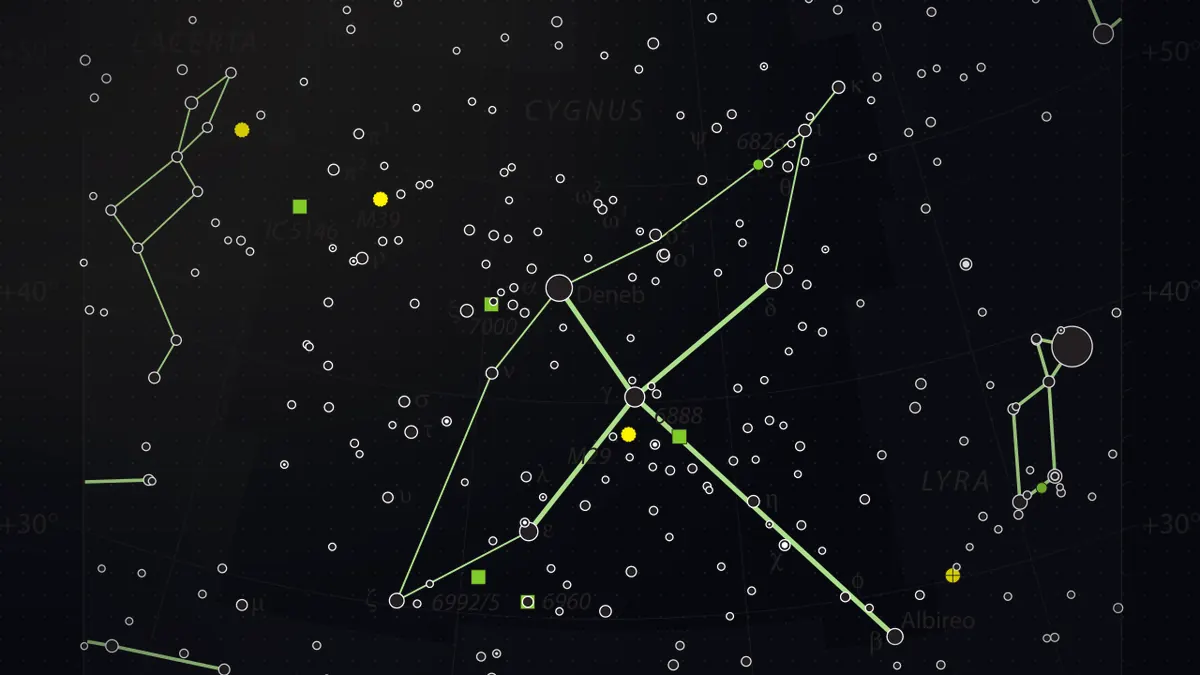
Cygnus is a swan flying south along the Milky Way, and it is one of the genuinely great constellations. Its main stars form the Northern Cross, large and obvious in the summer sky, with Deneb at the top: one of the most luminous stars we can see.
It also contains Albireo, widely considered the most beautiful double star in the sky, and Cygnus X-1, the first object ever identified as a black hole.
Where to find Cygnus
Look overhead on a summer evening for the Summer Triangle: three bright stars: Vega, Altair and Deneb. Deneb is the faintest of the three and marks the swan's tail.
From Deneb, a line of stars runs down through the middle of the Milky Way to Albireo, the swan's beak. Two more lines cross that spine as the wings. Together they make a large, clear cross.
Everything about Cygnus is helped by the Milky Way running straight through it. Under a dark sky you can see the Great Rift here: a dark lane of dust splitting the Milky Way in two, which is genuinely striking.
In sky coordinates Cygnus sits at right ascension 20h 37m and declination +42.0°. Those two numbers work like a grid reference. Right ascension runs around the sky the way longitude runs around the Earth, and declination measures north and south the way latitude does. It sits in the northern half of the sky, riding high for northern observers and low for southern ones. You can see it from anywhere north of latitude 30°S, including the whole northern hemisphere, and it sits highest after dark in September.
What Cygnus actually looks like
A large cross, or a swan in flight with a long neck stretched forward and wings spread. Deneb is the tail, Albireo the beak, and Sadr sits at the intersection.
Both readings work. The Northern Cross is easier for beginners, and the swan is more satisfying once you see it: the long neck really does give the impression of a big bird flying down the galaxy.
The name Deneb comes from the Arabic for 'tail', which is why several unrelated stars across the sky share the root: Deneb Kaitos in Cetus, Deneb Algedi in Capricornus. They all mark the tail of something.
The stars of Cygnus
- Deneb (Alpha Cygni, magnitude 1.25) — the nineteenth brightest star in the sky, and one of the most luminous known. Distance estimates vary widely, but it is somewhere around 1,500 to 2,600 light years away, which means it is intrinsically tens of thousands of times brighter than the Sun. If Deneb sat where Vega does, it would cast shadows.
- Albireo (Beta Cygni) — the swan's beak, and a showpiece. A small telescope splits it into a golden-yellow star and a vivid blue one. The colour contrast is the most striking of any double star, and it is the object most often used to convert someone into an amateur astronomer.
- Sadr (Gamma Cygni) — the centre of the cross, embedded in a large emission nebula.
- 61 Cygni — the first star ever to have its distance measured by parallax, by Friedrich Bessel in 1838. That measurement gave humanity its first real sense of the scale of interstellar space.
The story behind the name
Several stories, all involving a swan. In the most common, Zeus disguised himself as a swan to seduce Leda, queen of Sparta: an encounter that produced Helen of Troy and the twins of Gemini.
Another has Cygnus, a friend of Phaethon, diving repeatedly into the river Eridanus to recover his friend's body after the fall from the sun chariot. The gods were so moved by his devotion that they turned him into a swan and placed him in the sky, which sits well with Eridanus flowing nearby.
A third connects it to Orpheus, who was turned into a swan after his death and placed next to his lyre. Given that Lyra is the adjacent constellation, that arrangement is at least tidy.
What else is hiding in Cygnus
Cygnus sits in the thickest part of the northern Milky Way and is extraordinarily rich.
- The North America Nebula (NGC 7000) — a huge emission nebula whose shape genuinely resembles the continent, complete with a Gulf of Mexico. Visible in binoculars from a dark site as a brightening near Deneb.
- The Veil Nebula — the delicate, lacy remains of a star that exploded roughly 10,000 years ago, spread across an area six times the width of the full Moon. With an OIII filter under dark skies it is one of the most beautiful objects in the sky.
- M39 — a large, loose open cluster, good in binoculars.
- Cygnus X-1 — an X-ray source discovered in 1964 and identified as a black hole of about 21 solar masses pulling material off a blue supergiant companion. It was the subject of a famous bet between Stephen Hawking and Kip Thorne, which Hawking conceded in 1990.
When and where to see it
Best placed in the evening sky in September, riding overhead through the northern summer and early autumn.
It is a northern constellation reaching to about 40°S, so southern observers see it low in the north while northern observers get it directly overhead, the best possible position.
The Northern Cross survives city light. Albireo is bright enough to split from a suburb and is the single best first target for a new telescope owner. The nebulae need genuinely dark skies and, for the Veil, a filter. Sweeping the Milky Way through Cygnus with binoculars on a dark night is among the finest things the northern sky offers.
Cygnus at a glance
| Name | Cygnus |
| Abbreviation | Cyg |
| Genitive form | Cygni |
| Meaning | the Swan or Northern Cross |
| Family | Hercules family |
| First recorded | ancient (Ptolemy) |
| Right ascension | 20h 37m |
| Declination | +42.0° |
| Area | 804 square degrees (16th largest of 88) |
| Main stars in the figure | 9 |
| Stars brighter than magnitude 3 | 4 |
| Named Bayer / Flamsteed stars | 84 |
| Brightest star | Deneb (α Cyg) (magnitude 1.25) |
| Messier objects | 2 |
| Meteor showers | October Cygnids, Kappa Cygnids |
| Visible from | Anywhere north of latitude 30°S, including the whole northern hemisphere |
| Best seen at 9 pm in | September |
| Bordering constellations | Cepheus, Draco, Lacerta, Lyra, Pegasus, Vulpecula |
Where to go next
Its neighbours in the sky
Everything here shares a border with Cygnus. Find one and the rest are a short hop away: Cepheus, Draco, Lacerta, Lyra, Pegasus, Vulpecula.
The rest of the Hercules family
Cygnus belongs to the Hercules family: the largest family — heroes, serpents and the far southern sky. The others are: Aquila, Ara, Centaurus, Corona Australis, Corvus, Crater, Crux, Hercules, Hydra, Lupus, Lyra, Ophiuchus, Sagitta, Scutum, Serpens, Sextans, Triangulum Australe, Vulpecula.
Start from the beginning
New to all this? The 88 constellations: a complete beginner's guide explains what a constellation actually is, how the sky is divided up, and lists all 88 with a link to each one.
Star chart: Cygnus IAU chart by IAU and Sky & Telescope magazine (Roger Sinnott & Rick Fienberg), used under CC BY 4.0. Observing data cross-checked against Wikipedia's Cygnus entry.