Pegasus gives the autumn sky its landmark. The Great Square is exactly what it sounds like: four moderately bright stars forming a large, distinct box, big enough to fit your fist inside at arm's length.
It is not a dazzling constellation — the Square's stars are second and third magnitude — but its size and regularity make it unmistakable, and it is the key that unlocks Andromeda, Pisces and the whole autumn region. Pegasus also holds a genuine first in astronomy: the first planet ever found orbiting an ordinary star.
Where to find Pegasus
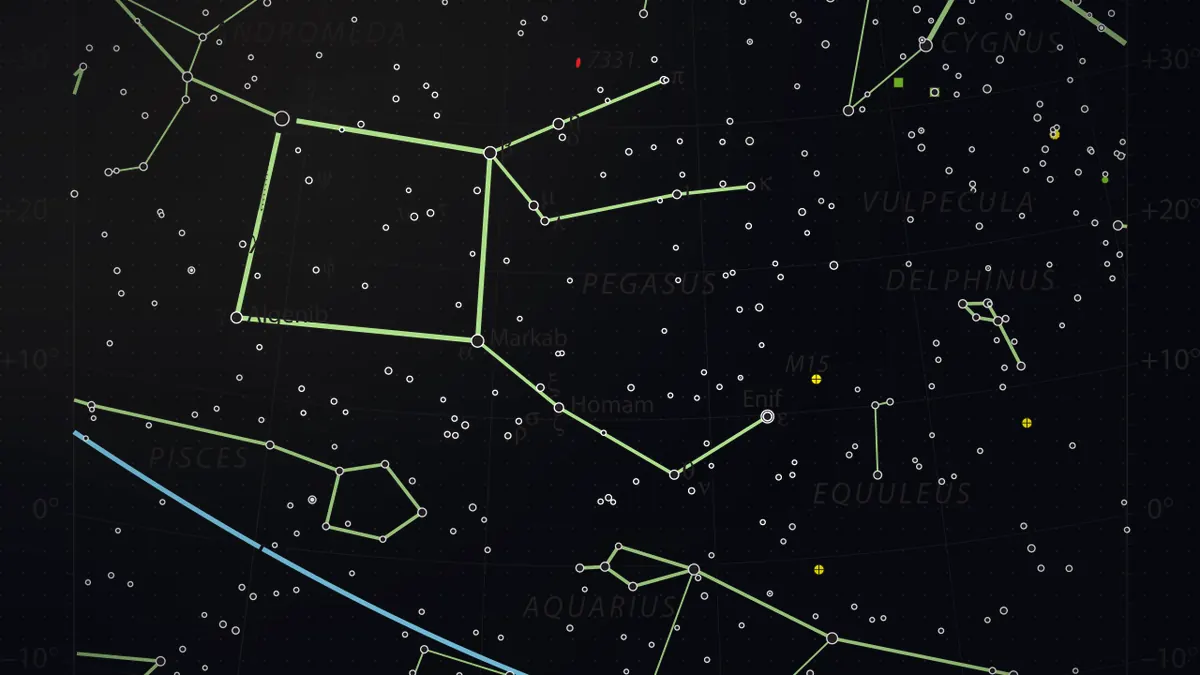
Look south (from the northern hemisphere) on an autumn evening for a large empty-looking box of four stars tilted like a diamond. That is the Great Square.
Its emptiness is a good identifier. The interior contains very few stars, so it reads as a dark rectangle framed by four corners. Counting how many stars you can see inside it is a classic way to gauge how dark your sky is, from a city, none; from a truly dark site, more than thirty.
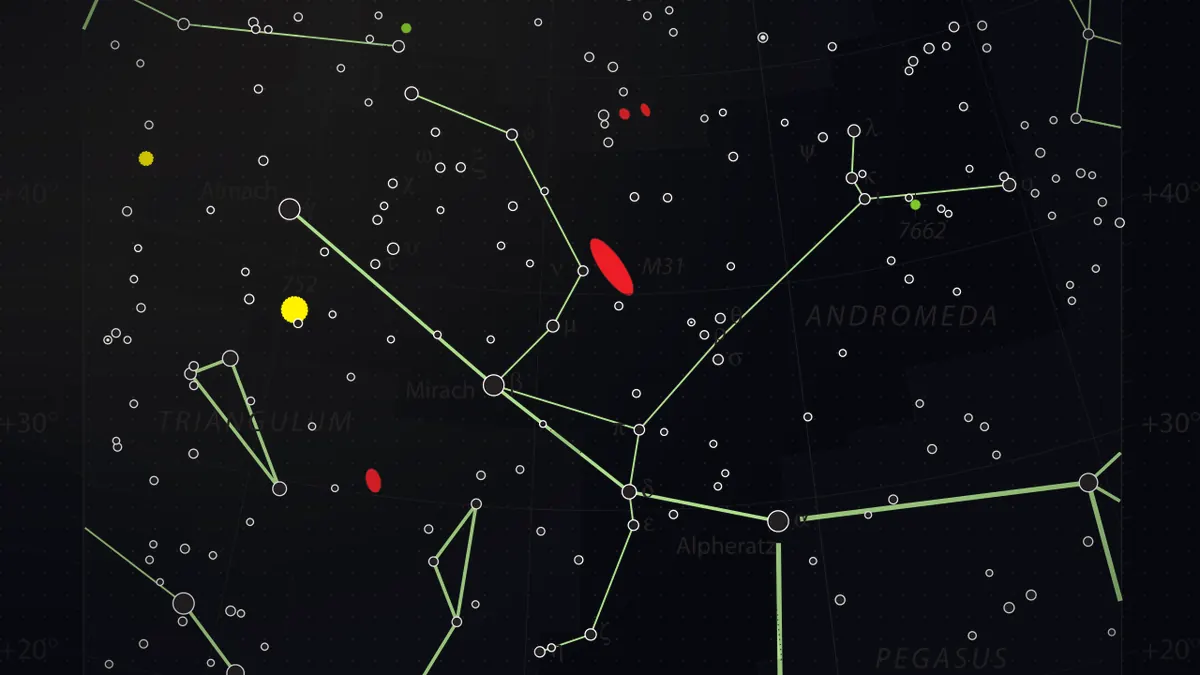
The north-east corner, Alpheratz, belongs to Andromeda, and from it the chains of Andromeda run out towards the galaxy.
In sky coordinates Pegasus sits at right ascension 21h 13m and declination +2.3°. Right ascension is the sky's version of longitude and declination its version of latitude, so those two numbers pin the constellation to one spot on the celestial sphere the way a map reference pins a town. It straddles the celestial equator, which is the happy case: essentially everyone on Earth can see it. In practice you can see it from anywhere north of latitude 54°S, including the whole northern hemisphere, and it stands highest in the evening sky around October.
What Pegasus actually looks like
The Great Square forms the horse's body. From two of its corners, chains of stars run west to form the neck and head (ending at Enif, the muzzle), and another pair marks the front legs.
Pegasus is drawn upside down and only half complete: the horse has a head, neck, forelegs and body, but no hindquarters. Ancient sources sometimes explain this as the horse rising out of the sea or emerging from clouds.
Once you accept the upside-down half-horse, the figure works surprisingly well. The neck and head are a clear curve, and Enif at the nose is the constellation's brightest star despite being far from the Square.
The stars of Pegasus
- Enif (Epsilon Pegasi, magnitude 2.4) — the brightest star, an orange supergiant marking the horse's nose. The name is Arabic for 'the nose'.
- Scheat (Beta Pegasi) — a red giant at a corner of the Square, and a variable star whose brightness wanders noticeably.
- Markab (Alpha Pegasi) — another Square corner, meaning 'the saddle'.
- 51 Pegasi — one of the most important stars in modern astronomy. In 1995 Michel Mayor and Didier Queloz found a planet orbiting it, the first exoplanet ever detected around a normal Sun-like star. The planet, 51 Pegasi b, is a gas giant orbiting in just over four days: a 'hot Jupiter' that nobody had predicted and that forced a rethink of how planetary systems form. The discovery won the 2019 Nobel Prize in Physics. The star itself is magnitude 5.5 and visible in binoculars.
The story behind the name
Pegasus sprang from the blood of Medusa when Perseus beheaded her, which is why the horse and the hero are neighbours in the sky. The winged horse later served the hero Bellerophon, who rode it to defeat the Chimera.
Bellerophon then made the classic Greek mistake: he tried to ride Pegasus up to Olympus to join the gods. Zeus sent a gadfly to sting the horse, Bellerophon was thrown and fell to Earth, and Pegasus continued alone to the heavens, where Zeus kept him to carry thunderbolts.
The Square itself has a much older, more practical history. Babylonian astronomers used these stars as a seasonal marker, and the pattern's size and regularity made it a reference frame for measuring positions long before anyone told stories about winged horses.
What else is hiding in Pegasus
Pegasus looks out of the galactic plane, so it offers galaxies rather than clusters and nebulae.
- M15 — the constellation's headline object and one of the finest globular clusters in the sky. It is extremely dense, having undergone core collapse, and is easy to find just off Enif. Bright in binoculars, and a telescope resolves the outer stars into a glittering ball.
- Stephan's Quintet — a compact group of five galaxies, four of them physically interacting and visibly distorted. It was one of the first targets released from the James Webb Space Telescope. Visually it needs a large telescope and a dark sky, but it is a famous field.
- NGC 7331 — a large spiral galaxy often described as a near-twin of the Milky Way, and much easier than the Quintet nearby.
- Einstein's Cross — a quasar lensed into four images by a foreground galaxy. Far beyond casual observing, but a beautiful demonstration of gravity bending light.
When and where to see it
Best placed in the evening sky in October, dominating the autumn sky from September to December.
Pegasus straddles a wide band of sky and reaches to about 60°S, so it is visible from nearly everywhere, though northern observers get it considerably higher.
The Great Square holds up well under city light: its stars are bright enough and its shape large enough to survive. M15 is a good suburban telescope target. The galaxies need dark skies. Use the Square as your autumn base camp: from it you can reach Andromeda, Pisces, Aquarius and Triangulum without ever losing your bearings.
Pegasus at a glance
| Name | Pegasus |
| Abbreviation | Peg |
| Genitive form | Pegasi |
| Meaning | the Winged Horse |
| Family | Perseus family |
| First recorded | ancient (Ptolemy) |
| Right ascension | 21h 13m |
| Declination | +2.3° |
| Area | 1121 square degrees (7th largest of 88) |
| Main stars in the figure | 9 |
| Stars brighter than magnitude 3 | 5 |
| Named Bayer / Flamsteed stars | 88 |
| Brightest star | ε Peg (Enif) (magnitude 2.38) |
| Messier objects | 1 |
| Meteor showers | July Pegasids |
| Visible from | Anywhere north of latitude 54°S, including the whole northern hemisphere |
| Best seen at 9 pm in | October |
| Bordering constellations | Andromeda, Aquarius, Cygnus, Delphinus, Equuleus, Lacerta, Pisces, Vulpecula |
Where to go next
Its neighbours in the sky
Pegasus borders all of these, which makes them the natural next targets once you can pick it out: Andromeda, Aquarius, Cygnus, Delphinus, Equuleus, Lacerta, Pisces, Vulpecula.
The rest of the Perseus family
Pegasus belongs to the Perseus family: the northern sky's Andromeda myth, told across nine constellations. The others are: Andromeda, Auriga, Cassiopeia, Cepheus, Cetus, Lacerta, Perseus, Triangulum.
Start from the beginning
Not sure where to begin? The guide to all 88 constellations explains how the sky is divided, what a constellation really is, and links to each of the 88.
Star chart: Pegasus IAU chart by IAU and Sky & Telescope magazine (Roger Sinnott & Rick Fienberg), used under CC BY 3.0. Observing data cross-checked against Wikipedia's Pegasus entry.