Andromeda contains the single most remarkable thing you can see without a telescope. M31, the Andromeda Galaxy, is a faint smudge of light about 2.5 million light years away: the most distant object the unaided human eye can detect.
When you look at it you are seeing light that left before our species existed, from a galaxy of a trillion stars that is heading straight for us. In about 4.5 billion years the Milky Way and Andromeda will merge. It is worth going somewhere dark to see it at least once.
Where to find Andromeda
Start with the Great Square of Pegasus, a large and obvious box of four stars in the autumn sky. The star at the Square's north-east corner, Alpheratz, actually belongs to Andromeda. It is shared real estate.
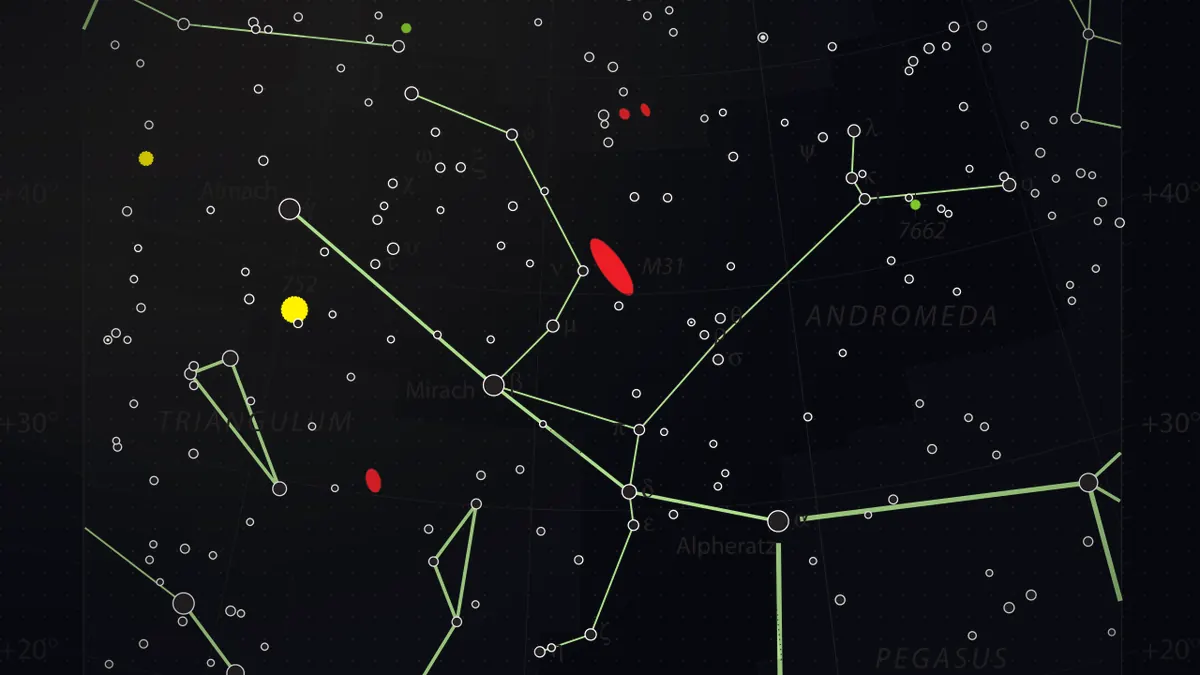
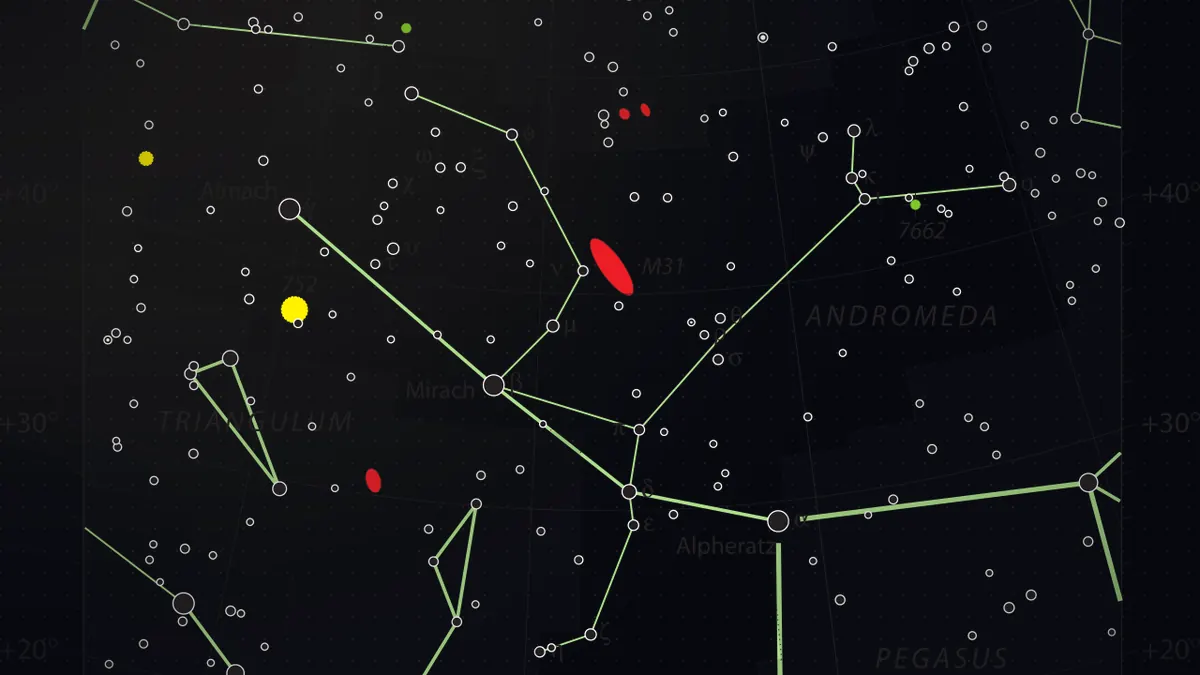
From Alpheratz, two chains of stars run north-east. Take the upper chain and count two bright stars along it to Mirach. Then turn at right angles towards Cassiopeia and hop two fainter stars up. Right there sits a faint elongated smudge: the Andromeda Galaxy.
Under a dark sky it is visible to the naked eye as a soft oval, noticeably larger than a star. In binoculars it is obvious.
In sky coordinates Andromeda sits at right ascension 23h 25m and declination +53.2°. If the units look unfamiliar, the idea behind them is not: declination is the sky's latitude, right ascension is its longitude, and together they place the constellation exactly. It is a far-northern constellation, so northern observers get the best of it and it never rises for much of the southern hemisphere. You can see it from anywhere north of latitude 37°S, including the whole northern hemisphere, and it sits highest after dark in November.
What Andromeda actually looks like
Two roughly parallel chains of stars running north-east from the corner of the Great Square, representing the princess chained to her rock. The brighter chain (Alpheratz, Mirach, Almach) is easy to follow; the second is fainter.
The figure is usually drawn as a woman with her arms outstretched and shackled, and the two chains do read convincingly as chains, which is one of the more successful pieces of celestial illustration.
Andromeda shares Alpheratz with Pegasus, and until the IAU fixed the boundaries in 1930 the star carried designations in both constellations. It now belongs officially to Andromeda.
The stars of Andromeda
- Alpheratz (Alpha Andromedae, magnitude 2.06) — the shared corner of the Great Square, a hot blue-white star with an unusual mercury-manganese chemical peculiarity.
- Mirach (Beta Andromedae) — a red giant, and the crucial waypoint for finding the galaxy. Beside it sits Mirach's Ghost, a small galaxy (NGC 404) whose faint glow is easy to mistake for an optical reflection of the star itself.
- Almach (Gamma Andromedae) — one of the finest double stars in the sky, pairing a golden-orange primary with a blue-green companion. The colour contrast rivals Albireo, and a small telescope splits it easily.
- Upsilon Andromedae — the first main-sequence star found to host multiple planets, a milestone in exoplanet science.
The story behind the name
Andromeda's mother Cassiopeia boasted that she — or her daughter — was more beautiful than the Nereids, the sea nymphs. Poseidon responded by sending the sea monster Cetus to ravage the coast, and an oracle told King Cepheus that the only remedy was to sacrifice his daughter.
Andromeda was chained to a rock at the water's edge to await the monster. Perseus, flying home with Medusa's head, saw her, killed the beast and married her.
The whole family went into the sky, and their arrangement preserves the punishment: Cassiopeia was placed on a throne that rotates around the pole so that she spends half of every night hanging upside down. It is the only constellation whose position is itself part of the story.
What else is hiding in Andromeda
- M31, the Andromeda Galaxy — a spiral galaxy roughly 2.5 million light years away and about twice the diameter of the Milky Way. Visible to the naked eye under dark skies, superb in binoculars, and in a telescope you can also pick up its two bright satellite galaxies, M32 and M110. In 1923 Edwin Hubble measured a Cepheid variable in it and proved it lay far outside our own galaxy: the observation that revealed the universe is full of other galaxies.
- M33, the Triangulum Galaxy — technically next door, but easiest to find by hopping from Mirach in the opposite direction to M31.
- NGC 752 — a large, loose open cluster, lovely in binoculars.
- NGC 7662, the Blue Snowball Nebula — a small, bright planetary nebula with a distinct blue-green tint. An excellent small-telescope target.
When and where to see it
Best placed in the evening sky in November, with a long autumn season either side.
Andromeda is a northern constellation, reaching to about 40°S. Northern observers get it nearly overhead; southern observers see it low, and from far southern latitudes M31 never rises.
Be realistic about the galaxy. From a city you will see nothing. From a dark site it is an obvious elongated glow. And manage expectations about what it looks like: photographs show colour and spiral arms built from hours of exposure, while your eye sees a soft grey ellipse. That grey ellipse is still a trillion stars, and the light hitting your retina is two and a half million years old.
Andromeda at a glance
| Name | Andromeda |
| Abbreviation | And |
| Genitive form | Andromedae |
| Meaning | Andromeda, the Chained Woman |
| Family | Perseus family |
| First recorded | ancient (Ptolemy) |
| Right ascension | 23h 25m |
| Declination | +53.2° |
| Area | 722 square degrees (19th largest of 88) |
| Main stars in the figure | 16 |
| Stars brighter than magnitude 3 | 3 |
| Named Bayer / Flamsteed stars | 65 |
| Brightest star | Alpheratz (α And) (magnitude 2.06) |
| Messier objects | 3 |
| Meteor showers | Andromedids (Bielids) |
| Visible from | Anywhere north of latitude 37°S, including the whole northern hemisphere |
| Best seen at 9 pm in | November |
| Bordering constellations | Cassiopeia, Lacerta, Pegasus, Perseus, Pisces, Triangulum |
Where to go next
Its neighbours in the sky
These constellations share a border with Andromeda, so once you have found it you already know where to look next: Cassiopeia, Lacerta, Pegasus, Perseus, Pisces, Triangulum.
The rest of the Perseus family
Andromeda belongs to the Perseus family: the northern sky's Andromeda myth, told across nine constellations. The others are: Auriga, Cassiopeia, Cepheus, Cetus, Lacerta, Pegasus, Perseus, Triangulum.
Start from the beginning
Not sure where to begin? The guide to all 88 constellations explains how the sky is divided, what a constellation really is, and links to each of the 88.
Star chart: Andromeda IAU chart by IAU and Sky & Telescope magazine (Roger Sinnott & Rick Fienberg), used under CC BY 3.0. Observing data cross-checked against Wikipedia's Andromeda entry.