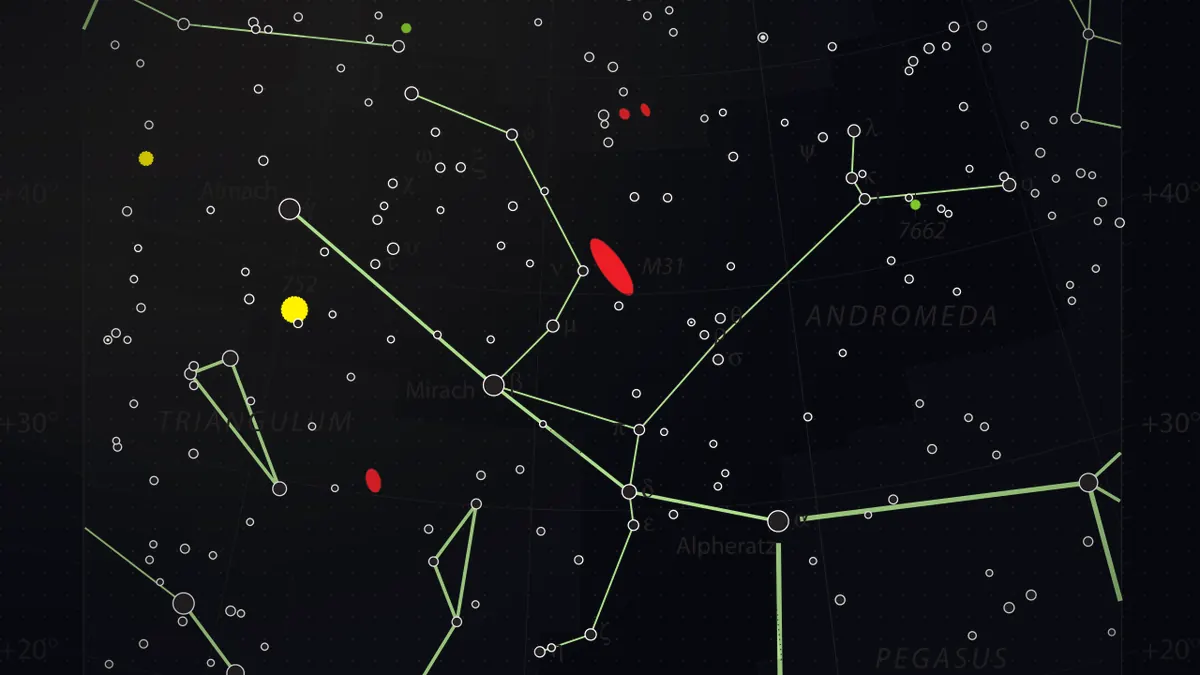
Pisces is large, ancient, and genuinely difficult to see. It sprawls across a big stretch of autumn sky with no star brighter than magnitude 3.6, which means most people have looked straight through it without noticing.
It matters anyway, for a reason that has nothing to do with brightness. The vernal equinox (the point where the Sun crosses the celestial equator each March, and the zero point from which all sky coordinates are measured) currently sits in Pisces. This faint constellation is where the astronomical year now begins.
Where to find Pisces
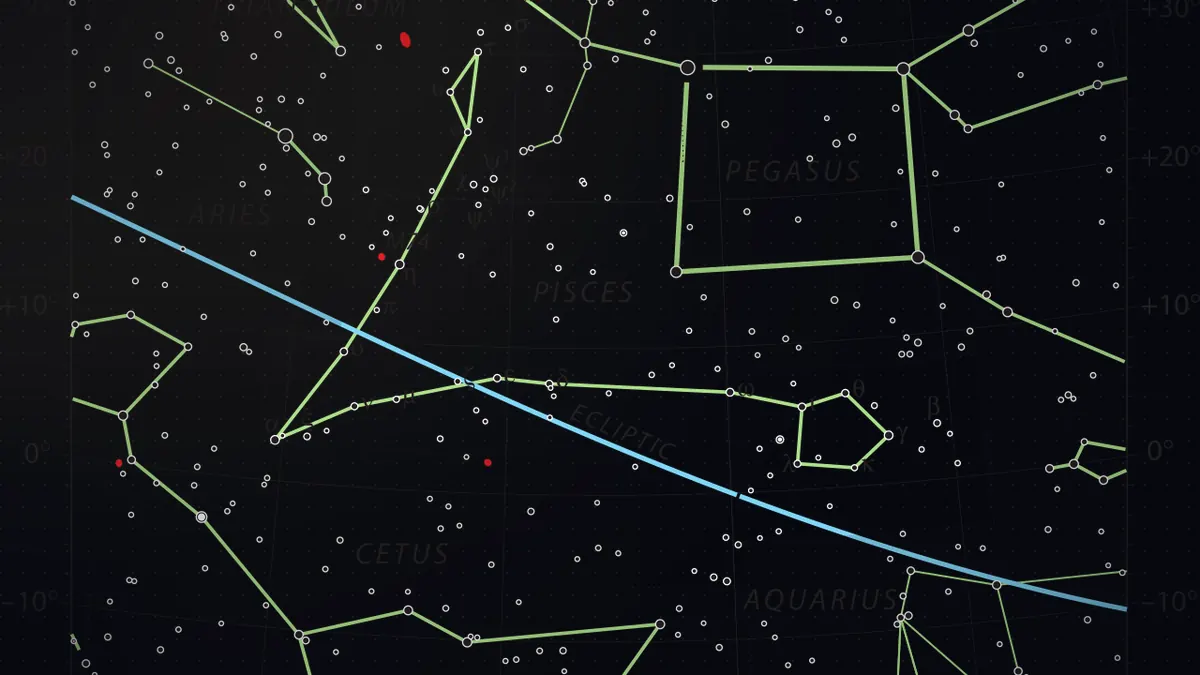
Use the Great Square of Pegasus, which is large, obvious and easy.
Pisces wraps around the Square's southern and eastern sides. Directly below the Square, look for the Circlet: a small ring of about five faint stars that forms the head of the western fish. It is the most identifiable part of the constellation and the right place to start.
From the Circlet, a long faint line of stars runs east, turns north, and ends at a second, smaller group. That is the other fish, and the two lines are the cords that tie them together.
In sky coordinates Pisces sits at right ascension 1h 00m and declination +15.0°. If the units look unfamiliar, the idea behind them is not: declination is the sky's latitude, right ascension is its longitude, and together they place the constellation exactly. It sits in the northern half of the sky, riding high for northern observers and low for southern ones. Practically speaking it is visible from between latitudes 84°N and 57°S, with the best evening views around November.
What Pisces actually looks like
Two fish joined by a long V-shaped cord. The western fish is marked by the Circlet, the small ring below Pegasus. The northern fish sits up alongside Andromeda. The two long lines of faint stars connecting them meet at Alrescha, whose name means 'the cord'.
It is a genuinely enormous figure — the V of cords spans a large fraction of the autumn sky — and tracing the whole thing under a dark sky is a satisfying project precisely because it is difficult.
The Circlet is the realistic target for most observers. If you get that, you have found Pisces.
The stars of Pisces
- Alrescha (Alpha Piscium) — the knot where the two cords meet, and a close binary that needs a good telescope to split.
- Eta Piscium (magnitude 3.6) — actually the brightest star in the constellation despite its Eta label, a yellow giant.
- Van Maanen's Star — the third-closest white dwarf to the Sun at about 14 light years, and the nearest solitary one. It is the burnt-out core of a dead star, roughly Earth-sized but with the mass of the Sun.
- HD 222582 — a Sun-like star hosting a massive planet on a highly eccentric orbit.
Nothing here is bright, and that is simply the character of the constellation. Pisces is about geometry and history rather than spectacle.
The story behind the name
The Greek story has Aphrodite and her son Eros fleeing the monster Typhon. To escape, they turned into fish and tied themselves together with a cord so they would not be separated in the water. The two fish and the cord went into the sky.
As with much of this region, the figure is older than Greece: Babylonian records show two fish here, again fitting the broader watery theme of the Sea.
The real significance is positional. Because of precession, the vernal equinox has been drifting westward through the zodiac at about one degree every 72 years. It moved out of Aries into Pisces roughly two thousand years ago, and will move on into Aquarius in a few hundred years, which is the actual astronomical basis for talk of an 'Age of Aquarius'. The point is still called the First Point of Aries out of pure tradition.
What else is hiding in Pisces
Pisces looks out of the galactic plane and is not rich, but it has one significant object.
- M74 — a beautiful face-on spiral galaxy with two clean, symmetric arms, sometimes called the Phantom Galaxy. That nickname is earned: its light is spread over a large area, giving it very low surface brightness, and it is widely considered one of the hardest Messier objects to observe. Under a dark sky with a decent telescope it appears as a faint round glow; the arms need photography or serious aperture. It has hosted several supernovae and is a favourite target for space telescopes.
- NGC 520 — a pair of galaxies caught mid-collision, their discs already merged into a single distorted mass.
- CL 0024+1654 — a galaxy cluster whose gravity lenses the light of more distant galaxies into visible arcs, a striking demonstration of general relativity.
When and where to see it
Best placed in the evening sky in November, with an autumn season alongside Pegasus and Andromeda.
It straddles the celestial equator, so it is visible from everywhere on Earth: no hemisphere misses out.
Darkness is everything. From a city Pisces simply is not there, and even from a decent suburb you may only manage the Circlet. From a properly dark site the full V of cords is traceable and genuinely impressive in scale. M74 is a serious challenge and a good benchmark: if you can see it clearly, both your sky and your technique are in good order.
Pisces at a glance
| Name | Pisces |
| Abbreviation | Psc |
| Genitive form | Piscium |
| Meaning | the Fishes |
| Family | Zodiac family |
| First recorded | ancient (Ptolemy) |
| Right ascension | 1h 00m |
| Declination | +15.0° |
| Area | 889 square degrees (14th largest of 88) |
| Main stars in the figure | 18 |
| Stars brighter than magnitude 3 | 0 |
| Named Bayer / Flamsteed stars | 86 |
| Brightest star | η Psc (Alpherg) (magnitude 3.62) |
| Messier objects | 1 |
| Meteor showers | Piscids |
| Visible from | Between latitudes 84°N and 57°S |
| Best seen at 9 pm in | November |
| Bordering constellations | Andromeda, Aquarius, Aries, Cetus, Pegasus, Triangulum |
Where to go next
Its neighbours in the sky
Everything here shares a border with Pisces. Find one and the rest are a short hop away: Andromeda, Aquarius, Aries, Cetus, Pegasus, Triangulum.
The rest of the Zodiac family
Pisces belongs to the Zodiac family: the twelve constellations the Sun, Moon and planets travel through. The others are: Aquarius, Aries, Cancer, Capricornus, Gemini, Leo, Libra, Sagittarius, Scorpius, Taurus, Virgo.
Start from the beginning
New to all this? The 88 constellations: a complete beginner's guide explains what a constellation actually is, how the sky is divided up, and lists all 88 with a link to each one.
Star chart: Pisces IAU chart by IAU and Sky & Telescope magazine (Roger Sinnott & Rick Fienberg), used under CC BY 3.0. Observing data cross-checked against Wikipedia's Pisces entry.