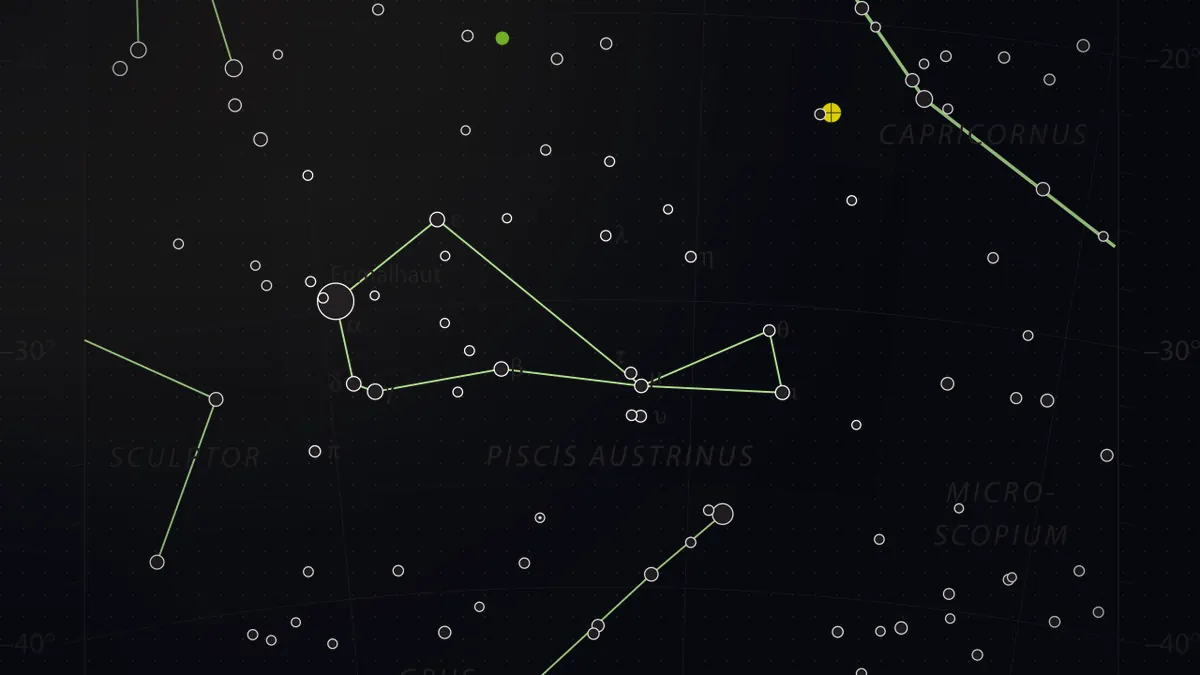
Piscis Austrinus is essentially one star, but what a star. Fomalhaut sits alone in a large empty stretch of the autumn sky, with no bright companions anywhere near it, which has earned it the nickname the Loneliest Star.
It is also one of the most scientifically famous stars of the past twenty years. Fomalhaut is surrounded by a sharp-edged ring of dust and debris, and in 2008 it hosted what was announced as the first exoplanet ever directly photographed in visible light: an object that then proceeded to disappear.
Where to find Piscis Austrinus
Fomalhaut is easy precisely because there is nothing else around it. Look low in the southern sky on an autumn evening from the northern hemisphere, or high overhead in spring from the southern one.
The reliable route is the Great Square of Pegasus. Take the Square's western edge, draw a line straight down (south), and extend it about three times the Square's height. The solitary bright star you land on is Fomalhaut.
The rest of the fish is a scatter of much fainter stars around it, requiring a dark sky. Most people never see anything here but Fomalhaut, and that is fine.
In sky coordinates Piscis Austrinus sits at right ascension 21h 27m and declination −24.8°. Declination is latitude by another name and right ascension is longitude, so the pair fixes the constellation at one point on the celestial sphere. It sits in the southern half of the sky, high for southern observers and low on the horizon for northern ones. In practice you can see it from anywhere south of latitude 55°N, including the whole southern hemisphere, and it stands highest in the evening sky around October.
What Piscis Austrinus actually looks like
A faint outline of a fish, with Fomalhaut marking its mouth. The fish is traditionally shown drinking the stream of water pouring from Aquarius's jar, which flows down from the north-east directly into it.
That connection is the constellation's real charm. Aquarius, the water bearer, tips his jar; the water runs down across the sky as a line of faint stars; the southern fish drinks it. It is one of the few places where two constellations form a single coherent scene.
The fish's body needs genuinely dark skies. In practice the constellation is Fomalhaut plus a suggestion.
The stars of Piscis Austrinus
-
Fomalhaut (Alpha Piscis Austrini, magnitude 1.16) — the eighteenth brightest star in the night sky, a young white star just 25 light years away and only a few hundred million years old. The name means 'the mouth of the fish'.
It was one of the four Royal Stars of Persia, the watcher of the south, alongside Aldebaran, Regulus and Antares.
Fomalhaut is encircled by a strikingly sharp ring of dust: a debris disc, the kind of structure from which planets form. In 2008 Hubble images revealed a moving point of light within it, announced as Fomalhaut b, the first exoplanet directly imaged in visible light. Later observations showed it fading and spreading out, and the current consensus is that it was not a planet at all but an expanding cloud of debris from a collision between two large bodies. Watching a planet turn into a collision is a rare and instructive thing to have witnessed.
-
Delta and Beta Piscis Austrini — faint stars marking the body.
The story behind the name
The southern fish is usually described as the parent of the two fish of Pisces, and it is shown drinking the water flowing from Aquarius's jar.
One Greek story connects it to the Syrian goddess Derceto, who fell into a lake and was saved by a large fish, afterwards placed in the sky in gratitude. That version links the constellation to older Near Eastern fish-deity traditions, which is consistent with the whole watery region the Babylonians called the Sea.
Fomalhaut carries its own weight of history. As one of the Royal Stars it was a seasonal marker in Persian astronomy around 3000 BC, and it appears in Arabic, Chinese and Indigenous Australian traditions. A lone bright star in an otherwise empty sky is memorable in any culture.
What else is hiding in Piscis Austrinus
Piscis Austrinus looks out of the galactic plane into fairly barren sky and has no Messier objects.
- Fomalhaut's debris disc — not visible to amateurs, but it is the reason this constellation appears in professional literature so often. The ring's sharp inner edge suggests shepherding by unseen planets, and it is one of the best-studied planetary systems in formation.
- NGC 7314 — a spiral galaxy with an active nucleus, reachable in a medium telescope as a faint elongated smudge.
- Fomalhaut C — a red dwarf that shares Fomalhaut's motion through space and also has its own debris disc, making this one of the very few known systems with two debris discs.
Realistically the observing plan here is: find Fomalhaut, appreciate how isolated it is, and know what is going on around it.
When and where to see it
Best placed in the evening sky in October, through the northern autumn and southern spring.
It lies well south of the celestial equator. Southern observers get Fomalhaut high and brilliant; northern observers see it low in the south, and from northern Britain or Canada it barely clears the horizon. Because it sits low for northern viewers, atmospheric turbulence often makes it twinkle dramatically.
Fomalhaut is bright enough for any sky, including cities: its isolation actually helps, since there is nothing nearby to confuse it with. The rest of the fish needs genuinely dark conditions and is a low-priority target. This is a one-star constellation, and it is a very good star.
Piscis Austrinus at a glance
| Name | Piscis Austrinus |
| Abbreviation | PsA |
| Genitive form | Piscis Austrini |
| Meaning | the Southern Fish |
| Family | Heavenly Waters family |
| First recorded | ancient (Ptolemy) |
| Right ascension | 21h 27m |
| Declination | −24.8° |
| Area | 245 square degrees (60th largest of 88) |
| Main stars in the figure | 7 |
| Stars brighter than magnitude 3 | 1 |
| Named Bayer / Flamsteed stars | 21 |
| Brightest star | Fomalhaut (α PsA) (magnitude 1.16) |
| Messier objects | None |
| Meteor showers | ? |
| Visible from | Anywhere south of latitude 55°N, including the whole southern hemisphere |
| Best seen at 9 pm in | October |
| Bordering constellations | Aquarius, Capricornus, Grus, Microscopium, Sculptor |
Where to go next
Its neighbours in the sky
Piscis Austrinus borders all of these, which makes them the natural next targets once you can pick it out: Aquarius, Capricornus, Grus, Microscopium, Sculptor.
The rest of the Heavenly Waters family
Piscis Austrinus belongs to the Heavenly Waters family: constellations tied to water, ships and the sea. The others are: Carina, Columba, Delphinus, Equuleus, Eridanus, Puppis, Pyxis, Vela.
Start from the beginning
Not sure where to begin? The guide to all 88 constellations explains how the sky is divided, what a constellation really is, and links to each of the 88.
Star chart: Piscis Austrinus IAU chart by IAU and Sky & Telescope magazine (Roger Sinnott & Rick Fienberg), used under CC BY 3.0. Observing data cross-checked against Wikipedia's Piscis Austrinus entry.