Carina is the single best argument for travelling south. It contains Canopus, the second brightest star in the entire night sky, and the Carina Nebula, which is four times larger and considerably brighter than the Orion Nebula.
Almost nobody in the northern hemisphere has seen either. Carina sits so far south that from Europe, most of North America and northern Asia it never rises. It is the great constellation the north misses out on.
Where to find Carina
From the southern hemisphere, Carina is unmissable. Find Canopus (a brilliant white star, the brightest thing in that part of the sky after Sirius), and you have the keel's western end.
From there the constellation runs east along the Milky Way towards Crux, the Southern Cross. Between Canopus and Crux you will notice a conspicuous bright patch in the Milky Way that looks like a detached piece of it: that is the Carina Nebula, visible to the naked eye.
Nearby, four stars form the False Cross, which catches out a lot of people looking for the real Southern Cross. The False Cross is larger and its stars are more evenly spaced.
In sky coordinates Carina sits at right ascension 6h 02m and declination −50.8°. Declination is latitude by another name and right ascension is longitude, so the pair fixes the constellation at one point on the celestial sphere. It is a far-southern constellation, so southern observers own it and much of the northern hemisphere never sees it at all. Practically speaking it is visible from anywhere south of latitude 20°N, including the whole southern hemisphere, with the best evening views around March.
What Carina actually looks like
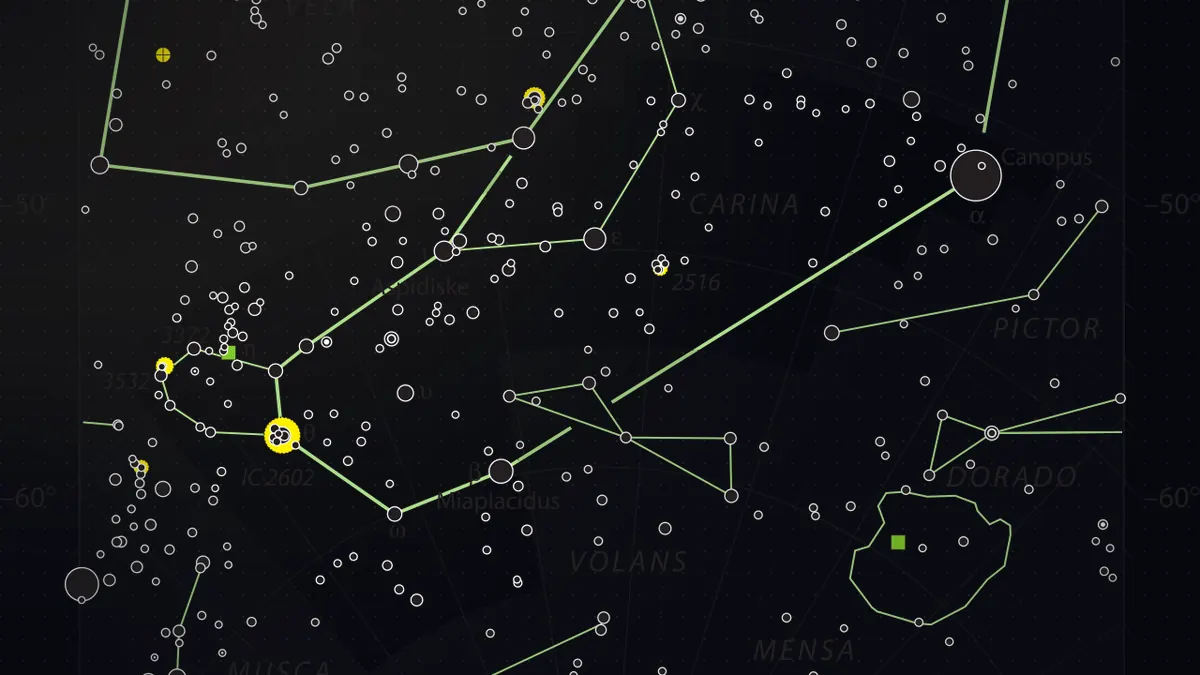
A long, curving chain of bright stars running through the Milky Way: the keel of a ship. Canopus marks one end, and the chain runs east through several second-magnitude stars.
Carina used to be part of something much bigger. Argo Navis, the ship of Jason and the Argonauts, was the largest constellation ever recognised, so unwieldy that in the eighteenth century Nicolas-Louis de Lacaille split it into three: Carina the keel, Puppis the stern, and Vela the sails.
That split is why the Bayer letters look broken. The three modern constellations share one original sequence, so Carina has an Alpha and Beta but Puppis begins at Zeta.
The stars of Carina
- Canopus (Alpha Carinae, magnitude −0.74) — the second brightest star in the night sky after Sirius, a white supergiant about 310 light years away. Because it is bright and far from the ecliptic, it is widely used for spacecraft navigation: many probes carry a 'Canopus star tracker' to orient themselves.
- Miaplacidus (Beta Carinae) — the second brightest here and one of the stars of the False Cross.
- Avior (Epsilon Carinae) — an orange giant and blue companion, also part of the False Cross.
- Eta Carinae — one of the most extraordinary stars known. A hypergiant of over 100 solar masses that in the 1840s underwent the Great Eruption, briefly becoming the second brightest star in the sky before fading. It survived, wrapped in the expanding Homunculus Nebula it threw off. It is expected to explode as a supernova, possibly within a human lifetime.
The story behind the name
Carina carries the mythology of Argo Navis, the ship built for Jason and the Argonauts to sail in search of the Golden Fleece: the same fleece represented by the constellation Aries. Ptolemy listed Argo as one figure; it covered such an enormous area that navigating it as a single constellation was impractical.
Lacaille dismantled it in the 1750s during his survey from the Cape of Good Hope, dividing it into keel, stern and sails. Argo Navis is the only one of Ptolemy's 48 constellations that no longer exists.
Canopus itself carries a great deal of separate history. It was the southern reference star for Egyptian and Arabic navigators, and in Vedic astronomy it is Agastya, named after a revered sage. Its appearance low on the southern horizon was a seasonal marker across several cultures.
What else is hiding in Carina
- The Carina Nebula (NGC 3372) — one of the largest and brightest nebulae in the sky, roughly four times the size of the Orion Nebula and easily visible to the naked eye as a bright patch of the Milky Way. It contains Eta Carinae, the dark Keyhole Nebula silhouetted against it, and some of the most massive stars known. In binoculars it is magnificent; in a telescope you can spend an entire night inside it.
- NGC 3532, the Wishing Well Cluster — a rich open cluster of some 150 stars, and the first object ever observed by the Hubble Space Telescope. Superb in binoculars.
- NGC 2516, the Southern Beehive — a bright, large open cluster, visible to the naked eye.
- IC 2602, the Southern Pleiades — a naked-eye cluster around the star Theta Carinae, and a lovely wide-field target.
When and where to see it
Best placed in the evening sky in March, riding high through the southern summer and autumn.
This is the constellation where hemisphere is everything. Carina is circumpolar from much of the southern hemisphere: visible every night of the year from Australia, southern Africa and southern South America. From the northern hemisphere it is largely invisible; Canopus can be glimpsed from the southern United States and the Mediterranean, but the nebula and clusters never rise.
If you ever travel south of the equator, make Carina the first thing you look for after the Southern Cross. Binoculars and a dark sky are all you need, and the Carina Nebula alone justifies the effort.
Carina at a glance
| Name | Carina |
| Abbreviation | Car |
| Genitive form | Carinae |
| Meaning | the keel |
| Family | Heavenly Waters family |
| First recorded | ancient (Ptolemy); 1756, Lacaille, split from Argo Navis |
| Right ascension | 6h 02m |
| Declination | −50.8° |
| Area | 494 square degrees (34th largest of 88) |
| Main stars in the figure | 9 |
| Stars brighter than magnitude 3 | 6 |
| Named Bayer / Flamsteed stars | 52 |
| Brightest star | Canopus (α Car) (magnitude −0.72) |
| Messier objects | None |
| Meteor showers | Alpha Carinids, Eta Carinids |
| Visible from | Anywhere south of latitude 20°N, including the whole southern hemisphere |
| Best seen at 9 pm in | March |
| Bordering constellations | Centaurus, Chamaeleon, Musca, Pictor, Puppis, Vela, Volans |
Where to go next
Its neighbours in the sky
Carina borders all of these, which makes them the natural next targets once you can pick it out: Centaurus, Chamaeleon, Musca, Pictor, Puppis, Vela, Volans.
The rest of the Heavenly Waters family
Carina belongs to the Heavenly Waters family: constellations tied to water, ships and the sea. The others are: Columba, Delphinus, Equuleus, Eridanus, Piscis Austrinus, Puppis, Pyxis, Vela.
Start from the beginning
Not sure where to begin? The guide to all 88 constellations explains how the sky is divided, what a constellation really is, and links to each of the 88.
Star chart: Carina IAU chart by IAU and Sky & Telescope magazine (Roger Sinnott & Rick Fienberg), used under CC BY 3.0. Observing data cross-checked against Wikipedia's Carina entry.