Pyxis is a small, faint constellation representing a mariner's compass, tucked into the Milky Way beside the remains of the great ship. It has three stars of any note and nothing brighter than magnitude 3.7.
Its one genuinely remarkable feature is T Pyxidis, a recurrent nova that has erupted at least six times since 1890. Each eruption brightens it by a factor of ten thousand, and astronomers have argued for years about whether the system is building towards something much bigger.
Where to find Pyxis
Pyxis sits between Puppis and Antlia, east of Canis Major and south of Hydra's head.
The practical route is to start at Sirius, move east into Puppis, and keep going east past the bright clusters until the Milky Way starts to thin. The three modest stars you find in a short north-south line are Pyxis.
There is no shortcut and no bright anchor. It is a constellation you find by careful navigation from its neighbours, and from a light-polluted site you will not find it at all.
In sky coordinates Pyxis sits at right ascension 9h 00m and declination −30.0°. Those two numbers work like a grid reference. Right ascension runs around the sky the way longitude runs around the Earth, and declination measures north and south the way latitude does. It sits in the southern half of the sky, high for southern observers and low on the horizon for northern ones. In practice that means you can find it from anywhere south of latitude 50°N, including the whole southern hemisphere; it rides highest in the evening sky in March.
What Pyxis actually looks like
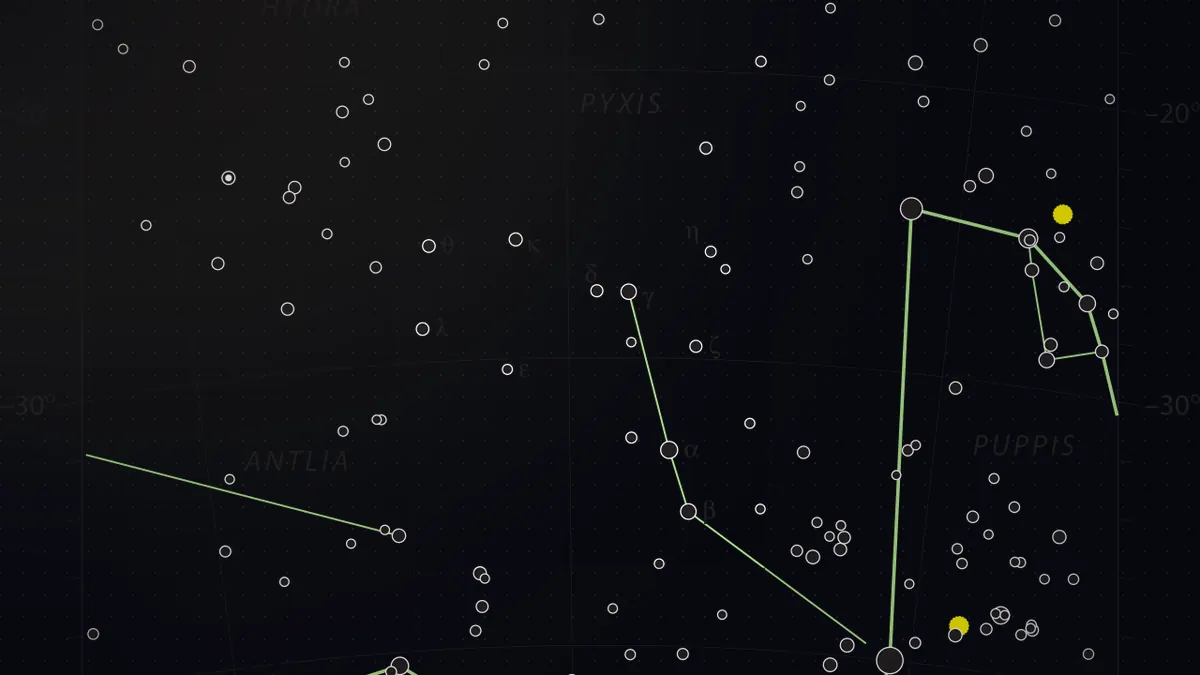
Three faint stars in a short, slightly bent line. That is the entire figure: Alpha, Beta and Gamma Pyxidis.
The line is meant to represent the needle or the box of a ship's compass, which is at least a shape that suits three stars in a row. It is one of the more modest constellations in the sky and does not pretend otherwise.
Because it sits in the Milky Way, the surrounding star field is richer than the constellation's own stars suggest, and sweeping the area with binoculars is more rewarding than looking at the figure itself.
The stars of Pyxis
- Alpha Pyxidis (magnitude 3.7) — the brightest star, a blue giant roughly 880 light years away and genuinely luminous; it looks faint only because of distance.
- Beta Pyxidis — a yellow giant, second brightest.
- Gamma Pyxidis — an orange giant completing the short line.
- T Pyxidis — the star that makes the constellation interesting. It is a recurrent nova: a white dwarf pulling material off a close companion until enough accumulates to trigger a runaway thermonuclear explosion on its surface. It erupted in 1890, 1902, 1920, 1944, 1967 and 2011, jumping from around magnitude 15 to magnitude 6 or 7: briefly within binocular reach. There has been sustained debate over whether the white dwarf is gaining mass towards the limit at which it would detonate as a Type Ia supernova.
The story behind the name
Pyxis has no mythology. Nicolas-Louis de Lacaille created it in the 1750s during his survey from the Cape of Good Hope, and like most of his creations it honours an instrument rather than a god or a hero.
Its position is deliberate: a compass placed beside the fragments of the ship Argo Navis, as if left on deck. Lacaille was dismantling Argo at the same time, so putting navigational equipment next to the wreck was a small, sly piece of celestial arrangement.
There was an attempt to fold it back into the ship. John Herschel proposed renaming the area Malus, the mast, to keep the whole nautical assembly coherent, and Bode had earlier tried a similar reorganisation. Neither took, and the compass survived the IAU's 1922 settlement while the mast did not.
What else is hiding in Pyxis
Pyxis is modest, with no Messier objects, but the Milky Way background helps.
- NGC 2818 — an unusual object: a planetary nebula that appears to sit inside an open cluster. Genuine cases of this are extremely rare, since clusters usually disperse before their stars reach the planetary nebula stage, and whether these two are truly associated has been debated. Either way it is a striking field in a larger telescope.
- NGC 2627 — a modest open cluster, reachable in small instruments.
- T Pyxidis — worth knowing the location. Between eruptions it is far too faint for casual observing, but when it goes it becomes a binocular object within hours. Knowing where to point is the whole game with recurrent novae.
Realistically, Pyxis is a constellation you tick off and a location you remember for the next time T Pyxidis makes the news.
When and where to see it
Best placed in the evening sky in March, during the southern autumn and northern spring.
It lies south of the celestial equator but reaches far enough north to be visible low from much of the northern hemisphere. Southern observers get it comfortably high.
Faintness is the obstacle. From a city Pyxis vanishes entirely, and even from a suburb the three stars are a struggle. Under a dark sky the line is easy enough, and NGC 2818 makes a decent telescope target. Treat this as a completist's constellation with one genuinely dramatic star hiding in it.
Pyxis at a glance
| Name | Pyxis |
| Abbreviation | Pyx |
| Genitive form | Pyxidis |
| Meaning | The compass box |
| Family | Heavenly Waters family |
| First recorded | 1756, Lacaille, as Pyxis Nautica |
| Right ascension | 9h 00m |
| Declination | −30.0° |
| Area | 221 square degrees (65th largest of 88) |
| Main stars in the figure | 3 |
| Stars brighter than magnitude 3 | 0 |
| Named Bayer / Flamsteed stars | 10 |
| Brightest star | α Pyx (magnitude 3.68) |
| Messier objects | None |
| Meteor showers | None |
| Visible from | Anywhere south of latitude 50°N, including the whole southern hemisphere |
| Best seen at 9 pm in | March |
| Bordering constellations | Antlia, Hydra, Puppis, Vela |
Where to go next
Its neighbours in the sky
These constellations share a border with Pyxis, so once you have found it you already know where to look next: Antlia, Hydra, Puppis, Vela.
The rest of the Heavenly Waters family
Pyxis belongs to the Heavenly Waters family: constellations tied to water, ships and the sea. The others are: Carina, Columba, Delphinus, Equuleus, Eridanus, Piscis Austrinus, Puppis, Vela.
Start from the beginning
New to all this? The 88 constellations: a complete beginner's guide explains what a constellation actually is, how the sky is divided up, and lists all 88 with a link to each one.
Star chart: Pyxis IAU chart by IAU and Sky & Telescope magazine (Roger Sinnott & Rick Fienberg), used under CC BY 3.0. Observing data cross-checked against Wikipedia's Pyxis entry.