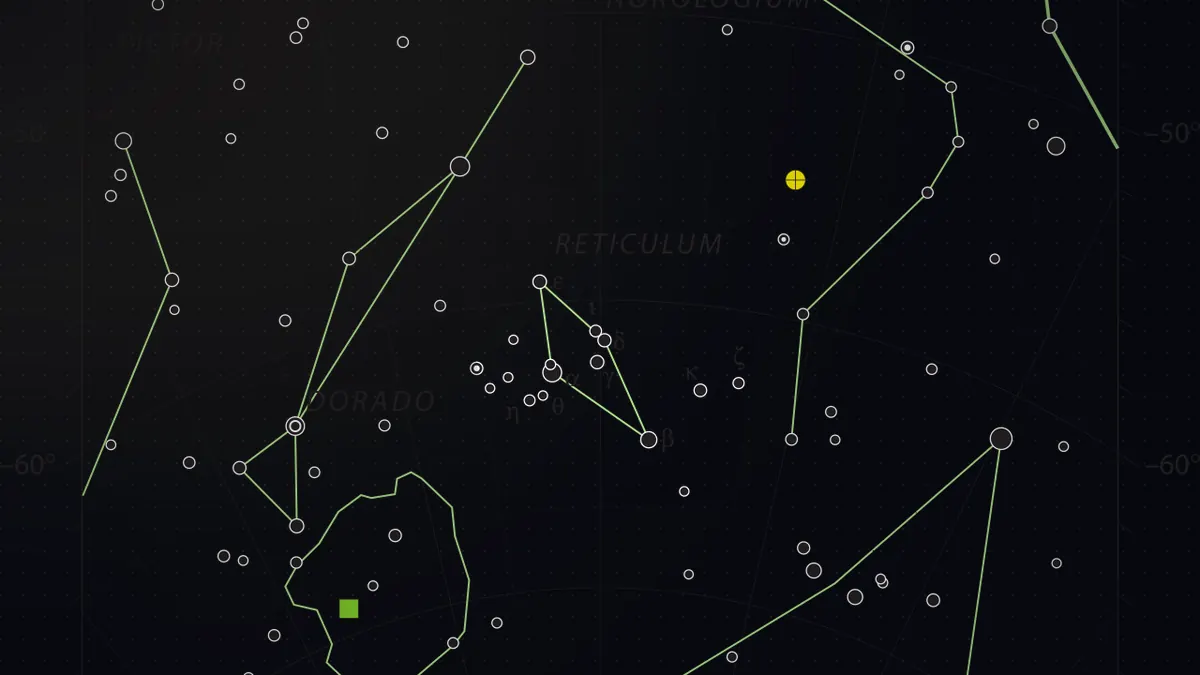
Reticulum is a small, faint constellation near the Large Magellanic Cloud, named after the reticle: the grid of fine lines in a telescope eyepiece used to measure star positions precisely.
It is far better known outside astronomy than within it, because of Zeta Reticuli. A pair of Sun-like stars here became the centrepiece of one of the most famous UFO stories of the twentieth century, and the name has appeared in science fiction ever since.
Where to find Reticulum
Reticulum sits between Achernar in Eridanus and the Large Magellanic Cloud in Dorado.
Find Achernar — a brilliant star at the end of the celestial river — then move south and east towards the Large Magellanic Cloud. The small, compact group of faint stars you pass through is Reticulum.
Its brightest star is magnitude 3.3, so a moderately dark sky is enough. It is small and reasonably tidy, which makes it easier to be sure of than some of the sprawling faint southern constellations.
In sky coordinates Reticulum sits at right ascension 3h 13m and declination −52.7°. Declination is latitude by another name and right ascension is longitude, so the pair fixes the constellation at one point on the celestial sphere. It is a far-southern constellation, so southern observers own it and much of the northern hemisphere never sees it at all. You can see it from anywhere south of latitude 23°N, including the whole southern hemisphere, and it sits highest after dark in December.
What Reticulum actually looks like
A small, compact diamond or kite of four faint stars. It is modest but tidy, and the shape holds together once found.
Lacaille created it in the 1750s as Reticulus Rhomboidalis, the rhomboidal reticle, honouring the measuring grid in the eyepiece of the instrument he used to make his southern survey. The diamond shape of the constellation deliberately echoes the rhombus of the reticle itself.
It is one of the more self-referential constellations in the sky: an astronomer naming a group of stars after the piece of equipment he was using to measure those very stars.
The stars of Reticulum
-
Alpha Reticuli (magnitude 3.3) — the brightest star, a yellow giant about 160 light years away.
-
Beta Reticuli — an orange giant, second brightest.
-
Zeta Reticuli — a pair of Sun-like stars about 39 light years away, gravitationally bound but very widely separated. Both are close analogues of the Sun, slightly older and metal-poor. Under a dark sky the pair can be split with the naked eye, which is a satisfying thing to manage.
Zeta Reticuli became famous through the Betty and Barney Hill case of 1961, in which a claimed star map drawn under hypnosis was later interpreted by an amateur astronomer as depicting this system. The identification is not accepted by astronomers and the reasoning has been heavily criticised, but the name entered popular culture permanently.
The story behind the name
There is no mythology. Reticulum is a Lacaille creation from the 1750s.
The reticle he honoured was central to his method. Measuring a star's position accurately requires a fixed reference grid in the eyepiece against which to time the star's passage. Lacaille used that technique to catalogue nearly 10,000 southern stars in about two years, which was an extraordinary rate of work.
The Zeta Reticuli story is a much later addition and belongs to cultural history rather than astronomy. It is worth knowing about, both because people ask, and because it is a clean example of how a real, ordinary star system can acquire a reputation entirely unconnected to anything observed about it. The two stars themselves are genuinely interesting for a much better reason: they are among the closest solar twins we know.
What else is hiding in Reticulum
A small constellation with no Messier objects and limited contents.
- NGC 1559 — a barred spiral galaxy, the best target here. It is actively forming stars, has produced several supernovae, and has been observed by the James Webb Space Telescope. Reachable in a medium telescope as a small bright patch.
- NGC 1313, the Topsy Turvy Galaxy — a barred spiral with a conspicuously distorted, asymmetric structure and no obvious companion to explain it. It straddles the border with Reticulum's neighbours.
- Zeta Reticuli — the realistic naked-eye project. Splitting the two stars without optics under a dark sky is a genuinely nice observation, and you are looking at two stars very much like the Sun.
For a small faint constellation, that is a reasonable return.
When and where to see it
Best placed in the evening sky in January, through the southern summer.
Reticulum is a far-southern constellation and is effectively a southern-hemisphere object, circumpolar from much of it. From the northern hemisphere it never rises.
A moderately dark sky is enough for the diamond shape, and splitting Zeta Reticuli by eye needs genuinely dark conditions. NGC 1559 wants a telescope. Combine it with the Large Magellanic Cloud next door: Reticulum sits right on the route between Achernar and one of the finest objects in the southern sky.
Reticulum at a glance
| Name | Reticulum |
| Abbreviation | Ret |
| Genitive form | Reticuli |
| Meaning | the Reticle |
| Family | La Caille family |
| First recorded | 1756, Lacaille |
| Right ascension | 3h 13m |
| Declination | −52.7° |
| Area | 114 square degrees (82nd largest of 88) |
| Main stars in the figure | 4 |
| Stars brighter than magnitude 3 | 0 |
| Named Bayer / Flamsteed stars | 11 |
| Brightest star | α Ret (Rhombus) (magnitude 3.33) |
| Messier objects | None |
| Meteor showers | None |
| Visible from | Anywhere south of latitude 23°N, including the whole southern hemisphere |
| Best seen at 9 pm in | December |
| Bordering constellations | Dorado, Horologium, Hydrus |
Where to go next
Its neighbours in the sky
Everything here shares a border with Reticulum. Find one and the rest are a short hop away: Dorado, Horologium, Hydrus.
The rest of the La Caille family
Reticulum belongs to the La Caille family: eighteenth-century southern constellations named after instruments. The others are: Antlia, Caelum, Circinus, Fornax, Horologium, Mensa, Microscopium, Norma, Octans, Pictor, Sculptor, Telescopium.
Start from the beginning
Not sure where to begin? The guide to all 88 constellations explains how the sky is divided, what a constellation really is, and links to each of the 88.
Star chart: Reticulum IAU chart by IAU and Sky & Telescope magazine (Roger Sinnott & Rick Fienberg), used under CC BY 3.0. Observing data cross-checked against Wikipedia's Reticulum entry.