Caelum is one of the emptiest constellations in the sky. It is the eighth smallest, contains four stars of any note, has no Messier objects, no bright deep-sky targets, and nothing brighter than magnitude 4.4.
It is named after the engraving chisel: the burin used by engravers to cut lines into copper plates, which was how astronomical charts themselves were printed in the eighteenth century. Lacaille named a constellation after the tool that reproduced his own star maps.
Where to find Caelum
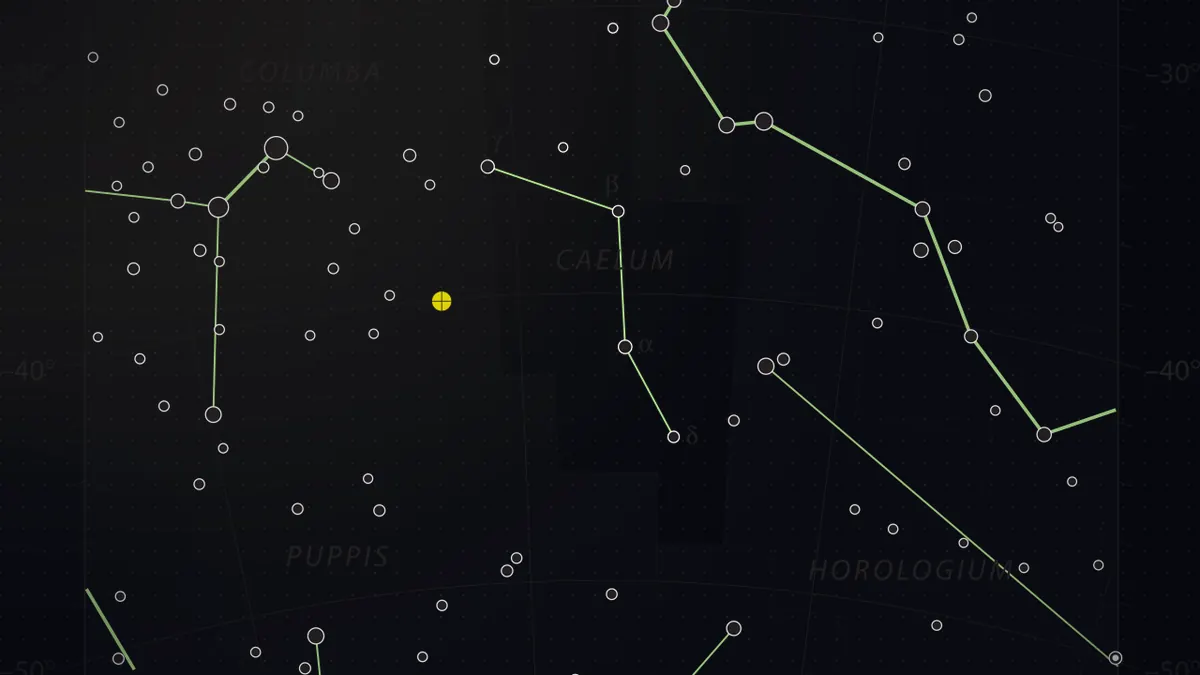
Caelum sits between Columba and Eridanus, south of Lepus, in a genuinely barren stretch of the southern sky.
The practical method is to bracket it. Find Columba below Canis Major, and the winding river of Eridanus to its west. Caelum is the narrow gap between them.
You need a dark sky and realistic expectations. Even under good conditions you are looking for four fifth-magnitude stars in a short line, and from a suburb there is nothing at all.
In sky coordinates Caelum sits at right ascension 4h 20m and declination −27.0°. If the units look unfamiliar, the idea behind them is not: declination is the sky's latitude, right ascension is its longitude, and together they place the constellation exactly. It sits in the southern half of the sky, high for southern observers and low on the horizon for northern ones. In practice that means you can find it from anywhere south of latitude 41°N, including the whole southern hemisphere; it rides highest in the evening sky in January.
What Caelum actually looks like
A short, faint line of four stars. There is no figure and no meaningful pattern.
Lacaille created it in the 1750s as Caela Sculptoris, the sculptor's chisels, and it was later shortened to Caelum. Early charts show a pair of crossed burins, the fine chisels used for engraving.
It is one of the more thankless of Lacaille's fourteen. He needed to assign every part of the southern sky to some constellation, and this narrow empty strip between the dove and the river had to be called something.
The stars of Caelum
- Alpha Caeli (magnitude 4.4) — the brightest star, a white main-sequence star about 66 light years away with a faint red dwarf companion.
- Gamma Caeli — an orange giant with a companion, a double star for medium telescopes.
- Beta Caeli — a white star, slightly fainter.
- RR Caeli — an eclipsing binary containing a white dwarf and a red dwarf orbiting each other in about seven hours, with a probable giant planet in the system. It is a good example of a post-common-envelope binary, a late stage in the life of a close double star.
That is the complete list of anything notable, and there is no point extending it artificially.
The story behind the name
There is no mythology. Caelum was created by Lacaille in the 1750s and named after the engraver's chisel.
The choice reflects something practical about eighteenth-century astronomy. Star charts and catalogues were reproduced by copperplate engraving: an engraver cut the lines and star positions into a metal plate with a burin, and prints were pulled from it. The accuracy of a published star map depended as much on the engraver's hand as on the astronomer's measurements.
Lacaille's fourteen constellations honour telescope, microscope, clock, octant, reticle, compasses, square, furnace, air pump, easel, sculptor's studio and engraver's chisel. Taken together they are a portrait of how scientific knowledge was actually produced and distributed in his era, which is a more interesting thing to put in the sky than it first appears.
What else is hiding in Caelum
Caelum is genuinely barren, and it is more useful to say so than to pad the list. There are no Messier objects and nothing within easy reach of a small telescope.
- HE0450-2958 — a peculiar quasar that appeared to have no host galaxy, which caused considerable discussion when reported. Later work suggested the host is simply very faint and hard to detect. Far beyond amateur reach, but a genuinely interesting object.
- NGC 1679 — an irregular galaxy, faint and requiring a large telescope under dark skies.
- RR Caeli — worth knowing about for the physics rather than the view.
If you are working through all 88 constellations, Caelum is one you tick off and move past. That is a perfectly respectable outcome for a constellation whose job was to fill a gap.
When and where to see it
Best placed in the evening sky in January, through the southern summer.
It lies south of the celestial equator, reaching to about 40°N, so it is technically visible low from much of the northern hemisphere. Southern observers get it higher, though there is little reward either way.
A dark sky is essential just to register the four stars. The honest recommendation is to find Caelum as part of a systematic tour of the southern sky, appreciate the story behind the name, and spend your remaining observing time on Columba or Eridanus next door: both of which have considerably more to offer.
Caelum at a glance
| Name | Caelum |
| Abbreviation | Cae |
| Genitive form | Caeli |
| Meaning | the chisel |
| Family | La Caille family |
| First recorded | 1756, Lacaille, as Caelum Sculptorium |
| Right ascension | 4h 20m |
| Declination | −27.0° |
| Area | 125 square degrees (81st largest of 88) |
| Main stars in the figure | 4 |
| Stars brighter than magnitude 3 | 0 |
| Named Bayer / Flamsteed stars | 8 |
| Brightest star | α Cae (magnitude 4.45) |
| Messier objects | None |
| Meteor showers | 1 |
| Visible from | Anywhere south of latitude 41°N, including the whole southern hemisphere |
| Best seen at 9 pm in | January |
| Bordering constellations | Columba, Dorado, Eridanus, Horologium, Lepus, Pictor |
Where to go next
Its neighbours in the sky
Caelum borders all of these, which makes them the natural next targets once you can pick it out: Columba, Dorado, Eridanus, Horologium, Lepus, Pictor.
The rest of the La Caille family
Caelum belongs to the La Caille family: eighteenth-century southern constellations named after instruments. The others are: Antlia, Circinus, Fornax, Horologium, Mensa, Microscopium, Norma, Octans, Pictor, Reticulum, Sculptor, Telescopium.
Start from the beginning
If you are starting from scratch, the complete beginner's guide to the 88 constellations covers what a constellation actually is, how the sky is carved up, and links to every one of them.
Star chart: Caelum IAU chart by IAU and Sky & Telescope magazine (Roger Sinnott & Rick Fienberg), used under CC BY 3.0. Observing data cross-checked against Wikipedia's Caelum entry.