Horologium is a long, thin, faint constellation winding along the edge of Eridanus, named after the pendulum clock.
That choice is more significant than it sounds. The pendulum clock, perfected by Christiaan Huygens in the 1650s, was the invention that made precise positional astronomy possible in the first place. Without accurate timekeeping you cannot measure right ascension, and without that you cannot make a star catalogue. Lacaille was honouring the instrument that made his own work feasible.
Where to find Horologium
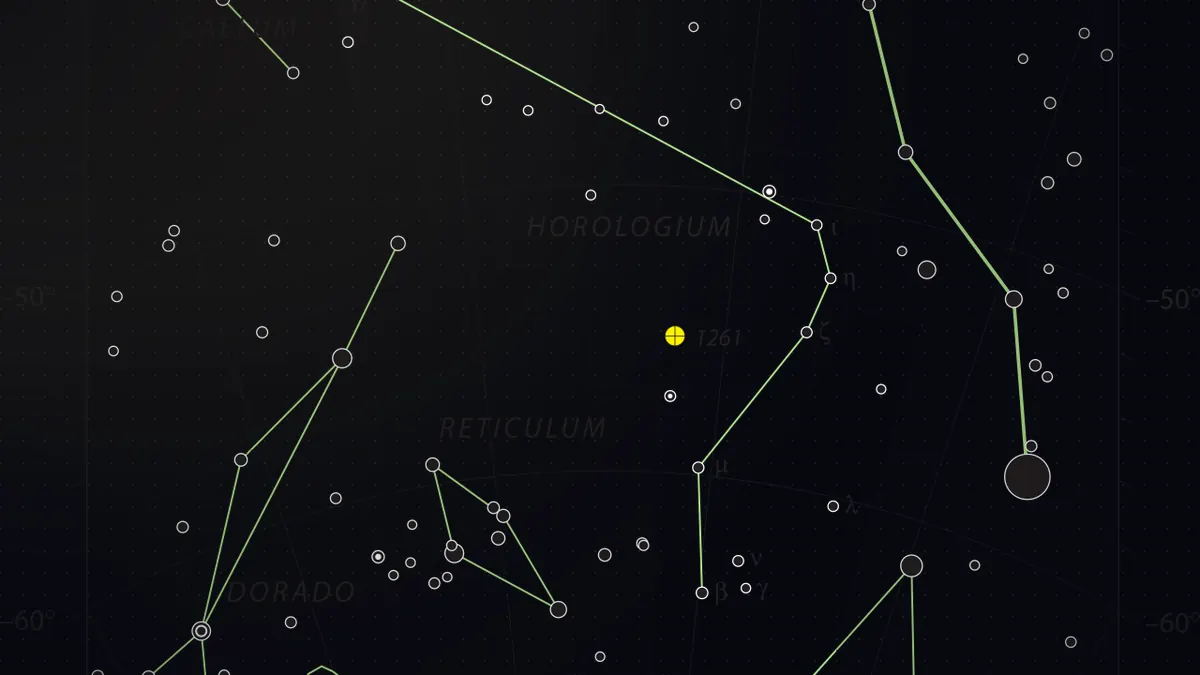
Horologium lies along the southern edge of Eridanus, between Achernar and the constellation Dorado.
Find Achernar, the bright star at the end of the celestial river, then look south and west. Horologium is the long, thin strip of faint stars running alongside.
It is genuinely difficult. Nothing reaches magnitude 3.8, the constellation is stretched over a long distance, and there is no compact pattern to lock onto. You need a dark sky and patience.
In sky coordinates Horologium sits at right ascension 2h 12m and declination −39.6°. Those two numbers work like a grid reference. Right ascension runs around the sky the way longitude runs around the Earth, and declination measures north and south the way latitude does. It sits in the southern half of the sky, high for southern observers and low on the horizon for northern ones. In practice that means you can find it from anywhere south of latitude 23°N, including the whole southern hemisphere; it rides highest in the evening sky in December.
What Horologium actually looks like
A long, thin, straggling line of faint stars with a small hook at one end. It is one of the more awkwardly shaped constellations, stretched out along the border of Eridanus.
Lacaille created it in the 1750s as Horologium Oscillitorium, the pendulum clock, later shortened. Early charts show a full pendulum clock with its weight and swinging bob, using the line of stars as the clock's case and pendulum.
With that image in mind the long thin shape makes more sense. You are meant to be seeing a tall clock case rather than a compact figure.
The stars of Horologium
- Alpha Horologii (magnitude 3.8) — the brightest star, an orange giant about 115 light years away.
- R Horologii — a Mira-type variable with one of the largest brightness ranges of any star, swinging between about magnitude 4.7 and 14.3 over roughly 13 months. At maximum it is an easy naked-eye object; at minimum you need a substantial telescope. Few stars change this dramatically, and following it through a full cycle is a genuinely rewarding long-term project.
- Iota Horologii — a Sun-like star hosting a giant planet, and thought to have formed in the same cluster as the Sun-like stars of the Hyades.
- TW Horologii — a carbon star with a deep red colour.
The story behind the name
There is no mythology. Horologium is a Lacaille creation from the 1750s, honouring the pendulum clock.
The tribute is technical rather than sentimental. Measuring a star's right ascension means timing precisely when it crosses the meridian, and that requires a clock accurate to seconds over hours. Christiaan Huygens's pendulum clock of 1656 was the first instrument capable of it, and it transformed astronomy from a discipline of angles into one of angles and time.
Lacaille's southern catalogue depended entirely on that technology. Naming a constellation after the clock, alongside the telescope, the reticle and the octant, amounts to a list of the equipment that made his expedition possible: a working astronomer's tribute to his own toolkit.
What else is hiding in Horologium
A faint constellation with no Messier objects and modest contents.
- NGC 1261 — a globular cluster, and the best conventional target here. It is reachable in a small to medium telescope as a compact fuzzy ball, resolving at the edges with more aperture.
- NGC 1512 — a barred spiral galaxy with a striking ring of star formation around its nucleus, a notable Hubble subject.
- The Horologium Supercluster — an enormous structure of galaxy clusters spanning hundreds of millions of light years, one of the larger known concentrations of matter in the universe. Not observable by amateurs, but a reminder that even the sky's dullest-looking regions have structure on the largest scales.
- R Horologii — the real observing project, and worth checking every month or two.
When and where to see it
Best placed in the evening sky in December, through the southern summer.
Horologium is a southern constellation reaching to about 30°N in its northernmost parts, but it is effectively a southern-hemisphere object.
You need a dark sky to trace the long thin shape at all. NGC 1261 is a worthwhile telescope target. But the best reason to learn Horologium is R Horologii: a star that goes from obvious to invisible and back over a little over a year. Checking on it periodically turns a forgettable constellation into something you have a genuine relationship with.
Horologium at a glance
| Name | Horologium |
| Abbreviation | Hor |
| Genitive form | Horologii |
| Meaning | The Pendulum Clock |
| Family | La Caille family |
| First recorded | 1756, Lacaille |
| Right ascension | 2h 12m |
| Declination | −39.6° |
| Area | 249 square degrees (58th largest of 88) |
| Main stars in the figure | 6 |
| Stars brighter than magnitude 3 | 0 |
| Named Bayer / Flamsteed stars | 10 |
| Brightest star | α Hor (magnitude 3.85) |
| Messier objects | None |
| Meteor showers | None |
| Visible from | Anywhere south of latitude 23°N, including the whole southern hemisphere |
| Best seen at 9 pm in | December |
| Bordering constellations | Caelum, Dorado, Eridanus, Hydrus, Reticulum |
Where to go next
Its neighbours in the sky
Horologium borders all of these, which makes them the natural next targets once you can pick it out: Caelum, Dorado, Eridanus, Hydrus, Reticulum.
The rest of the La Caille family
Horologium belongs to the La Caille family: eighteenth-century southern constellations named after instruments. The others are: Antlia, Caelum, Circinus, Fornax, Mensa, Microscopium, Norma, Octans, Pictor, Reticulum, Sculptor, Telescopium.
Start from the beginning
New to all this? The 88 constellations: a complete beginner's guide explains what a constellation actually is, how the sky is divided up, and lists all 88 with a link to each one.
Star chart: Horologium IAU chart by IAU and Sky & Telescope magazine (Roger Sinnott & Rick Fienberg), used under CC BY 3.0. Observing data cross-checked against Wikipedia's Horologium entry.