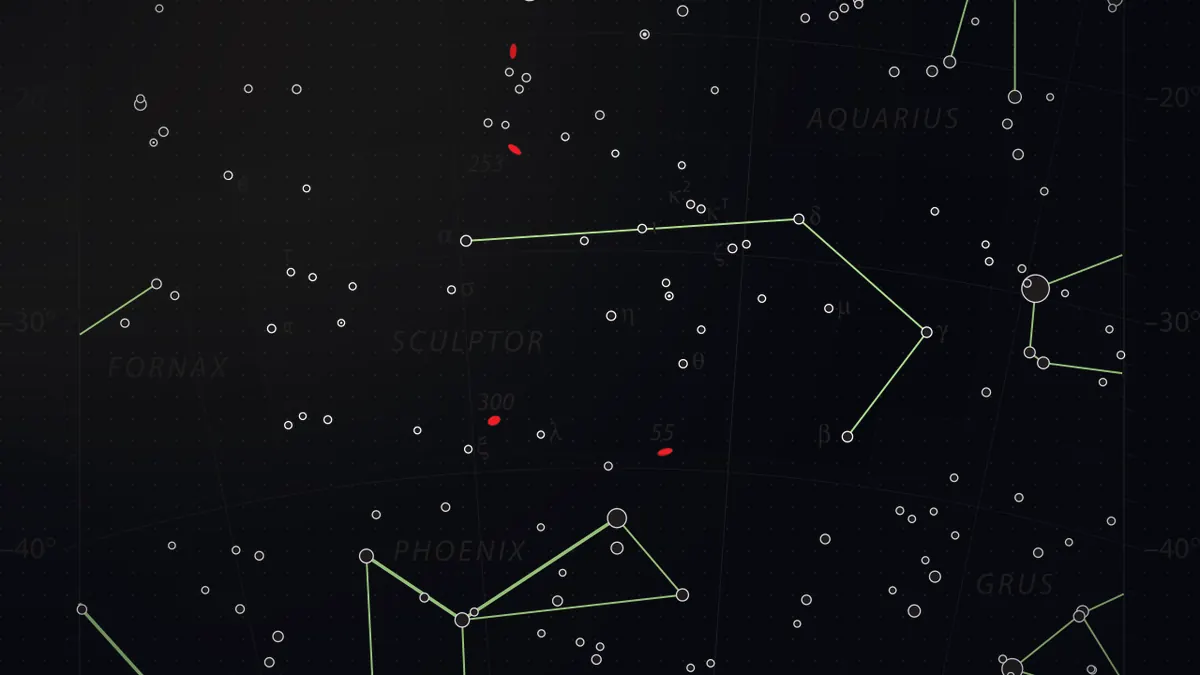
Sculptor is faint — nothing here reaches magnitude 4 — but its position is extraordinary. It contains the South Galactic Pole, the direction pointing straight out of the plane of the Milky Way.
That means there is almost no dust in the way, and we get an unusually clear view of the universe beyond. The result is one of the best galaxies in the sky for amateur telescopes: NGC 253, the Sculptor Galaxy, a large, bright, edge-on spiral bursting with star formation.
Where to find Sculptor
Sculptor sits south of Cetus and east of Fomalhaut, in a dim region of the autumn sky.
Because its own stars are so faint, navigate from the neighbours. Find Fomalhaut, the isolated bright star, and look east and south. Or find Deneb Kaitos in Cetus and drop south.
For NGC 253, the galaxy is genuinely easier to find than the constellation. Under a dark sky it is visible in binoculars as an elongated smudge, and it is bright enough to be one of the first galaxies many observers ever see.
In sky coordinates Sculptor sits at right ascension 0h 00m and declination −30.0°. Right ascension is the sky's version of longitude and declination its version of latitude, so those two numbers pin the constellation to one spot on the celestial sphere the way a map reference pins a town. It sits in the southern half of the sky, high for southern observers and low on the horizon for northern ones. Practically speaking it is visible from anywhere south of latitude 50°N, including the whole southern hemisphere, with the best evening views around November.
What Sculptor actually looks like
There is essentially no figure: a scatter of fourth and fifth magnitude stars with no pattern worth tracing.
Nicolas-Louis de Lacaille created it in the 1750s during his survey from the Cape of Good Hope, originally naming it Apparatus Sculptoris, the sculptor's studio or apparatus. The name was later shortened to Sculptor.
Lacaille filled the southern sky with instruments and tools of the Enlightenment: a furnace, a clock, a telescope, a microscope, a chisel, a compass, an air pump. Where the Greeks put heroes and the Dutch put exotic animals, the eighteenth century put laboratory equipment.
The stars of Sculptor
- Alpha Sculptoris (magnitude 4.3) — the brightest star, a blue-white giant several hundred light years away.
- Beta Sculptoris — a blue-white star, second brightest.
- Gamma Sculptoris — an orange giant.
- R Sculptoris — a red giant carbon star surrounded by a spiral shell of ejected material, imaged by the ALMA array. The spiral was carved by a companion star as the giant shed its outer layers, and it is one of the more beautiful structures found around a dying star.
The stars are unremarkable. The value of Sculptor lies entirely in what you can see through it.
The story behind the name
There is no mythology. Sculptor is a Lacaille creation from the 1750s, named after the sculptor's workshop.
Lacaille spent two years at the Cape of Good Hope cataloguing nearly 10,000 southern stars: an enormous undertaking with the instruments of the time. He introduced fourteen new constellations, all named after the arts, sciences and crafts of his era.
It was a deliberate statement. The northern sky was full of gods and monsters inherited from antiquity; Lacaille filled the south with the tools of reason. Some contemporaries found it prosaic and several of his names were mocked, but all fourteen survived into the modern 88, which is a better hit rate than most constellation-makers achieved.
What else is hiding in Sculptor
The clear view out of the galaxy makes this excellent extragalactic territory.
- NGC 253, the Sculptor Galaxy — one of the brightest galaxies in the sky and a genuine showpiece. It is a large edge-on spiral about 11 million light years away, undergoing an intense burst of star formation. In binoculars it is an obvious elongated glow; in a telescope it shows mottled structure and dust lanes. Many observers rate it second only to Andromeda among galaxies visible to amateurs.
- NGC 288 — a loose globular cluster conveniently close to NGC 253, so you can take in both in one session.
- The Sculptor Dwarf Galaxy — a faint satellite of the Milky Way, important scientifically and essentially invisible visually.
- The Cartwheel Galaxy — a ring galaxy formed by a head-on collision, and an early James Webb Space Telescope target.
When and where to see it
Best placed in the evening sky in November, through the southern spring and northern autumn.
Sculptor sits south of the celestial equator but reaches far enough north to be visible from most of the world. Southern observers get NGC 253 high overhead, which makes a real difference for a galaxy.
The constellation needs dark skies; the galaxy is more forgiving and can be picked up from a decent suburban site with binoculars. If you have never seen a galaxy other than Andromeda, NGC 253 is the best next step: big, bright and genuinely structured.
Sculptor at a glance
| Name | Sculptor |
| Abbreviation | Scl |
| Genitive form | Sculptoris |
| Meaning | the Sculptor |
| Family | La Caille family |
| First recorded | 1756, Lacaille, as Apparatus Sculptoris |
| Right ascension | 0h 00m |
| Declination | −30.0° |
| Area | 475 square degrees (36th largest of 88) |
| Main stars in the figure | 5 |
| Stars brighter than magnitude 3 | 0 |
| Named Bayer / Flamsteed stars | 18 |
| Brightest star | α Scl (magnitude 4.30) |
| Messier objects | None |
| Meteor showers | None |
| Visible from | Anywhere south of latitude 50°N, including the whole southern hemisphere |
| Best seen at 9 pm in | November |
| Bordering constellations | Aquarius, Cetus, Fornax, Grus, Phoenix, Piscis Austrinus |
Where to go next
Its neighbours in the sky
Sculptor borders all of these, which makes them the natural next targets once you can pick it out: Aquarius, Cetus, Fornax, Grus, Phoenix, Piscis Austrinus.
The rest of the La Caille family
Sculptor belongs to the La Caille family: eighteenth-century southern constellations named after instruments. The others are: Antlia, Caelum, Circinus, Fornax, Horologium, Mensa, Microscopium, Norma, Octans, Pictor, Reticulum, Telescopium.
Start from the beginning
Not sure where to begin? The guide to all 88 constellations explains how the sky is divided, what a constellation really is, and links to each of the 88.
Star chart: Sculptor IAU chart by IAU and Sky & Telescope magazine (Roger Sinnott & Rick Fienberg), used under CC BY 3.0. Observing data cross-checked against Wikipedia's Sculptor entry.