Phoenix is the mythical firebird that burns and is reborn from its own ashes: one of the few Dutch southern constellations named after a creature that never existed.
It is a modest constellation, with one star above magnitude 2.5, sitting in the southern sky near Achernar. Its contents are mostly faint and distant: a dwarf galaxy, a very large galaxy cluster, and a meteor shower that appeared spectacularly once and has been quiet ever since.
Where to find Phoenix
Phoenix sits between Achernar in Eridanus and Fomalhaut in Piscis Austrinus: two bright, isolated stars that bracket it neatly.
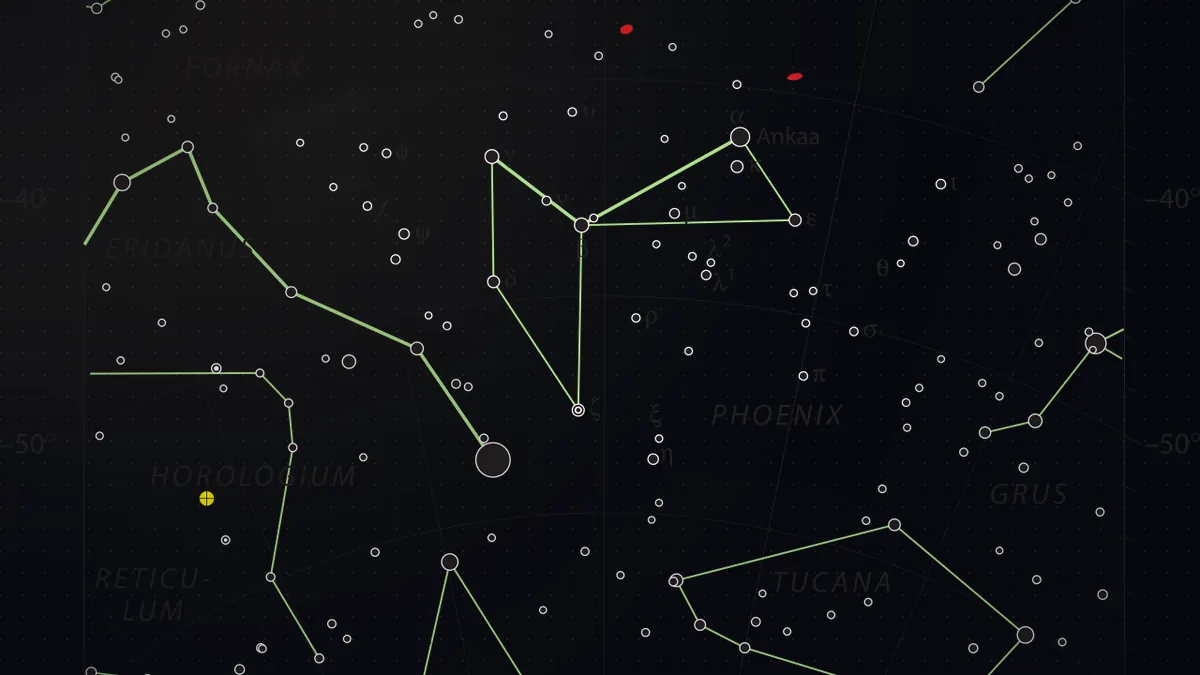
Find those two, then look in the region between them, closer to Achernar. The moderately bright star you find is Ankaa, the constellation's anchor, with fainter stars forming a shallow shape around it.
From the southern hemisphere it is comfortably placed on spring evenings. From mid-northern latitudes only the northernmost part clears the horizon, and Ankaa is about all you will manage.
In sky coordinates Phoenix sits at right ascension 23h 26m and declination −39.3°. If the units look unfamiliar, the idea behind them is not: declination is the sky's latitude, right ascension is its longitude, and together they place the constellation exactly. It sits in the southern half of the sky, high for southern observers and low on the horizon for northern ones. In practice that means you can find it from anywhere south of latitude 32°N, including the whole southern hemisphere; it rides highest in the evening sky in November.
What Phoenix actually looks like
A shallow, boat-like or wishbone arrangement of moderately faint stars around Ankaa. There is no bird to be seen, and the figure requires the usual generosity.
Phoenix is another of the twelve constellations introduced by Keyser and de Houtman and published by Plancius in 1598, appearing in Bayer's Uranometria in 1603.
It is the largest of the group of southern bird constellations (Phoenix, Grus, Pavo and Tucana), which sit near each other and are sometimes collectively called the Southern Birds.
The stars of Phoenix
- Ankaa (Alpha Phoenicis, magnitude 2.4) — the brightest star, an orange giant about 85 light years away. The name derives from an Arabic word for the phoenix.
- Beta Phoenicis — a binary of two yellow giants, splittable in a small telescope.
- Zeta Phoenicis — an eclipsing binary of the Algol type, dropping from magnitude 3.9 to 4.4 every 1.7 days. The change is followable by eye against nearby comparison stars, and the short period means you can watch a complete cycle in a couple of nights.
- Gliese 915 — a nearby white dwarf, the burnt-out remnant of a star, about 26 light years away.
The story behind the name
The phoenix is a mythical bird that lives for centuries, burns itself on a pyre, and is reborn from the ashes. The story appears in Egyptian, Greek, Persian and later Christian traditions, always as a symbol of renewal and resurrection.
The constellation itself dates only from the 1590s. Keyser and de Houtman gave the southern sky its bird constellations, and choosing a mythical one alongside real toucans and peacocks was a deliberate flourish.
Some earlier Arabic and Chinese traditions had figures in roughly this part of the sky, and there are claims that a phoenix-like bird was recognised here earlier, but the evidence is thin, and the modern constellation is best understood as a Dutch creation with a very old name attached to it.
What else is hiding in Phoenix
Faint constellation, mostly distant contents, and no Messier objects.
- The Phoenix Dwarf Galaxy — a small, faint member of our Local Group of galaxies, about 1.4 million light years away. It is extremely diffuse and essentially a photographic target.
- The Phoenix Cluster — a colossal galaxy cluster around 5.7 billion light years away, and one of the most massive known. Its central galaxy is forming stars at an extraordinary rate, hundreds of times faster than typical, making it one of the most striking objects in extragalactic astronomy.
- Robert's Quartet — a compact group of four interacting galaxies, visibly distorted, and a good target for a larger telescope.
- The Phoenicids — a meteor shower that produced a strong display in 1956 and has been almost entirely inactive since. Its parent comet, 289P/Blanpain, was lost for over a century before being rediscovered.
When and where to see it
Best placed in the evening sky in November, through the southern spring.
Phoenix is a southern constellation reaching to about 30°N, so the northern edge is glimpsable from southern Europe and the southern United States, but it belongs to the southern hemisphere.
Ankaa is easy enough; the rest of the figure needs a reasonably dark sky. The deep-sky objects are demanding. The most rewarding project here is Zeta Phoenicis: an eclipsing binary with a short enough period that you can genuinely watch it fade and recover over two evenings, which is a rare and satisfying thing to observe directly.
Phoenix at a glance
| Name | Phoenix |
| Abbreviation | Phe |
| Genitive form | Phoenicis |
| Meaning | the Phoenix |
| Family | Bayer family |
| First recorded | 1598, Plancius, Keyser, de Houtman |
| Right ascension | 23h 26m |
| Declination | −39.3° |
| Area | 469 square degrees (37th largest of 88) |
| Main stars in the figure | 4 |
| Stars brighter than magnitude 3 | 1 |
| Named Bayer / Flamsteed stars | 25 |
| Brightest star | α Phe (Ankaa) (magnitude 2.40) |
| Messier objects | None |
| Meteor showers | Phoenicids |
| Visible from | Anywhere south of latitude 32°N, including the whole southern hemisphere |
| Best seen at 9 pm in | November |
| Bordering constellations | Eridanus, Fornax, Grus, Hydrus, Sculptor, Tucana |
Where to go next
Its neighbours in the sky
Phoenix borders all of these, which makes them the natural next targets once you can pick it out: Eridanus, Fornax, Grus, Hydrus, Sculptor, Tucana.
The rest of the Bayer family
Phoenix belongs to the Bayer family: southern constellations charted by Dutch navigators in the 1590s. The others are: Apus, Chamaeleon, Dorado, Grus, Hydrus, Indus, Musca, Pavo, Tucana, Volans.
Start from the beginning
New to all this? The 88 constellations: a complete beginner's guide explains what a constellation actually is, how the sky is divided up, and lists all 88 with a link to each one.
Star chart: Phoenix IAU chart by IAU and Sky & Telescope magazine (Roger Sinnott & Rick Fienberg), used under CC BY 3.0. Observing data cross-checked against Wikipedia's Phoenix entry.