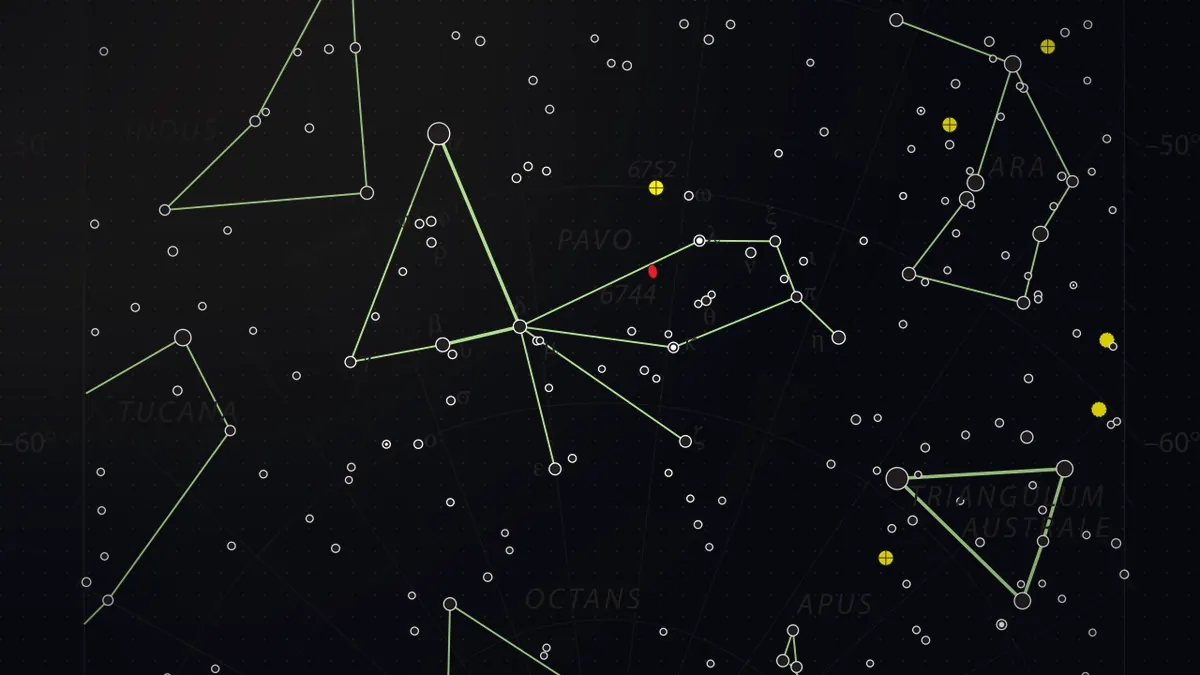
Pavo is the peacock, one of the exotic birds the Dutch navigators put into the southern sky in the 1590s. Its brightest star is officially named Peacock, which is one of the more literal star names in use.
Its real attraction is NGC 6752, the third or fourth brightest globular cluster in the sky depending on who is counting, and close enough that even modest telescopes resolve it into a swarm of individual stars.
Where to find Pavo
Pavo sits in the southern sky between Sagittarius and the south celestial pole, west of Grus and east of Triangulum Australe.
The anchor is Peacock (Alpha Pavonis), at magnitude 1.9 the only genuinely bright star here. From a southern site, look south of Sagittarius for a lone reasonably bright star with fainter ones scattered around it.
NGC 6752 lies a short hop away and is visible to the naked eye under dark skies as a faint fuzzy spot: one of the easier globular clusters to locate without optical aid.
In sky coordinates Pavo sits at right ascension 18h 10m and declination −56.0°. Declination is latitude by another name and right ascension is longitude, so the pair fixes the constellation at one point on the celestial sphere. It is a far-southern constellation, so southern observers own it and much of the northern hemisphere never sees it at all. You can see it from anywhere south of latitude 30°N, including the whole southern hemisphere, and it sits highest after dark in August.
What Pavo actually looks like
A scattered group of faint stars with Peacock as the one bright anchor. There is no convincing peacock to be seen, and the figure is a cartographic convention rather than an observation.
It is one of the twelve Keyser and de Houtman constellations, appearing in Bayer's Uranometria in 1603 alongside Tucana, Grus, Phoenix and the rest of the southern menagerie.
The star name Peacock is unusually recent. It was assigned in the 1930s by Britain's Royal Air Force, which needed named stars for air navigation and found that several bright southern stars had no traditional names to use.
The stars of Pavo
- Peacock (Alpha Pavonis, magnitude 1.9) — the brightest star, a hot blue-white spectroscopic binary about 180 light years away. Its two components orbit every 11.75 days.
- Delta Pavonis — a Sun-like star just 20 light years away, and a long-standing favourite in discussions of where life might exist. It is slightly older and cooler than the Sun and is one of the closest solar analogues visible to the naked eye.
- Kappa Pavonis — a bright W Virginis type variable, a class of pulsating star used as a distance indicator.
- Lambda Pavonis — a hot, rapidly rotating star with a gas disc around its equator.
The story behind the name
Pavo has no classical mythology of its own, though the peacock does carry Greek associations that were retrofitted after the fact. The bird was sacred to Hera, and the hundred eyes in its tail were said to be those of the giant Argus Panoptes, placed there by Hera after Hermes killed him.
The constellation itself is Dutch and dates from the 1590s. Keyser and de Houtman's group of twelve reflects what sixteenth-century European sailors found remarkable about the wider world: peacocks, toucans, birds of paradise, chameleons, flying fish.
It is worth noting what that means about the southern sky in general. Where the northern constellations carry three thousand years of layered Babylonian, Greek and Arabic story, the far south is largely a sixteenth-century European invention laid over skies that Indigenous peoples had been reading in their own terms for tens of thousands of years.
What else is hiding in Pavo
- NGC 6752 — the highlight, and one of the finest globular clusters anywhere. It is among the closest globulars to Earth at roughly 13,000 light years, which means it appears large and resolves easily. Even a small telescope breaks its outer regions into individual stars, and larger instruments show curving chains of stars radiating from the core. Visible to the naked eye as a faint smudge.
- NGC 6744 — a large barred spiral galaxy often described as one of the closest analogues to the Milky Way in appearance. It is big but has low surface brightness, so it needs a dark sky.
- The Pavo Group — a nearby group of galaxies, several within reach of a medium telescope.
- NGC 6872 — one of the largest known spiral galaxies, its arms drawn out enormously by an interaction with a neighbour.
When and where to see it
Best placed in the evening sky in August, through the southern winter.
Pavo is far southern, reaching only to about 30°N in theory, and is effectively a southern-hemisphere constellation. From much of the southern hemisphere it is circumpolar.
NGC 6752 is the target to prioritise, and it is unusually forgiving: bright enough to enjoy from a suburban site with a small telescope, and spectacular from a dark one. Because it resolves so readily, it is one of the best globulars for showing someone what these clusters actually are: not fuzzy balls, but hundreds of thousands of individual suns.
Pavo at a glance
| Name | Pavo |
| Abbreviation | Pav |
| Genitive form | Pavonis |
| Meaning | the Peacock |
| Family | Bayer family |
| First recorded | 1598, Plancius, Keyser, de Houtman |
| Right ascension | 18h 10m |
| Declination | −56.0° |
| Area | 378 square degrees (44th largest of 88) |
| Main stars in the figure | 7 |
| Stars brighter than magnitude 3 | 1 |
| Named Bayer / Flamsteed stars | 24 |
| Brightest star | α Pav (Peacock) (magnitude 1.91) |
| Messier objects | None |
| Meteor showers | Delta Pavonids |
| Visible from | Anywhere south of latitude 30°N, including the whole southern hemisphere |
| Best seen at 9 pm in | August |
| Bordering constellations | Apus, Ara, Indus, Octans, Telescopium |
Where to go next
Its neighbours in the sky
These constellations share a border with Pavo, so once you have found it you already know where to look next: Apus, Ara, Indus, Octans, Telescopium.
The rest of the Bayer family
Pavo belongs to the Bayer family: southern constellations charted by Dutch navigators in the 1590s. The others are: Apus, Chamaeleon, Dorado, Grus, Hydrus, Indus, Musca, Phoenix, Tucana, Volans.
Start from the beginning
If you are starting from scratch, the complete beginner's guide to the 88 constellations covers what a constellation actually is, how the sky is carved up, and links to every one of them.
Star chart: Pavo IAU chart by IAU and Sky & Telescope magazine (Roger Sinnott & Rick Fienberg), used under CC BY 3.0. Observing data cross-checked against Wikipedia's Pavo entry.