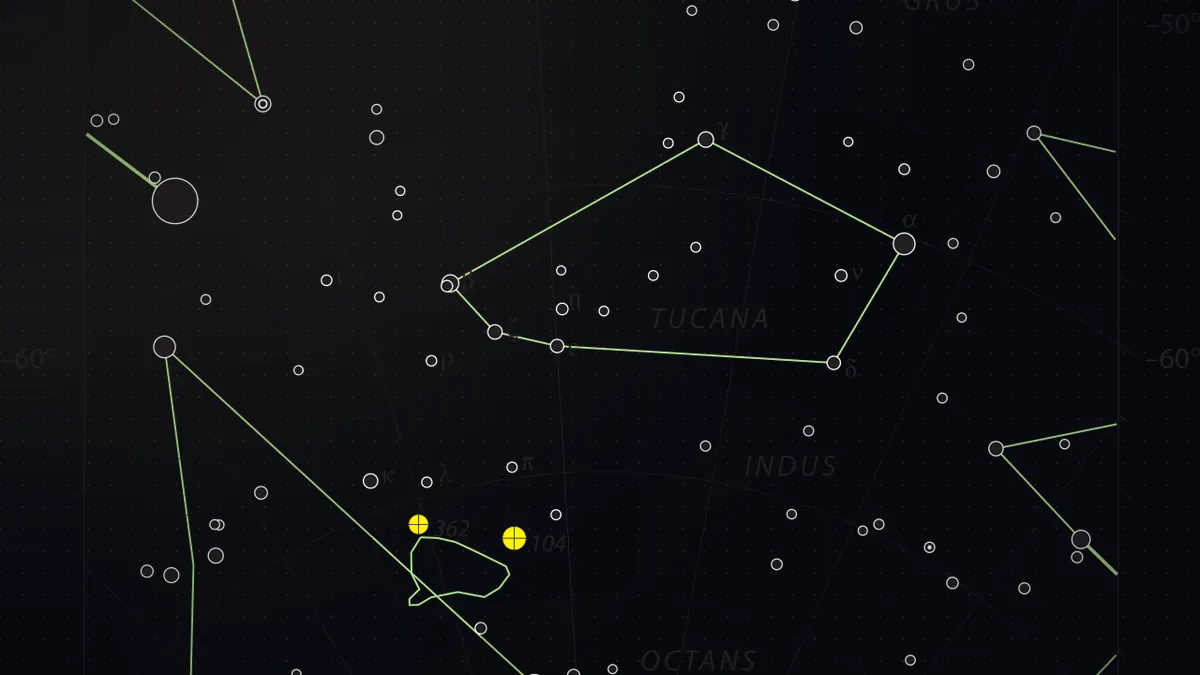
Tucana is a faint constellation with two of the best objects in the entire sky sitting inside it. It contains the Small Magellanic Cloud, a satellite galaxy of the Milky Way visible to the naked eye as a detached piece of the Milky Way, and 47 Tucanae, the second brightest globular cluster there is.
Neither is visible from the northern hemisphere. Tucana is one of the strongest arguments for getting yourself south of the equator at least once.
Where to find Tucana
Tucana lies in the far southern sky, between Achernar at the end of Eridanus and the south celestial pole.
The practical method is to find the Small Magellanic Cloud first. It is far easier to see than any of the constellation's stars. Under a dark southern sky it appears as a distinctly fuzzy, detached patch of Milky Way, roughly the size of your fist at arm's length.
Right beside it, looking like a slightly fuzzy star, sits 47 Tucanae. Once you have those two, the constellation's faint stars fall into place around them.
In sky coordinates Tucana sits at right ascension 22h 08m and declination −56.3°. Right ascension is the sky's version of longitude and declination its version of latitude, so those two numbers pin the constellation to one spot on the celestial sphere the way a map reference pins a town. It is a far-southern constellation, so southern observers own it and much of the northern hemisphere never sees it at all. In practice you can see it from anywhere south of latitude 15°N, including the whole southern hemisphere, and it stands highest in the evening sky around October.
What Tucana actually looks like
A loose scatter of faint stars, nothing brighter than magnitude 2.9, with no convincing figure. A toucan is drawn on charts, but you are supplying essentially all of it.
It is one of the twelve constellations introduced by the Dutch navigators Pieter Dirkszoon Keyser and Frederick de Houtman in the 1590s, from observations made during trading voyages to the East Indies. Most of that group are named after exotic animals the sailors encountered or heard described.
The stars barely matter here. Tucana is defined by the two spectacular objects it happens to contain.
The stars of Tucana
- Alpha Tucanae (magnitude 2.9) — the brightest star, an orange giant about 200 light years away.
- Beta Tucanae — a complex multiple star system of at least six components, and a fine sight in a small telescope.
- Kappa Tucanae — a double star, splittable in modest instruments.
The constellation's stars are genuinely unremarkable and there is no point dressing them up. What makes Tucana matter lies far beyond them: a whole satellite galaxy roughly 200,000 light years away, and a globular cluster of hundreds of thousands of stars in our own galaxy's halo.
The story behind the name
There is no mythology. Tucana was created in the 1590s by Keyser and de Houtman during Dutch voyages to the East Indies, and published by Petrus Plancius on a celestial globe in 1598. It appeared in Johann Bayer's 1603 Uranometria, which is how these southern figures entered mainstream European astronomy.
The toucan is a South American bird, which is slightly odd for navigators sailing east: the group's naming drew on exotic creatures generally rather than on what was strictly local.
The Magellanic Clouds it contains carry far older significance. They were known to Indigenous Australians, Polynesians and Middle Eastern astronomers long before Ferdinand Magellan's crew described them in 1519. Naming them after Magellan is a good example of European exploration attaching its own labels to things people had watched for millennia.
What else is hiding in Tucana
- The Small Magellanic Cloud (SMC) — a dwarf irregular galaxy about 200,000 light years away, and a satellite of the Milky Way. It is visible to the naked eye as a detached, hazy patch and contains its own star clusters and nebulae, which larger telescopes resolve. Along with the Large Magellanic Cloud in Dorado, it is being slowly torn apart and absorbed by our galaxy.
- 47 Tucanae (NGC 104) — the second brightest globular cluster in the sky after Omega Centauri, and by many accounts the more beautiful of the two. It contains millions of stars in an intensely concentrated core, sits about 13,000 light years away, and is visible to the naked eye as a fuzzy fourth-magnitude star. In a telescope it is breathtaking.
- NGC 362 — another good globular cluster on the far side of the SMC, and it would be famous in any other constellation.
When and where to see it
Best placed in the evening sky in November, through the southern spring and summer.
Tucana is a far-southern constellation and is circumpolar from much of the southern hemisphere: visible every night of the year from Australia, southern Africa and southern South America. From the northern hemisphere it never rises.
Both headline objects reward simple equipment. The Small Magellanic Cloud is a naked-eye object under dark skies and lovely in binoculars; 47 Tucanae is naked-eye as a fuzzy point and spectacular in any telescope. If you have one clear night in the southern hemisphere, spend part of it here.
Tucana at a glance
| Name | Tucana |
| Abbreviation | Tuc |
| Genitive form | Tucanae |
| Meaning | the toucan |
| Family | Bayer family |
| First recorded | 1598, Plancius, Keyser, de Houtman |
| Right ascension | 22h 08m |
| Declination | −56.3° |
| Area | 295 square degrees (48th largest of 88) |
| Main stars in the figure | 3 |
| Stars brighter than magnitude 3 | 1 |
| Named Bayer / Flamsteed stars | 17 |
| Brightest star | α Tuc (Lang-Exster) (magnitude 2.87) |
| Messier objects | None |
| Meteor showers | None |
| Visible from | Anywhere south of latitude 15°N, including the whole southern hemisphere |
| Best seen at 9 pm in | October |
| Bordering constellations | Eridanus, Grus, Hydrus, Indus, Octans, Phoenix |
Where to go next
Its neighbours in the sky
These constellations share a border with Tucana, so once you have found it you already know where to look next: Eridanus, Grus, Hydrus, Indus, Octans, Phoenix.
The rest of the Bayer family
Tucana belongs to the Bayer family: southern constellations charted by Dutch navigators in the 1590s. The others are: Apus, Chamaeleon, Dorado, Grus, Hydrus, Indus, Musca, Pavo, Phoenix, Volans.
Start from the beginning
New to all this? The 88 constellations: a complete beginner's guide explains what a constellation actually is, how the sky is divided up, and lists all 88 with a link to each one.
Star chart: Tucana IAU chart by IAU and Sky & Telescope magazine (Roger Sinnott & Rick Fienberg), used under CC BY 3.0. Observing data cross-checked against Wikipedia's Tucana entry.