Apus is the bird of paradise, and its name preserves a genuine misunderstanding. It comes from the Greek apous, meaning 'without feet', because the first bird-of-paradise skins brought to Europe had had their feet removed by the traders who prepared them.
Europeans concluded that the birds had no feet at all and floated permanently in the air, never landing. The constellation name records that mistake, and nobody has ever corrected it.
Where to find Apus
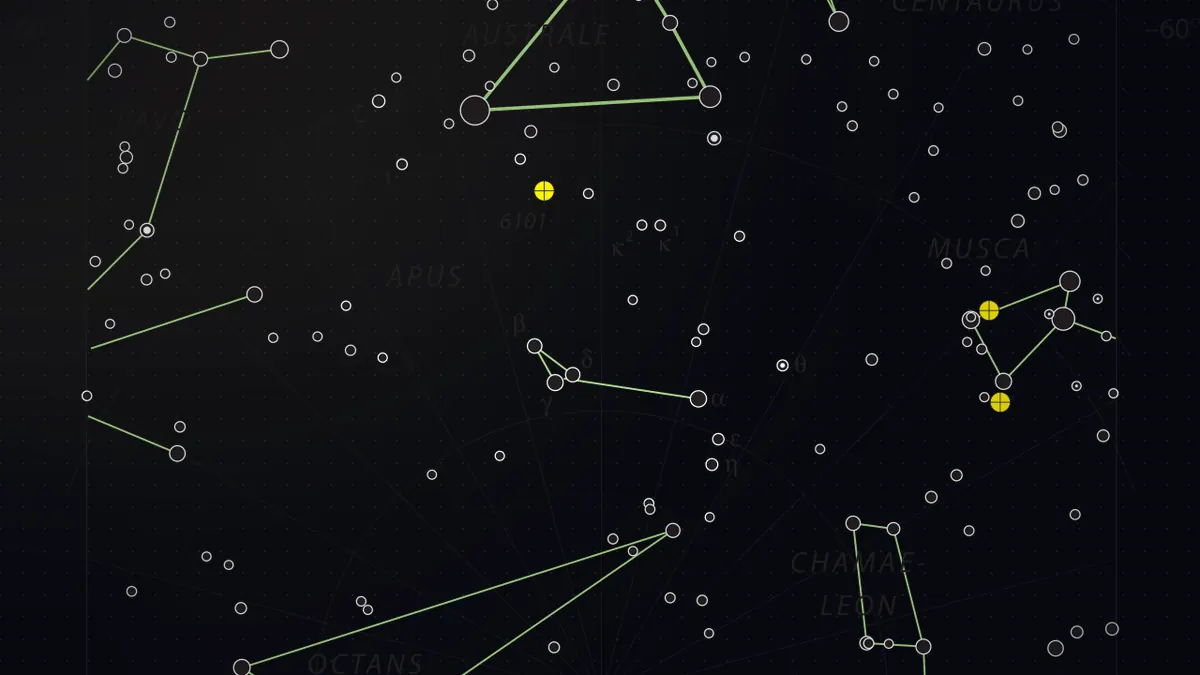
Apus lies very close to the south celestial pole, between Triangulum Australe and Octans.
Find the bright triangle of Triangulum Australe, then look south towards the pole. The faint scatter of stars you find, none brighter than magnitude 3.8, is Apus.
You will need a dark sky. This is a genuinely faint constellation in an unremarkable part of the sky, and there is no bright anchor to guide you. Because it is so close to the pole, it is available all year from southern latitudes.
In sky coordinates Apus sits at right ascension 13h 51m and declination −67.5°. Those two numbers work like a grid reference. Right ascension runs around the sky the way longitude runs around the Earth, and declination measures north and south the way latitude does. It is a far-southern constellation, so southern observers own it and much of the northern hemisphere never sees it at all. In practice you can see it from anywhere south of latitude 5°N, including the whole southern hemisphere, and it stands highest in the evening sky around July.
What Apus actually looks like
A small, faint triangle of stars with a few fainter ones scattered around. There is no bird to be seen, and the figure is entirely conventional.
Apus is one of the twelve Keyser and de Houtman constellations from the 1590s. Plancius published it in 1598 and Bayer included it in Uranometria in 1603, initially under the name Apis Indica, which confused it with Apis, the bee, now Musca.
The southern polar region is populated almost entirely by these faint sixteenth- and eighteenth-century inventions, because there was simply nothing bright enough there for earlier astronomers to have named.
The stars of Apus
- Alpha Apodis (magnitude 3.8) — the brightest star, an orange giant about 400 light years away.
- Gamma Apodis — a yellow giant, second brightest.
- Delta Apodis — a wide double star of two red giants, splittable in binoculars, and one of the more pleasant sights here.
- Theta Apodis — a red giant and semiregular variable, changing brightness noticeably over about four months, which makes it followable with binoculars.
Nothing in Apus is bright, and the honest summary is that it is a constellation of faint stars in an out-of-the-way part of the sky.
The story behind the name
There is no mythology, only the naming mistake. Birds of paradise are native to New Guinea and surrounding islands, and Dutch traders encountered them during voyages to the East Indies in the 1590s: exactly when Keyser and de Houtman were charting these stars.
The skins that reached Europe had been prepared for trade with the feet removed, and the resulting belief that the birds were footless and permanently airborne persisted for a long time. Linnaeus later gave the greater bird-of-paradise the scientific name Paradisaea apoda, meaning 'legless bird of paradise', so the error is preserved in biology as well as astronomy.
It is a good example of how the southern sky records the European encounter with the wider world, including what that encounter got wrong.
What else is hiding in Apus
A quiet constellation with no Messier objects and modest contents.
- NGC 6101 — a globular cluster, and the best target here. It is unusually loose and sparse for a globular, which makes it easier to resolve into individual stars in a medium telescope than more concentrated examples.
- IC 4499 — another globular cluster, faint and diffuse, and notable to astronomers for being unusually young by globular standards.
- NGC 5799 — a small open cluster.
- Delta Apodis — the wide double, and realistically the most enjoyable thing to look at here since it needs only binoculars.
Apus is a completist's constellation, and there is no dishonour in saying so.
When and where to see it
Best placed in the evening sky in July, through the southern winter.
It lies very close to the south celestial pole and is circumpolar from essentially the whole southern hemisphere, so it is available every night of the year from Australia, southern Africa and southern South America. From the northern hemisphere it never rises.
You need a properly dark sky to see anything at all. The realistic plan is to split Delta Apodis with binoculars, track down NGC 6101 with a telescope, and take satisfaction in having found one of the sky's more obscure corners. If you are working systematically through all 88, Apus is one you will have to make a deliberate effort for.
Apus at a glance
| Name | Apus |
| Abbreviation | Aps |
| Genitive form | Apodis |
| Meaning | The Bird-of-Paradise |
| Family | Bayer family |
| First recorded | 1598, Plancius, Keyser, de Houtman |
| Right ascension | 13h 51m |
| Declination | −67.5° |
| Area | 206 square degrees (67th largest of 88) |
| Main stars in the figure | 4 |
| Stars brighter than magnitude 3 | 0 |
| Named Bayer / Flamsteed stars | 12 |
| Brightest star | α Aps (Paradys) (magnitude 3.83) |
| Messier objects | None |
| Meteor showers | None |
| Visible from | Anywhere south of latitude 5°N, including the whole southern hemisphere |
| Best seen at 9 pm in | July |
| Bordering constellations | Ara, Chamaeleon, Circinus, Musca, Octans, Pavo, Triangulum Australe |
Where to go next
Its neighbours in the sky
These constellations share a border with Apus, so once you have found it you already know where to look next: Ara, Chamaeleon, Circinus, Musca, Octans, Pavo, Triangulum Australe.
The rest of the Bayer family
Apus belongs to the Bayer family: southern constellations charted by Dutch navigators in the 1590s. The others are: Chamaeleon, Dorado, Grus, Hydrus, Indus, Musca, Pavo, Phoenix, Tucana, Volans.
Start from the beginning
If you are starting from scratch, the complete beginner's guide to the 88 constellations covers what a constellation actually is, how the sky is carved up, and links to every one of them.
Star chart: Apus IAU chart by IAU and Sky & Telescope magazine (Roger Sinnott & Rick Fienberg), used under CC BY 3.0. Observing data cross-checked against Wikipedia's Apus entry.