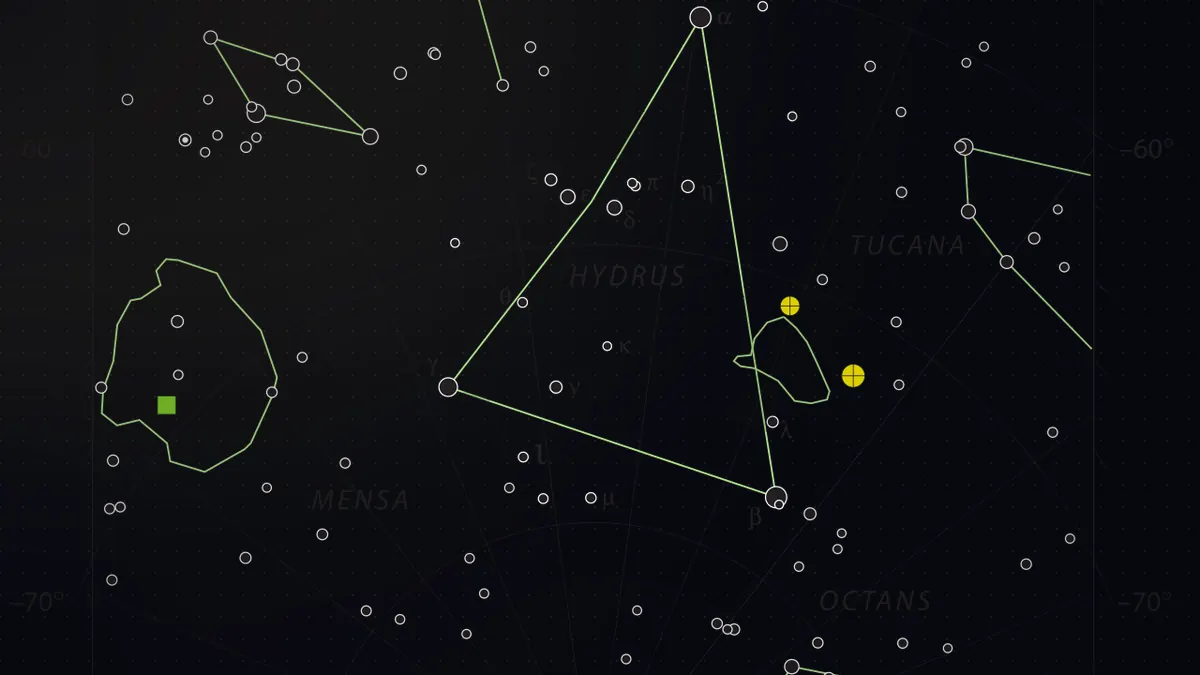
Hydrus is the small water snake, not to be confused with Hydra, the enormous water snake in the northern sky, which is an entirely separate and much older constellation. The similar names cause endless confusion.
It is a modest southern constellation that winds between the Large and Small Magellanic Clouds, and it contains Beta Hydri, one of the nearest and most Sun-like bright stars we can see.
Where to find Hydrus
Hydrus lies close to the south celestial pole, between Achernar in Eridanus and the two Magellanic Clouds.
The most reliable route is to find the two Clouds — both are naked-eye objects from a dark southern sky — and look at the region between and below them. The chain of faint stars threading through there is Hydrus.
Beta Hydri sits at one end and is the brightest star at magnitude 2.8. Because Hydrus is so close to the pole, it is available all year from southern latitudes, but it never rises for northern observers.
In sky coordinates Hydrus sits at right ascension 0h 06m and declination −57.9°. If the units look unfamiliar, the idea behind them is not: declination is the sky's latitude, right ascension is its longitude, and together they place the constellation exactly. It is a far-southern constellation, so southern observers own it and much of the northern hemisphere never sees it at all. Practically speaking it is visible from anywhere south of latitude 8°N, including the whole southern hemisphere, with the best evening views around December.
What Hydrus actually looks like
A long, meandering line of faint stars: a small snake, and reasonably convincing as one given the winding chain.
Its position between the Magellanic Clouds is the memorable feature. The snake appears to slither between two galaxies, which is a nice image even if the arrangement is pure coincidence.
Hydrus is another of the twelve Keyser and de Houtman constellations from the 1590s. The name was deliberately chosen as a southern counterpart to Hydra, distinguished only by gender in the Latin, which, with hindsight, was not the clearest possible naming decision.
The stars of Hydrus
- Beta Hydri (magnitude 2.8) — the brightest star and genuinely notable: at 24 light years it is the nearest reasonably bright star that closely resembles the Sun. It is a little older and slightly more evolved, which makes it a useful preview of what our Sun will look like in a couple of billion years.
- Alpha Hydri — a white subgiant, second brightest.
- Gamma Hydri — a red giant, and a good colour contrast with the constellation's whiter stars.
- VW Hydri — a dwarf nova, a close binary in which a white dwarf pulls material from a companion and periodically flares as that material ignites. It is one of the brighter examples of its class and is monitored by amateur variable-star observers.
The story behind the name
There is no mythology. Hydrus was created in the 1590s by Keyser and de Houtman during Dutch voyages to the East Indies, published by Plancius in 1598 and included in Bayer's Uranometria in 1603.
The naming is straightforwardly derivative: a small southern water snake to accompany the large northern one. Some early charts and later astronomers, including John Herschel, suggested renaming or reorganising it to reduce confusion with Hydra, but nothing came of it.
It is worth noting how much of the far southern sky comes from this single brief episode. Twelve constellations, created within a few years by navigators on trading voyages, still define how we divide up the sky around the south celestial pole four centuries later.
What else is hiding in Hydrus
Hydrus is a quiet constellation with no Messier objects and no headline deep-sky targets of its own.
- NGC 1466 — a globular cluster that actually belongs to the Large Magellanic Cloud rather than to our galaxy, seen through Hydrus's borders. Observing a globular cluster in another galaxy is an unusual thing to be able to do.
- NGC 602 — a young star cluster in the Small Magellanic Cloud, surrounded by sculpted nebulosity. A famous Hubble image.
- Beta Hydri — worth pointing out for what it is rather than how it looks. Knowing you are looking at the closest bright analogue of our own Sun, seen from outside, gives an ordinary star some weight.
The main pleasure here is context: Hydrus is the constellation you pass through while moving between the two Magellanic Clouds.
When and where to see it
Best placed in the evening sky in December, through the southern summer.
Hydrus is very far south and circumpolar from most of the southern hemisphere, so it is visible every night of the year from Australia, southern Africa and southern South America. From the northern hemisphere it never rises at all.
You need a reasonably dark sky to trace the snake, since its stars are modest. The best approach is to treat it as part of a larger tour: find the Small Magellanic Cloud in Tucana, follow Hydrus across, and arrive at the Large Magellanic Cloud in Dorado. That journey takes in three constellations and two galaxies in one sweep.
Hydrus at a glance
| Name | Hydrus |
| Abbreviation | Hyi |
| Genitive form | Hydri |
| Meaning | the water snake |
| Family | Bayer family |
| First recorded | 1598, Plancius, Keyser, de Houtman |
| Right ascension | 0h 06m |
| Declination | −57.9° |
| Area | 243 square degrees (61st largest of 88) |
| Main stars in the figure | 3 |
| Stars brighter than magnitude 3 | 2 |
| Named Bayer / Flamsteed stars | 19 |
| Brightest star | β Hyi (magnitude 2.82) |
| Messier objects | None |
| Meteor showers | None |
| Visible from | Anywhere south of latitude 8°N, including the whole southern hemisphere |
| Best seen at 9 pm in | December |
| Bordering constellations | Dorado, Eridanus, Horologium, Mensa, Octans, Phoenix, Reticulum, Tucana |
Where to go next
Its neighbours in the sky
Everything here shares a border with Hydrus. Find one and the rest are a short hop away: Dorado, Eridanus, Horologium, Mensa, Octans, Phoenix, Reticulum, Tucana.
The rest of the Bayer family
Hydrus belongs to the Bayer family: southern constellations charted by Dutch navigators in the 1590s. The others are: Apus, Chamaeleon, Dorado, Grus, Indus, Musca, Pavo, Phoenix, Tucana, Volans.
Start from the beginning
If you are starting from scratch, the complete beginner's guide to the 88 constellations covers what a constellation actually is, how the sky is carved up, and links to every one of them.
Star chart: Hydrus IAU chart by IAU and Sky & Telescope magazine (Roger Sinnott & Rick Fienberg), used under CC BY 3.0. Observing data cross-checked against Wikipedia's Hydrus entry.