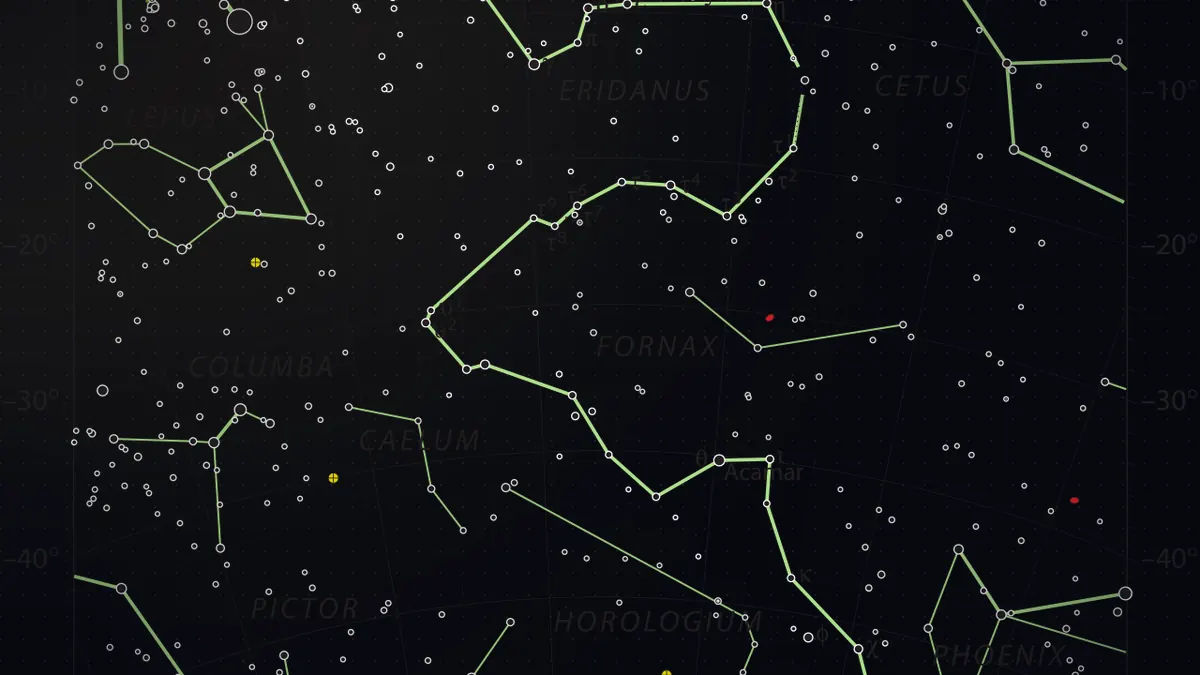
Eridanus is a river, and it behaves like one. It is the sixth largest constellation in the sky, a long meandering chain of stars that begins beside Orion's foot and winds south and west for an enormous distance before ending at Achernar, the ninth brightest star in the night sky.
Following it from one end to the other is one of the more satisfying naked-eye journeys available, and for northern observers, a slightly frustrating one, because the river runs off the bottom of the sky before it finishes.
Where to find Eridanus
Start at Rigel, the bright blue-white star at Orion's foot. Just west of it sits Cursa, a moderately bright star that marks the river's source.
From Cursa, the river winds west, then loops south, then turns back east, then heads south again in a long series of bends. There is no shortcut: you trace it star by star, and the stars are mostly third and fourth magnitude.
From the southern hemisphere the reward at the end is Achernar, a brilliant blue-white star whose name means 'the end of the river'. From the northern hemisphere the river simply disappears below the horizon partway along, which is oddly fitting.
In sky coordinates Eridanus sits at right ascension 3h 15m and declination −29.0°. If the units look unfamiliar, the idea behind them is not: declination is the sky's latitude, right ascension is its longitude, and together they place the constellation exactly. It sits in the southern half of the sky, high for southern observers and low on the horizon for northern ones. In practice you can see it from anywhere south of latitude 32°N, including the whole southern hemisphere, and it stands highest in the evening sky around December.
What Eridanus actually looks like
A long, winding chain of stars with several distinct bends: genuinely one of the better shape-to-name matches, because a meandering line of stars is exactly what a river looks like.
The constellation stretches across a huge range of declination, from near the celestial equator at Orion's foot down to about 60 degrees south. That span is why no single observer at mid-northern latitudes can see all of it.
Historically the river was shorter. Ancient charts ended it further north, and it was extended south to Achernar only after European navigators reached latitudes where that star was visible.
The stars of Eridanus
- Achernar (Alpha Eridani, magnitude 0.5) — the ninth brightest star in the sky and the flattest star known. It spins so fast that its equatorial diameter is over 50 percent greater than its polar diameter, making it a distinctly squashed ellipsoid rather than a sphere.
- Cursa (Beta Eridani) — the river's source, next to Rigel.
- Acamar (Theta Eridani) — a fine double star. It was considered the end of the river in ancient times, before Achernar was known to European astronomers, and both names derive from the same Arabic phrase for 'the river's end'.
- Epsilon Eridani — one of the nearest stars to the Sun at 10.5 light years, a young orange dwarf with a debris disc and at least one confirmed planet. It is a perennial favourite in the search for other Earths and appears constantly in science fiction.
The story behind the name
The river is most often identified with the Eridanos, a mythical river sometimes equated with the Po or the Nile. Its central story is the fall of Phaethon, son of the sun god Helios.
Phaethon persuaded his father to let him drive the sun chariot for a day, lost control, and scorched the Earth: burning Africa to desert and turning its people dark, in the Greek explanation. To stop the destruction, Zeus struck him down with a thunderbolt and he fell into the river Eridanos.
It is a story about hubris and the danger of handling forces beyond your competence, and the river in the sky is where the wreckage landed. The constellation's position, flowing away from the fiery region of Orion, fits the narrative neatly.
What else is hiding in Eridanus
Eridanus looks away from the galactic plane, so it offers galaxies rather than clusters and has no Messier objects.
- NGC 1291 — a barred spiral galaxy with an unusual outer ring, reachable in a medium telescope.
- NGC 1300 — a textbook barred spiral, one of the most photographed examples of the type and a Hubble showpiece.
- NGC 1535, Cleopatra's Eye — a bright planetary nebula with a distinct blue-grey disc and a visible central star. One of the better small-telescope targets here.
- The CMB Cold Spot — not observable, but remarkable. A region in Eridanus where the cosmic microwave background is unusually cool. One proposed explanation is an enormous supervoid roughly a billion light years across; more exotic suggestions have included a collision with another universe. It remains genuinely unexplained.
When and where to see it
Best placed in the evening sky in December, through the northern winter and southern summer.
Eridanus spans an enormous range of latitude, and where you stand determines how much of the river you get. Northern observers see the upper reaches near Orion but lose the southern half, and Achernar is invisible from most of Europe and North America. Southern observers get the whole river, ending in a brilliant star high in the sky.
The river needs a dark sky to trace, since its stars are mostly modest. The galaxies want a telescope. Tracing the full length of Eridanus from Cursa to Achernar is one of the classic southern-sky exercises and is genuinely worth doing once.
Eridanus at a glance
| Name | Eridanus |
| Abbreviation | Eri |
| Genitive form | Eridani |
| Meaning | the river Eridanus |
| Family | Heavenly Waters family |
| First recorded | ancient (Ptolemy) |
| Right ascension | 3h 15m |
| Declination | −29.0° |
| Area | 1138 square degrees (6th largest of 88) |
| Main stars in the figure | 24 |
| Stars brighter than magnitude 3 | 4 |
| Named Bayer / Flamsteed stars | 87 |
| Brightest star | Achernar (α Eri) (magnitude 0.46) |
| Messier objects | None |
| Meteor showers | None |
| Visible from | Anywhere south of latitude 32°N, including the whole southern hemisphere |
| Best seen at 9 pm in | December |
| Bordering constellations | Caelum, Cetus, Fornax, Horologium, Hydrus, Lepus, Orion, Phoenix, Taurus, Tucana |
Where to go next
Its neighbours in the sky
Eridanus borders all of these, which makes them the natural next targets once you can pick it out: Caelum, Cetus, Fornax, Horologium, Hydrus, Lepus, Orion, Phoenix, Taurus, Tucana.
The rest of the Heavenly Waters family
Eridanus belongs to the Heavenly Waters family: constellations tied to water, ships and the sea. The others are: Carina, Columba, Delphinus, Equuleus, Piscis Austrinus, Puppis, Pyxis, Vela.
Start from the beginning
New to all this? The 88 constellations: a complete beginner's guide explains what a constellation actually is, how the sky is divided up, and lists all 88 with a link to each one.
Star chart: Eridanus IAU chart by IAU and Sky & Telescope magazine (Roger Sinnott & Rick Fienberg), used under CC BY 3.0. Observing data cross-checked against Wikipedia's Eridanus entry.