Cetus is the sea monster sent to devour Andromeda, and it is built to scale: the fourth largest constellation in the sky, sprawling across a huge stretch of the autumn heavens.
It is also home to one of the most important stars in the history of astronomy. Mira swings from an easy naked-eye star to completely invisible and back over about eleven months. When David Fabricius noticed it in 1596, the idea that a star could change at all was close to heretical: the heavens were supposed to be perfect and unchanging.
Where to find Cetus
Cetus lies south of Pisces and Aries, in the watery region of the autumn sky. Its stars are faint and widely spread, so use bright anchors.
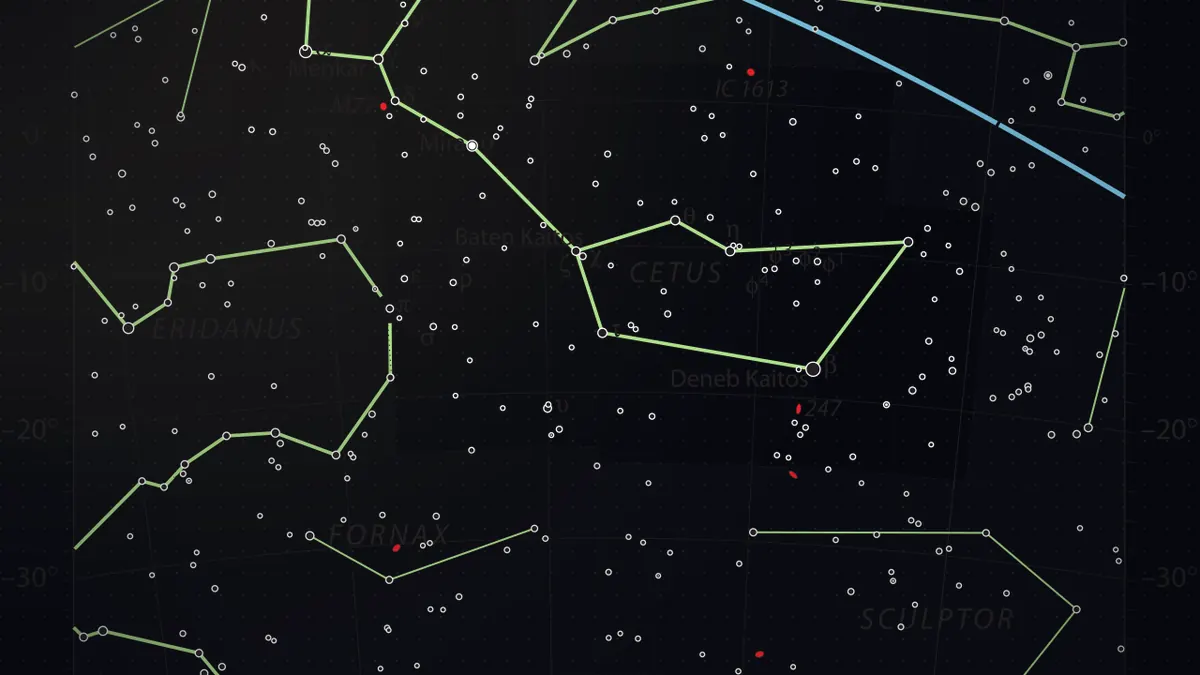
The most reliable route is to find the Great Square of Pegasus, drop south past Pisces, and look for a compact group of stars forming the monster's head: Menkar is the brightest of these, an orange star.
The body and tail then run a long way west and south, ending at Deneb Kaitos, which is actually the constellation's brightest star and sits well away from the head. Do not expect a compact pattern; Cetus is a long, loose sprawl.
In sky coordinates Cetus sits at right ascension 0h 26m and declination +10.5°. Right ascension is the sky's version of longitude and declination its version of latitude, so those two numbers pin the constellation to one spot on the celestial sphere the way a map reference pins a town. It sits in the northern half of the sky, riding high for northern observers and low for southern ones. In practice you can see it from between latitudes 65°N and 79°S, and it stands highest in the evening sky around November.
What Cetus actually looks like
A long, straggling figure with a distinct compact head and a much larger diffuse body. The head is a small ring of stars around Menkar; the body trails south-west across a huge area to Deneb Kaitos, whose name means 'the tail of the sea monster'.
Ancient illustrations show something between a whale, a fish and a dragon: the Greek ketos meant any large sea creature, which is why the constellation is sometimes called the Whale.
Tracing the whole thing is a real project under a dark sky. Most observers settle for the head and Mira, which is a reasonable compromise given how faint the middle sections are.
The stars of Cetus
- Deneb Kaitos (Beta Ceti, magnitude 2.0) — the brightest star, an orange giant marking the tail, despite the Beta label.
- Menkar (Alpha Ceti) — a red giant in the head, and a good colour-contrast object.
- Mira (Omicron Ceti) — the star that matters. A pulsating red giant that varies from about magnitude 2 at its best, comfortably naked-eye, down to magnitude 10, requiring a telescope, over roughly 332 days. Its name means 'the wonderful'. It gave its name to an entire class, the Mira variables, and it also trails a 13-light-year tail of shed material behind it as it ploughs through interstellar space.
- Tau Ceti — a Sun-like star just 12 light years away, and one of the very first targets in the search for extraterrestrial intelligence. It hosts a debris disc and several candidate planets.
The story behind the name
Cetus is the monster Poseidon sent to ravage the coast of Aethiopia after Cassiopeia's boast. It was on its way to devour the chained Andromeda when Perseus intervened and, in most versions, turned it to stone with Medusa's head.
Its placement in the sky is deliberate. Cetus is separated from Andromeda by a stretch of sky, kept permanently at a distance from the princess it was sent to eat, the threat frozen mid-approach.
Mira's discovery attached a very different kind of significance to the constellation. A star that appears, vanishes and returns was direct evidence against the idea of an immutable heaven, alongside Tycho's supernova and Galileo's observations. Cetus quietly became one of the places where the medieval cosmos started coming apart.
What else is hiding in Cetus
- M77 — a bright barred spiral galaxy and the constellation's only Messier object. It is a Seyfert galaxy, with an extremely active nucleus powered by a supermassive black hole, and one of the closest and best-studied active galaxies. Reachable in a modest telescope as a bright core with a faint halo.
- Mira — treat it as an observing project rather than a single view. Check it every few weeks over a year and you can watch it climb to naked-eye visibility and disappear again. Few objects give such a clear sense of stars as things that live and change.
- NGC 246, the Skull Nebula — a planetary nebula with a mottled structure and several stars visible through it, giving the impression of eye sockets.
- IC 1613 — a faint dwarf irregular galaxy belonging to our Local Group.
When and where to see it
Best placed in the evening sky in November, running through the autumn months.
Cetus straddles the celestial equator, so it is visible from essentially everywhere on Earth, with southern observers getting the tail higher.
Because the constellation is large and faint, dark skies help enormously, from a city you will get Deneb Kaitos, Menkar and little else. The one thing worth committing to is Mira. Look up where it currently sits in its cycle, find the field, and come back to it. Watching a star appear from nothing over a few months is a genuinely different experience from looking at a fixed object once.
Cetus at a glance
| Name | Cetus |
| Abbreviation | Cet |
| Genitive form | Ceti |
| Meaning | the Whale, Shark, or Sea Monster |
| Family | Perseus family |
| First recorded | ancient (Ptolemy) |
| Right ascension | 0h 26m |
| Declination | +10.5° |
| Area | 1231 square degrees (4th largest of 88) |
| Main stars in the figure | 14 |
| Stars brighter than magnitude 3 | 2 |
| Named Bayer / Flamsteed stars | 88 |
| Brightest star | Diphda (magnitude 2.02) |
| Messier objects | 1 |
| Meteor showers | October Cetids, Eta Cetids, Omicron Cetids |
| Visible from | Between latitudes 65°N and 79°S |
| Best seen at 9 pm in | November |
| Bordering constellations | Aquarius, Aries, Eridanus, Fornax, Pisces, Sculptor, Taurus |
Where to go next
Its neighbours in the sky
Everything here shares a border with Cetus. Find one and the rest are a short hop away: Aquarius, Aries, Eridanus, Fornax, Pisces, Sculptor, Taurus.
The rest of the Perseus family
Cetus belongs to the Perseus family: the northern sky's Andromeda myth, told across nine constellations. The others are: Andromeda, Auriga, Cassiopeia, Cepheus, Lacerta, Pegasus, Perseus, Triangulum.
Start from the beginning
Not sure where to begin? The guide to all 88 constellations explains how the sky is divided, what a constellation really is, and links to each of the 88.
Star chart: Cetus IAU chart by IAU and Sky & Telescope magazine (Roger Sinnott & Rick Fienberg), used under CC BY 3.0. Observing data cross-checked against Wikipedia's Cetus entry.