Cepheus is the least noticed member of the Andromeda cast. It is large, circumpolar and faint, shaped like a child's drawing of a house, and it sits in a part of the sky most people skip on their way to Cassiopeia.
It is scientifically one of the most important constellations there is. Delta Cephei gave its name to the Cepheid variables: stars whose pulsation rate reveals their true brightness, and therefore their distance. That relationship is the foundation of the cosmic distance ladder, and it is how we learned the universe is expanding.
Where to find Cepheus
Cepheus sits between Cassiopeia and Polaris, and that is the easiest way in. Find the W, then look towards the pole star; Cepheus fills the space between them.
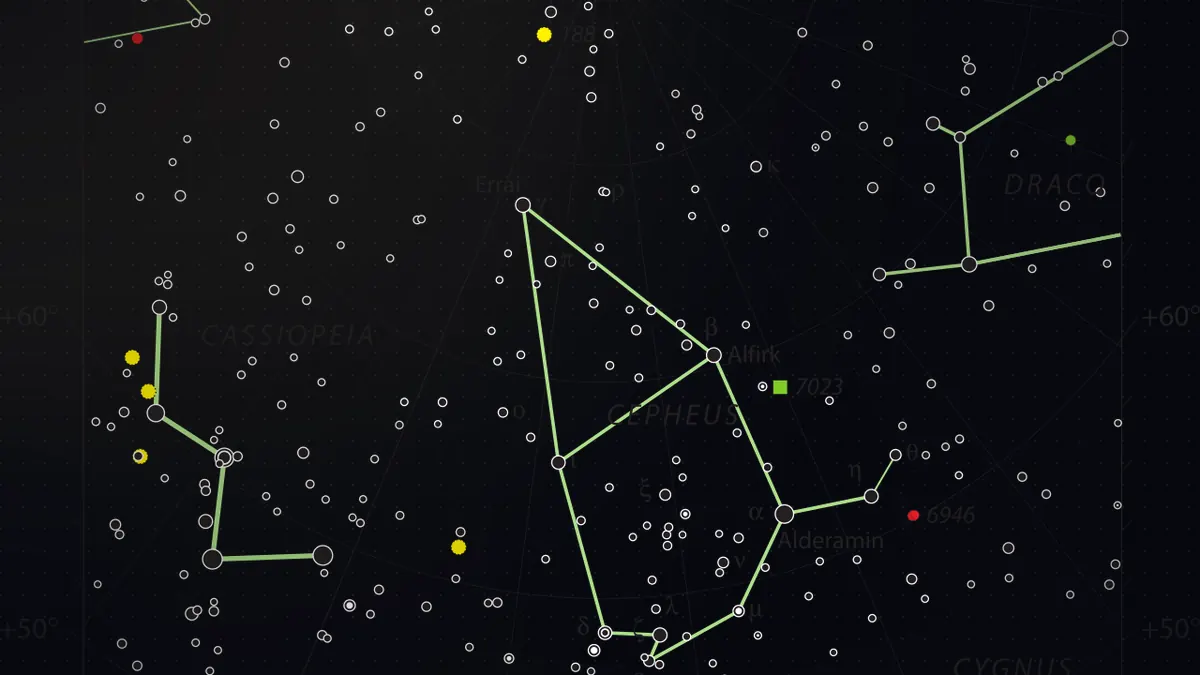
You are hunting for a shape like a square with a triangular roof: a simple house, with the point of the roof aimed towards Polaris. Its stars are around magnitude 2.5 to 3.5, so it is visible from a suburb but easy to overlook next to its brilliant neighbour.
Once you know the house shape, Cepheus becomes obvious, and it is a genuinely useful stepping stone deeper into the northern Milky Way.
In sky coordinates Cepheus sits at right ascension 20h 01m and declination +88.7°. Those two numbers work like a grid reference. Right ascension runs around the sky the way longitude runs around the Earth, and declination measures north and south the way latitude does. It is a far-northern constellation, so northern observers get the best of it and it never rises for much of the southern hemisphere. In practice you can see it from anywhere north of latitude 1°S, including the whole northern hemisphere, and it stands highest in the evening sky around November.
What Cepheus actually looks like
A house: a rough square of four stars with a triangle balanced on top. Alderamin marks one corner of the square, and the roof apex points towards the pole.
The official figure is a king in robes and crown, but nobody sees that. The house is what you get, and it is a perfectly good pattern: simple, memorable and distinct from anything nearby.
Cepheus lies along the Milky Way, so the surrounding field is rich, and it contains several of the most extreme stars known.
The stars of Cepheus
- Alderamin (Alpha Cephei, magnitude 2.5) — a white star spinning extremely fast. It is also a future pole star: precession will bring it close to the celestial pole around 7500 AD.
- Delta Cephei — the prototype Cepheid variable, pulsing between magnitude 3.5 and 4.4 over 5.37 days. John Goodricke discovered its variability in 1784. Over a century later, Henrietta Swan Leavitt found that a Cepheid's pulsation period predicts its intrinsic luminosity, turning these stars into standard candles. Hubble used exactly that to measure the distance to Andromeda and prove other galaxies exist. It is not an exaggeration to say modern cosmology begins with this star.
- Mu Cephei, the Garnet Star — one of the largest and reddest stars known, a red supergiant so deeply coloured that William Herschel named it for the gemstone. Stunning in binoculars.
- VV Cephei — an eclipsing binary containing one of the largest stars ever measured.
The story behind the name
Cepheus was the king of Aethiopia, husband of Cassiopeia and father of Andromeda. When his wife's boasting brought the sea monster, it was Cepheus who received the oracle's verdict and made the decision to chain his own daughter to the rock.
He is the least sympathetic figure in the story and, appropriately enough, the least conspicuous constellation of the group. Where Cassiopeia got a brilliant W and Perseus got a hero's chain of bright stars, the king who sacrificed his daughter got a faint house.
Some accounts are kinder, presenting him as a decent man trapped between an oracle and his kingdom. The stars do not take a position either way, but the arrangement of the family in the sky — all five within one sweep — keeps the whole uncomfortable scene together permanently.
What else is hiding in Cepheus
Cepheus sits in the Milky Way and is rich, if faint.
- The Garnet Star (Mu Cephei) — the standout naked-eye and binocular target. Its deep red-orange is among the most obvious colours of any star in the sky, and it is a genuinely striking sight in binoculars.
- The Wizard Nebula (NGC 7380) — an emission nebula wrapped around a young star cluster, its shape suggesting a robed figure in photographs.
- The Iris Nebula (NGC 7023) — a beautiful blue reflection nebula lit by a central star, and a favourite astrophotography subject.
- The Elephant's Trunk Nebula (IC 1396) — a vast star-forming region with a long dark column of dust winding through it. The whole complex is several times the width of the full Moon.
- NGC 188 — one of the oldest known open clusters, roughly 6.8 billion years old and still bound together near the pole.
When and where to see it
Best placed in the evening sky in November, though from most northern latitudes Cepheus is circumpolar and available all year.
It is a far-northern constellation, reaching only to about 10°S, so southern hemisphere observers effectively miss it entirely.
The house shape holds up under moderate light pollution. The nebulae emphatically do not. They are faint, large and mostly photographic targets. The realistic observing plan is the Garnet Star with binoculars and, if you are feeling scientific, tracking Delta Cephei's brightness over a week. Watching a star pulse on a five-day cycle, knowing that behaviour is how we measured the universe, is one of the more satisfying things amateur astronomy offers.
Cepheus at a glance
| Name | Cepheus |
| Abbreviation | Cep |
| Genitive form | Cephei |
| Meaning | the King/King Cepheus |
| Family | Perseus family |
| First recorded | ancient (Ptolemy) |
| Right ascension | 20h 01m |
| Declination | +88.7° |
| Area | 588 square degrees (27th largest of 88) |
| Main stars in the figure | 7 |
| Stars brighter than magnitude 3 | 1 |
| Named Bayer / Flamsteed stars | 43 |
| Brightest star | α Cep (Alderamin) (magnitude 2.45) |
| Messier objects | None |
| Meteor showers | None |
| Visible from | Anywhere north of latitude 1°S, including the whole northern hemisphere |
| Best seen at 9 pm in | November |
| Bordering constellations | Camelopardalis, Cassiopeia, Cygnus, Draco, Lacerta, Ursa Minor |
Where to go next
Its neighbours in the sky
Everything here shares a border with Cepheus. Find one and the rest are a short hop away: Camelopardalis, Cassiopeia, Cygnus, Draco, Lacerta, Ursa Minor.
The rest of the Perseus family
Cepheus belongs to the Perseus family: the northern sky's Andromeda myth, told across nine constellations. The others are: Andromeda, Auriga, Cassiopeia, Cetus, Lacerta, Pegasus, Perseus, Triangulum.
Start from the beginning
If you are starting from scratch, the complete beginner's guide to the 88 constellations covers what a constellation actually is, how the sky is carved up, and links to every one of them.
Star chart: Cepheus IAU chart by IAU and Sky & Telescope magazine (Roger Sinnott & Rick Fienberg), used under CC BY 3.0. Observing data cross-checked against Wikipedia's Cepheus entry.