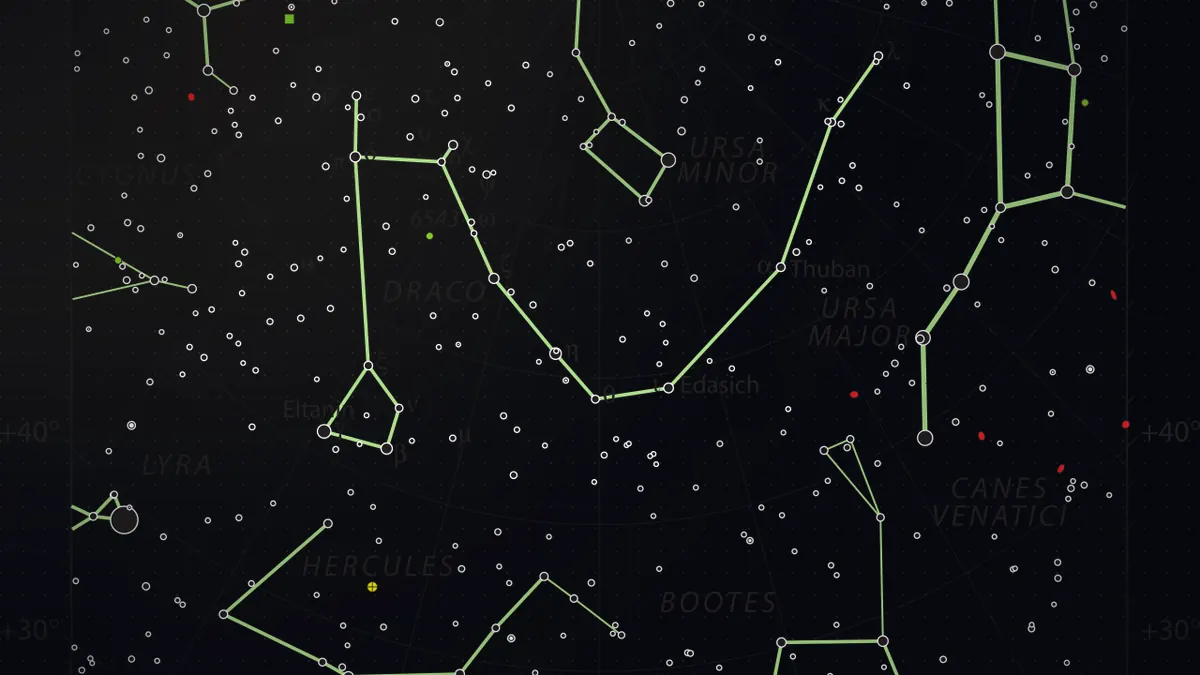
Draco is enormous — the eighth largest constellation in the sky — and it is shaped like exactly what it claims to be: a long dragon coiling around the north celestial pole, with Ursa Minor caught in its bend.
It is also a constellation with a claim to real historical importance. Around 3000 BC the pole star was not Polaris but Thuban, in Draco's tail. The builders of the Egyptian pyramids aligned their monuments using it, and one of the Great Pyramid's shafts appears to have been cut so that Thuban would shine down it.
Where to find Draco
Draco needs patience, because none of its stars are bright. Start with the two Dippers. Draco's body threads between them, running from a point near the Big Dipper's bowl, curling around Ursa Minor, and finishing with the head near Hercules.
The head is the easiest part and the best starting point: a compact quadrilateral of four stars, quite distinct once you find it, sitting near brilliant Vega. Find Vega, look towards the pole, and the little lopsided box you meet is the dragon's head. From there you can trace the body backwards.
In sky coordinates Draco sits at right ascension 17h 00m and declination +65.0°. Those two numbers work like a grid reference. Right ascension runs around the sky the way longitude runs around the Earth, and declination measures north and south the way latitude does. It is a far-northern constellation, so northern observers get the best of it and it never rises for much of the southern hemisphere. You can see it from anywhere north of latitude 7°S, including the whole northern hemisphere, and it sits highest after dark in July.
What Draco actually looks like
The figure is a long, winding line of moderately faint stars: seventeen of them make up the main pattern, more than almost any other constellation. It starts with the quadrilateral head, runs down a neck, then coils in a broad S-curve around the pole before the tail ends between the Dipper's bowl and Polaris.
Tracing the whole dragon is one of the genuinely satisfying naked-eye projects in the northern sky. It takes a dark night and a bit of determination, but unlike many constellations the shape actually delivers: once you have it, it really does look like something long and serpentine wrapped around the pole.
The stars of Draco
- Eltanin (Gamma Draconis, magnitude 2.24) — the brightest star, an orange giant in the dragon's head. It passes almost directly overhead in London, which is how James Bradley came to study it and accidentally discover the aberration of starlight: the first direct proof that Earth moves.
- Thuban (Alpha Draconis) — the pole star from roughly 3942 BC to 1793 BC. It is only magnitude 3.7 today, which makes it a surprisingly modest star for such a famous job. Precession will bring it back around the year 21000.
- Rastaban (Beta) — another head star, a yellow giant whose name means 'the serpent's head'.
- Struve 2398 — a red dwarf binary just 11.5 light years away, one of the Sun's nearest neighbours.
- Kepler-10 — an ordinary-looking star that hosts Kepler-10b, the first confirmed rocky exoplanet.
The story behind the name
Draco is usually identified as Ladon, the hundred-headed dragon that guarded the golden apples of the Hesperides. Hercules killed it as his eleventh labour, which is why the constellation Hercules is drawn directly above it, foot planted on the dragon's head.
Another version makes it the dragon killed by Cadmus, or the one Minerva flung into the sky during the war between gods and titans, where it froze around the pole.
The pole connection gives Draco a weight the Greeks did not invent. A constellation coiled around the point everything else revolves about reads naturally as a guardian, and dragon or serpent figures appear near the celestial pole in Babylonian and Chinese astronomy too. When Thuban was the pole star, Draco was quite literally the constellation that held the sky's hinge.
What else is hiding in Draco
- The Cat's Eye Nebula (NGC 6543) — one of the finest planetary nebulae in the sky and among the first ever studied spectroscopically. Its intricate structure of concentric shells and jets is a Hubble classic, and it is bright enough to show as a small blue-green disc in a modest telescope.
- The Spindle Galaxy (M102 / NGC 5866) — an edge-on lens-shaped galaxy cut by a sharp dust lane. It is the constellation's only Messier object, and its identity has been argued over for two centuries.
- The Tadpole Galaxy (Arp 188) — a disrupted spiral trailing a 280,000-light-year tail of stars pulled out by a close encounter.
- The Draconids — a meteor shower peaking around 8 October. Usually quiet, occasionally spectacular: in 1933 and 1946 it produced storms of thousands of meteors an hour. Unusually, it is best watched in the evening rather than after midnight.
When and where to see it
Best placed in the evening sky in July, though from most northern latitudes Draco is circumpolar and available every night of the year.
It is emphatically a northern constellation. From the tropics you will catch the head but lose the tail below the horizon, and from most of the southern hemisphere it is simply not visible.
Tracing the dragon needs a dark sky, from a city you will get Eltanin and little else. The Cat's Eye Nebula is the standout telescope target and takes magnification well. For the Draconids, watch in the evening and keep expectations low; the shower's reputation rests on rare outbursts rather than reliable performance.
Draco at a glance
| Name | Draco |
| Abbreviation | Dra |
| Genitive form | Draconis |
| Meaning | the Dragon |
| Family | Ursa Major family |
| First recorded | ancient (Ptolemy) |
| Right ascension | 17h 00m |
| Declination | +65.0° |
| Area | 1083 square degrees (8th largest of 88) |
| Main stars in the figure | 17 |
| Stars brighter than magnitude 3 | 3 |
| Named Bayer / Flamsteed stars | 76 |
| Brightest star | γ Dra (Eltanin) (magnitude 2.24) |
| Messier objects | 1 |
| Meteor showers | Draconids |
| Visible from | Anywhere north of latitude 7°S, including the whole northern hemisphere |
| Best seen at 9 pm in | July |
| Bordering constellations | Boötes, Camelopardalis, Cepheus, Cygnus, Hercules, Lyra, Ursa Major, Ursa Minor |
Where to go next
Its neighbours in the sky
Everything here shares a border with Draco. Find one and the rest are a short hop away: Boötes, Camelopardalis, Cepheus, Cygnus, Hercules, Lyra, Ursa Major, Ursa Minor.
The rest of the Ursa Major family
Draco belongs to the Ursa Major family: the circumpolar northern group anchored by the Big Dipper. The others are: Boötes, Camelopardalis, Canes Venatici, Coma Berenices, Corona Borealis, Leo Minor, Lynx, Ursa Major, Ursa Minor.
Start from the beginning
New to all this? The 88 constellations: a complete beginner's guide explains what a constellation actually is, how the sky is divided up, and lists all 88 with a link to each one.
Star chart: Draco IAU chart by IAU and Sky & Telescope magazine (Roger Sinnott & Rick Fienberg), used under CC BY 3.0. Observing data cross-checked against Wikipedia's Draco entry.